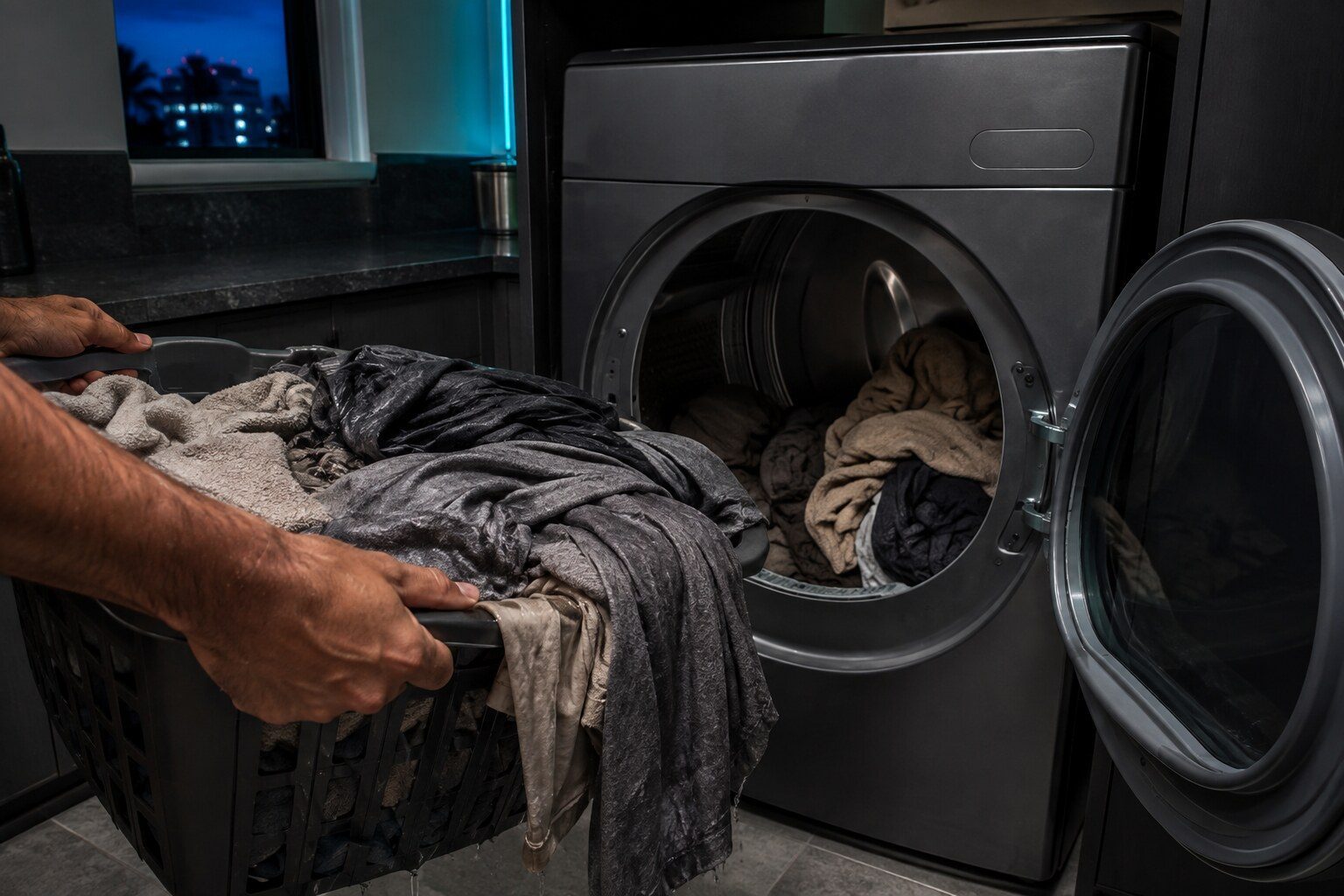
- “Almost always airflow — the duct, the screen, or the slot the screen sits in”
- “A moisture sensor that has scaled over will end cycles early on an automatic setting”
- “The running cost of this doubles quietly, which is why it is worth fixing rather than living with”
Symptom
Maytag dryer takes two or three cycles
This is the complaint that costs the most money and gets reported the latest, because it creeps. A dryer that used to finish a load in fifty minutes and now takes two runs has generally lost airflow rather than heat, and it has been losing it for a year.
- From $89 diagnostic, credited to the repair
- 59 cities and neighborhoods covered
- OEM parts available on order
- In writing the price, before anything is opened
Five ordinary causes
What this usually turns out to be
Cheapest and commonest first, which is also the order we check them in. They sit hundreds of dollars apart, and only the unit settles which one is yours.
-
The duct run to the outside
Lint, a crushed section behind the machine, or a hood with a screen on it that should never have had one. This is the answer most of the time.
Dryer vent cleaning from $129 -
The lint screen slot
Distinct from the screen and nobody cleans it. Years of fine lint pack the housing and choke the machine before the air even reaches the duct.
Appliance maintenance from $119 -
The moisture sensor
Two metal strips inside the drum. Scaled or coated with softener residue, they read a wet load as dry and stop the cycle early.
Dryer moisture sensor service from $109 -
The vent hood outside
Painted shut, screened, or blocked by a nest. It is the end of the duct nobody thinks of as part of the appliance.
Dryer vent cleaning from $129 -
Weak heat rather than weak airflow
Less common but real, particularly on an electric machine with an element that is partly through. It is what is left after the airflow is proved good.
Dryer not heating repair from $145
In five minutes
Before you call anybody
None of it needs tools, and all of it makes the visit shorter.
-
01
Time a real load
Numbers rather than impressions. Compare it against what the machine used to do.
-
02
Watch the outside hood
The flap should be pushed well open. Weak air there is the whole diagnosis.
-
03
Light up the screen slot
Behind and below the screen. If you cannot see clean metal, that is the restriction.
-
04
Try a timed cycle
If a timed cycle dries fine and an automatic one stops early, the sensor is the suspect rather than the airflow.
How it shows up
What people describe when they call
A shortcut
Narrow it down before anybody arrives
A description of the behaviour leaves a few possible causes. A code names the subsystem before anybody opens anything, which is why it is worth photographing before it clears.
If there is no code at all
MDE508DAYK
MDG270SAWW
MED3000BG
MEDB800VE
MEDE200WJ
MEDZ400TF
MGD3000BG
MGDE200WR
MGDZ400TE
YMED5100DW
The data plate is inside the cabinet, upper left wall or behind the grille. All models
In more detail
About Maytag dryer takes two or three cycles
Time it, then look outside
Run one normal load on a timed setting rather than an automatic one and note how long it genuinely takes. Then go outside and watch the hood while it runs. The flap should be pushed firmly open with warm air you can feel from a foot away. If it is barely moving, you have your answer and it is the duct. Pull the lint screen and look into the slot underneath it with a light — that slot is not the screen, it almost never gets cleaned, and on a machine that is eight years old it is often packed.
What it usually means, by the kind of machine
One complaint, several machines. This maker still sells a top-load washer with an agitator alongside one without, a front-loader, and a stacked pair, and it sells the same oven as a range and as a wall unit in gas and in electric. The behavior you can describe is identical on all of them; the first hour of the repair is not. A front-load washer has a drain filter the owner can open and a top-loader has nothing to reach from the front, and that single difference decides how the same afternoon goes.
- Electric — Heat is plentiful and slow drying is nearly always the duct. An electric machine will keep making heat happily while the moisture sits in the drum with nowhere to go.
- Gas — Same story, with the extra note that a gas machine cycling its burner on and off constantly through a load is describing a restriction rather than a burner problem.
- Stacked laundry center — The tightest ducting in the house and the hardest to reach. If a stacked unit has slowed down, the duct is the first and usually the last thing to look at.
The cost of putting it off
A dryer running two cycles instead of one is drawing roughly twice the energy for the same laundry, every load, every week. That is the argument for treating slow drying as a repair rather than a habit — the duct cleaning generally pays for itself inside a year, and it also removes the fire risk that comes with a duct full of lint. Neither of those is a sales line; they are the two reasons this particular complaint should not wait.
Sensor against airflow
There is one clean test that separates the two. Run the same load on a timed cycle. If it dries properly in a timed hour but stops damp on automatic, the machine can dry and cannot tell when it has — that is the sensor. If it is still damp after a timed hour, the machine cannot dry, and that is air.
This article is based on:
- Official manufacturer documentation
- Internal repair procedures
- Technician repair history
- Company quality standards

Before you book
Questions about Maytag dryer takes two or three cycles
It got worse gradually.
That is the signature of a duct filling up rather than a part giving out. Parts tend to change things overnight.
The lint screen is always clean.
Good — but the housing the screen slides into is a separate space, and it is the one that packs solid. Look into it with a flashlight before ruling out lint.
Does the softener sheet matter?
It can. The residue coats the moisture sensor strips and it is one of the two reasons an automatic cycle ends early. Wiping the strips with rubbing alcohol is a reasonable thing to try first.
Where we do it
Across Miami-Dade, Broward, and Palm Beach
Same terms everywhere we go: an on-site diagnostic first, the price agreed in writing, and the exact figure confirmed once we have seen the unit.
Neighborhoods people ask for by name