
MaytagRepair Miami

46 jobs · 11 appliances

Maytag work in South Florida, priced from the job rather than from the badge.

This is a badge people buy expecting to keep, and a great many of the machines we are called to have been in the same laundry room for a decade or more. That changes the arithmetic on every line of this list: the parts are commodity parts and they are on the van, and the question is almost never whether a repair is possible but whether it is the right thing to do on a machine of that age. Each card says what the work involves. The figure beside it is a floor, not a quote.

  • 46 jobs with a published figure
  • 16 of them in the laundry room
  • 11 appliance types on this badge
  • from $89 diagnostic, credited to the repair

Start from the job

What each job is, and where its number starts

Read every figure as a floor. It reflects what this equipment and this labor cost in South Florida, and what moves it is set out on the job's own cost page rather than left to the visit.

  • A multimeter and an open notebook on a dark counter beside an appliance whose panel is dark, a hand writing. One visit, one answer in writing, which is what this page promises.
    from $89

    Diagnostic visit

    We find out what is wrong before anybody quotes a part, and on this make that means two different visits depending on which half of the kitchen we are in. A washer or an oven will usually be showing something, and the first ten minutes are spent reading it. A refrigerator or a freezer will be showing nothing at all, because this maker publishes almost no codes for cold, and those minutes go on thermometers instead. The fee comes off the bill when you go ahead with the work.

    • Read first where the machine talks, measure first where it does not
    • Age is established early: these machines are routinely older than the kitchen
    • Credited toward the repair
    What this involves
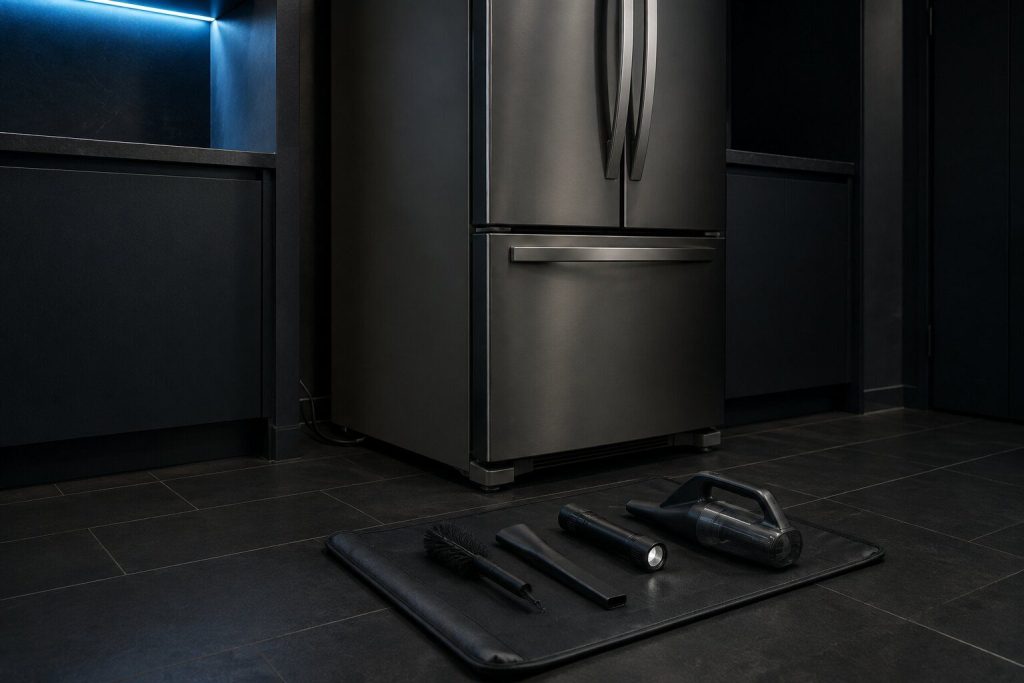
  • A rolled tool mat opened on near-black tile in front of a refrigerator pulled forward, a coil brush, a vacuum crevice tool, a torch and a small vacuum standing on it, nothing dismantled and no panel off.
    from $119

    Appliance maintenance

    The visit that stops the other visits, and on equipment bought to last it is the one that pays for itself twice over. The list is short and specific: the condenser at floor level in a humid kitchen, the dryer duct that gets longer every year in effect if not in fact, the seals this climate works harder than the manual assumed, and the drain that must not stand. None of the four announces itself, and all four are cheaper to keep than to repair.

    • Condenser, seals, drains, vents and leveling, on every appliance in the run
    • The intervals are set to this climate rather than to the manual's calendar
    • You keep a written note of what is aging and roughly when it will matter
    What this involves
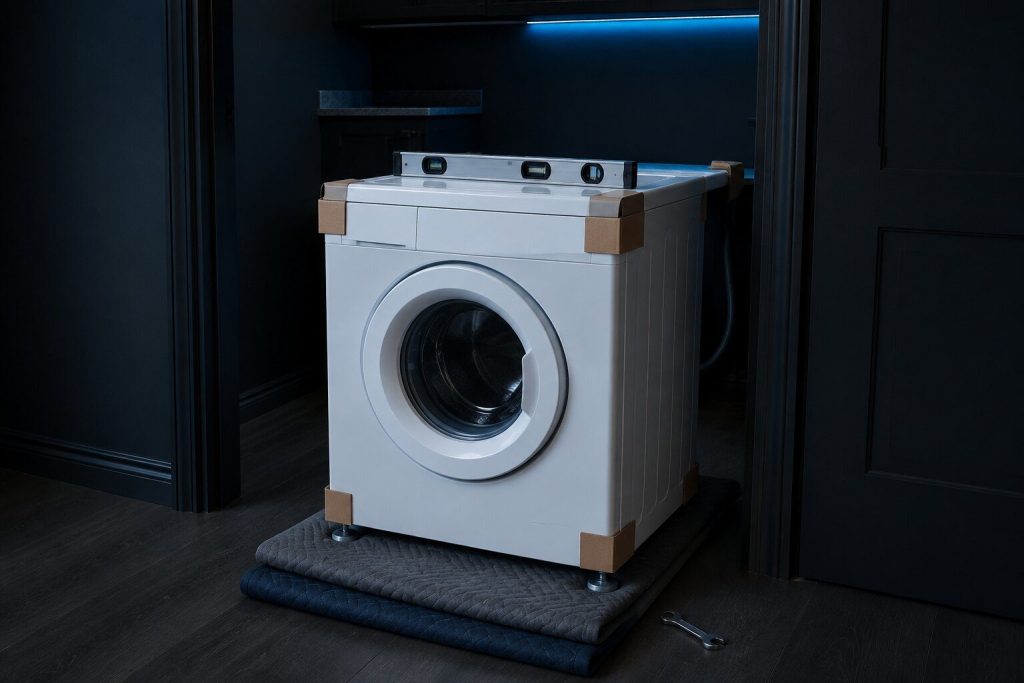
  • A washing machine standing on two folded moving blankets just clear of its opening in a dark laundry closet, cardboard corner guards still on it, a spirit level lying across the lid and an open-ended wrench on the floor beside a front foot.
    from $139

    Appliance installation

    Fitted against the maker's own figures rather than pushed into a hole and switched on. There is a published cutout, a required clearance, an anti-tip fixing and a water connection, and equipment installed to those figures gives years of quiet service. Installed without them, it generates precisely the calls the rest of this site describes: doors that will not seal, coils with nowhere to breathe, laundry that never comes out dry.

    • Cutout, clearance and anti-tip against the maker's published figures
    • The dryer duct is inspected and measured at installation, not after the first complaint
    • Run under load before we leave, not plugged in and left
    What this involves
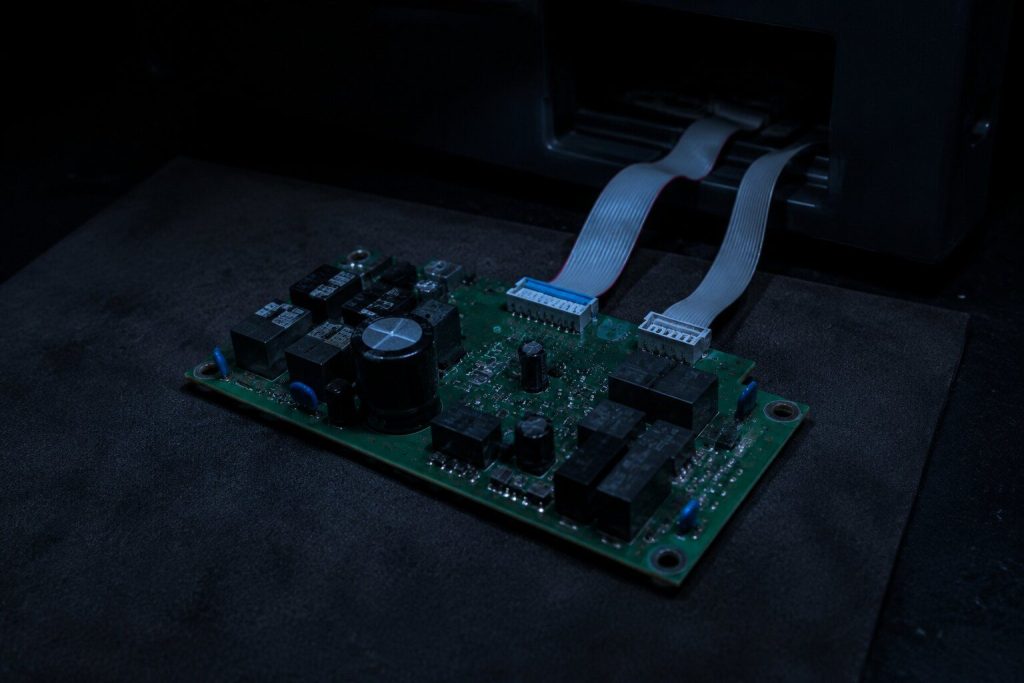
  • A green control board lifted out of an appliance and laid on a dark antistatic mat under one low lamp, two ribbon connectors still trailing back into the opening, relays and a large capacitor visible, nothing on the board readable.
    from $265

    Appliance control board repair

    Everybody reaches for this part first, and the manufacturer's own documentation asks that it be proved innocent before it comes out. One control architecture runs across this whole corporation, which is why a letter-and-number on a range looks so much like one on a washer — and why a board diagnosed by resemblance rather than by measurement gets replaced perfectly well and changes nothing. Boards seldom die of nothing, and whatever killed this one is still in the appliance when the new one goes in.

    • Proved before it is condemned: supply, harness and the connections into it
    • A browned connector or a pin backed out of its housing is cheap; a board is not
    • Programmed to your model afterwards, or the appliance behaves oddly in ways nobody links back
    What this involves
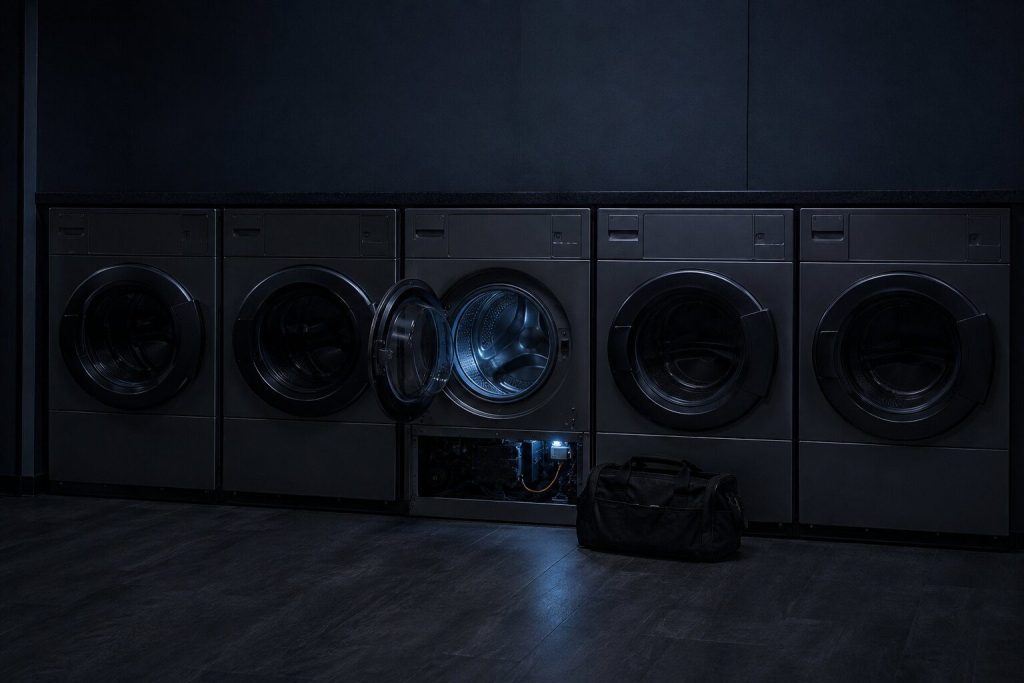
  • A row of five identical coin-operated front-load machines along the wall of a shared laundry room at night, one of them standing open with its lower panel off and a tool bag on the floor beside it, the rest closed and dark.
    from $159

    Commercial appliance repair

    This make's commercial line is laundry, and that is what this covers: coin and card washers and dryers in condominium laundry rooms, small buildings, salons and gyms across South Florida. They are not domestic machines with a different badge. They run to a duty cycle, they are opened more often, and their downtime costs somebody money by the hour — so they are scheduled against that rather than against a convenient window.

    • Coin and card laundry, which is what this maker's commercial line is
    • 142 pages of its own in the maker's base, 39 of them published codes on the dryer
    • Scheduled against downtime rather than against a convenient window
    What this involves
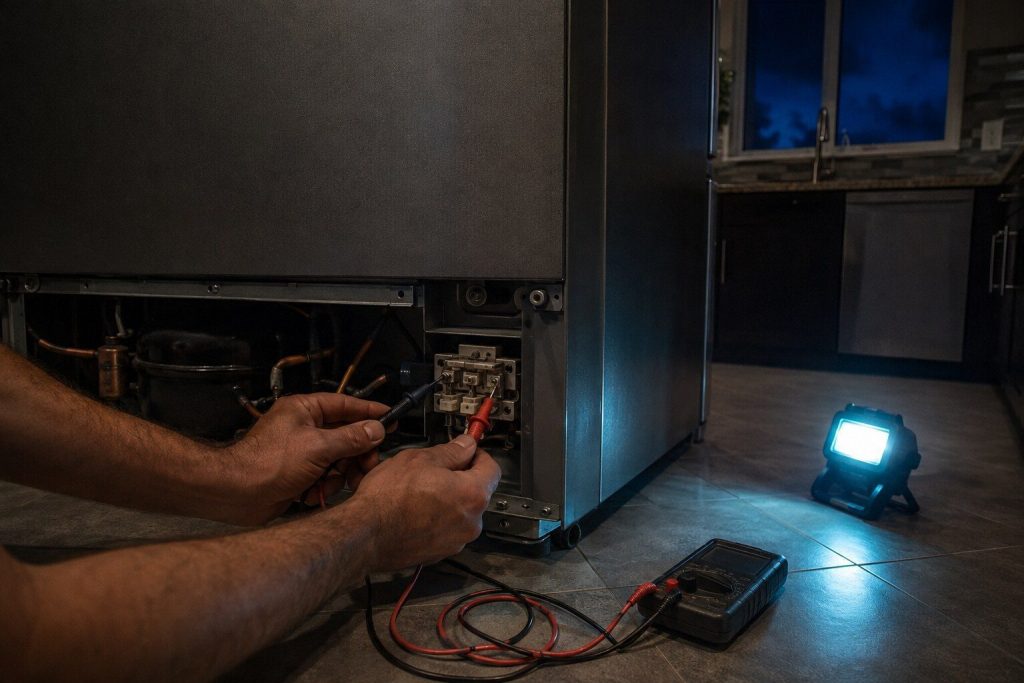
  • Meter probes on a terminal block behind the lower rear panel of a refrigerator pulled out from the wall
    from $145

    Refrigerator not cooling repair

    A cabinet that runs and will not hold its number. On most makes the first move is to read the panel; here there is usually nothing on it, because this maker publishes twenty-six numbered conditions across five hundred refrigeration pages and none at all for a top-freezer cabinet. So this is an hour with instruments and a fixed order — the free causes, then the air, then the gauges — and it is why the first visit is longer here than on the cooking side of the same kitchen.

    • Instruments rather than a code lookup: this half of the make explains very little
    • The free causes come first, and they close more of these calls than any part
    • Refrigerant work is quoted only after gauges, and never on a warm-side-only complaint
    What this involves
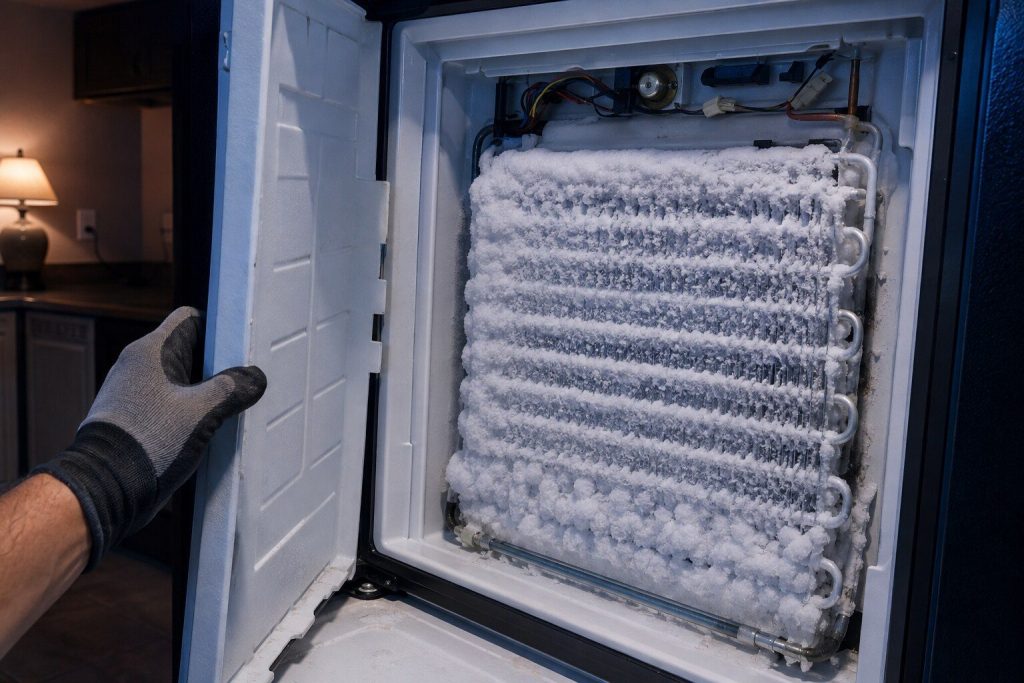
  • The inner rear panel off to show the evaporator coil packed solid with frost and the glass heater rod along its foot. Both halves of the diagnosis in one frame: the ice, and the part that should have cleared it.
    from $165

    Defrost system repair

    Ice on the evaporator behind the back wall rather than frost around the door, and a cabinet that gets worse over weeks instead of failing outright. The circuit is a heater, a terminator and the sensor that decides when to stop, and on this make none of the three announces itself — so the finding takes longer than the fixing and the price says so. What sends a defrost circuit here is usually humidity getting in somewhere it should not.

    • Ice at the back is the defrost circuit; ice at the door is the seal
    • Heater, terminator and sensor measured cold, not judged by how thick the ice looks
    • The way the moisture is getting in is found too, or it comes back next season
    What this involves
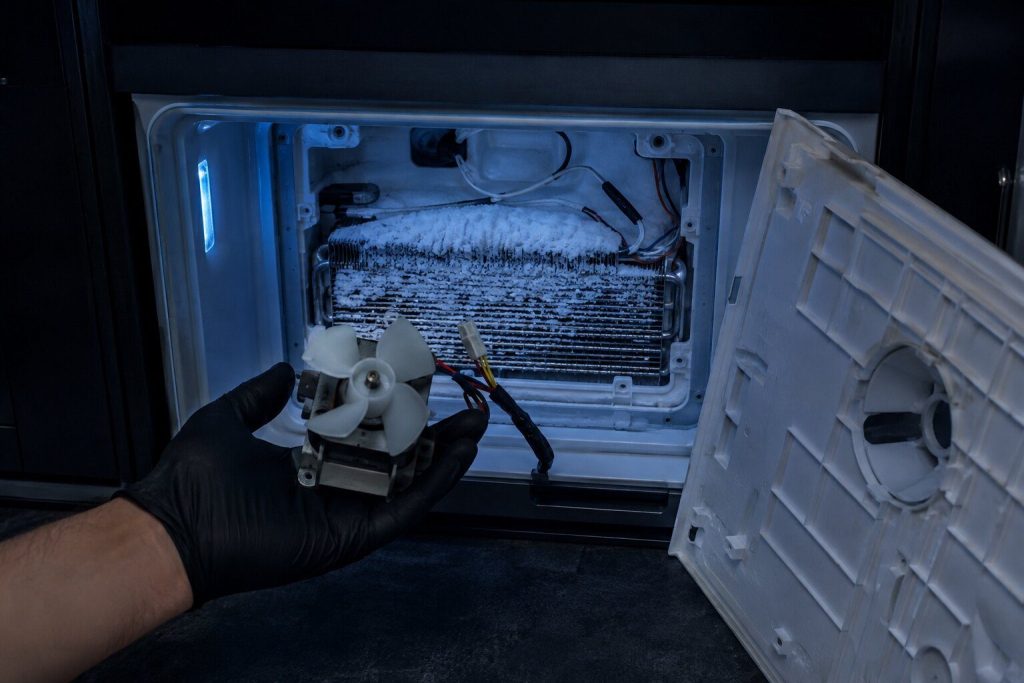
  • The inner rear panel of a freezer removed and leaning aside, a small evaporator fan motor with its plastic blade lifted out on a gloved palm and its harness trailing back into the opening, frost still on the coil behind.
    from $155

    Evaporator fan repair

    The reason a freezer holds perfectly while the food section goes warm. One compressor serves the whole cabinet, so cold is being made and simply is not arriving — and the part that moves it is behind the rear panel with the shelves out. It is a short repair once the panel is off and a longer diagnosis before that, because on this make nothing on the front of the appliance will point at it.

    • The classic warm-fresh-food, cold-freezer complaint
    • Behind the rear panel: the strip-down is the job, the part is not
    • The ice that stopped the blade is checked for as well as the blade
    What this involves
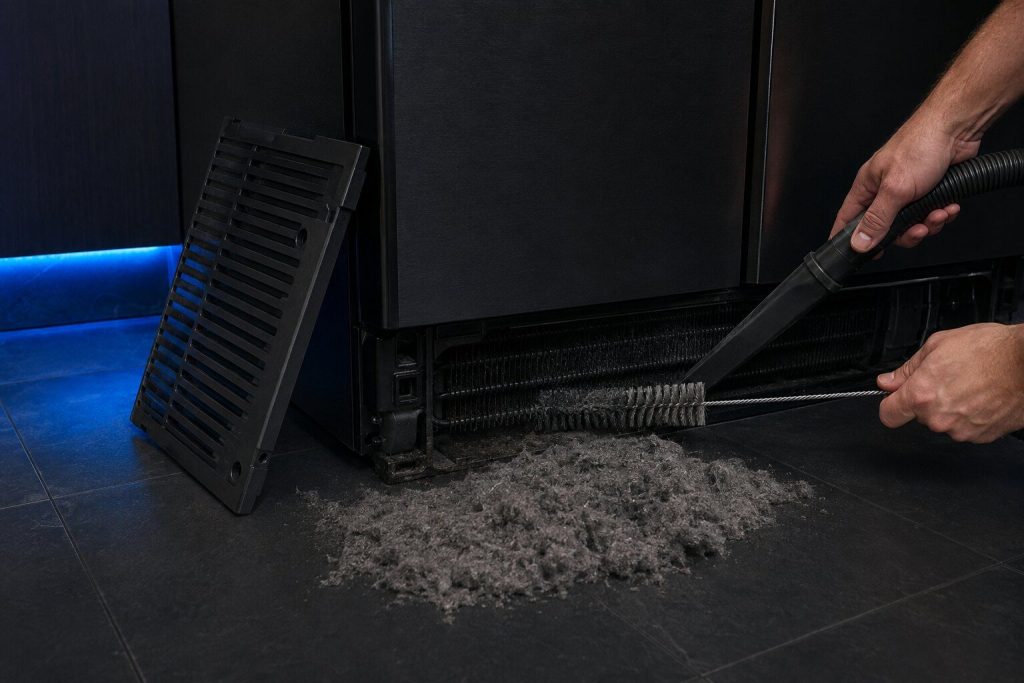
  • The base grille of a refrigerator removed and leaning against the cabinet, a coil brush and a vacuum nozzle worked in among the black condenser fins behind it, a grey mat of dust drawn out onto near-black tile.
    from $115

    Condenser cleaning service

    The maker's own first answer for a cabinet that is not cold enough, and in this city it is right often enough to do on every visit anyway. The coil sits behind a grille a few inches off the floor and collects what floors collect — dust, pet hair, and near the water a fine salt film that binds the rest into a blanket. Nothing on the appliance reports it. The compressor simply runs longer for less.

    • The cheapest thing on this site and the cause of a real share of cold calls
    • Cleaned the way the manual allows, without a chemical and without bending fins
    • The clearance around the cabinet is measured too, not just the coil
    What this involves
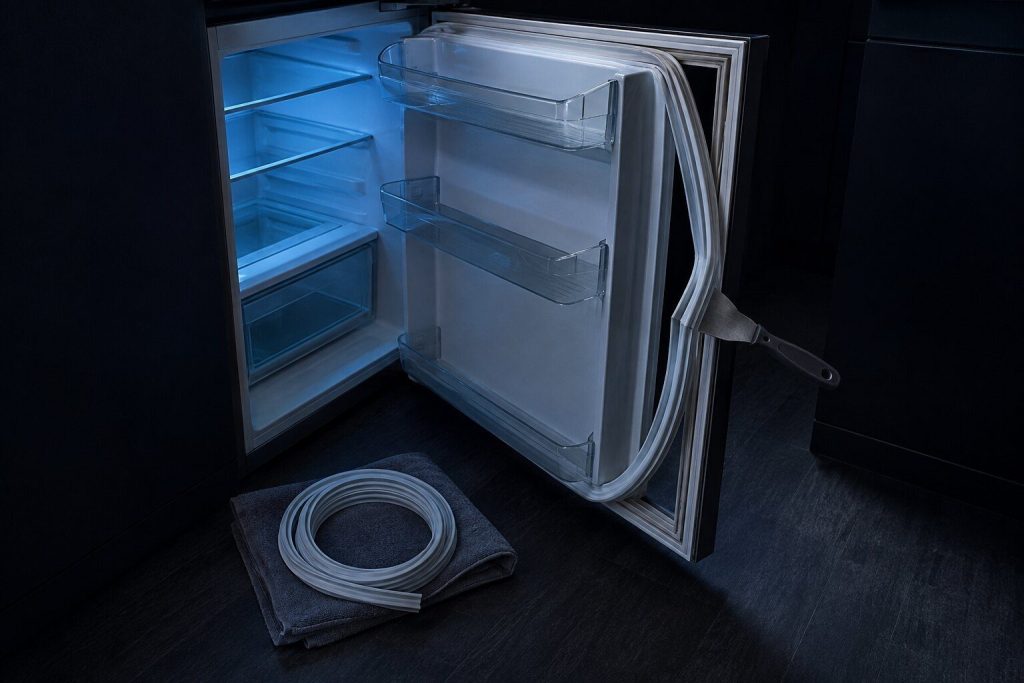
  • A refrigerator door swung wide in a near-black kitchen with the magnetic gasket peeled back out of its channel along one side by a putty knife, the empty channel visible and a new coiled gasket lying on a folded towel on the floor.
    from $135

    Refrigerator door seal replacement

    Few parts this inexpensive cost you as much temperature, and in this humidity the bill arrives in days rather than months. A gasket that has taken a set still touches along most of its run, which is why the handle side always feels fine — the gap is at a hinge corner or low down where the door is heaviest. Fitted to a door that no longer closes square it fails again, so the door is set at the same visit.

    • Found along the whole run rather than at the handle
    • The door is squared at the same visit, or the new gasket fails the same way
    • Frost and condensation are traced to the seal before anything else is suspected
    What this involves
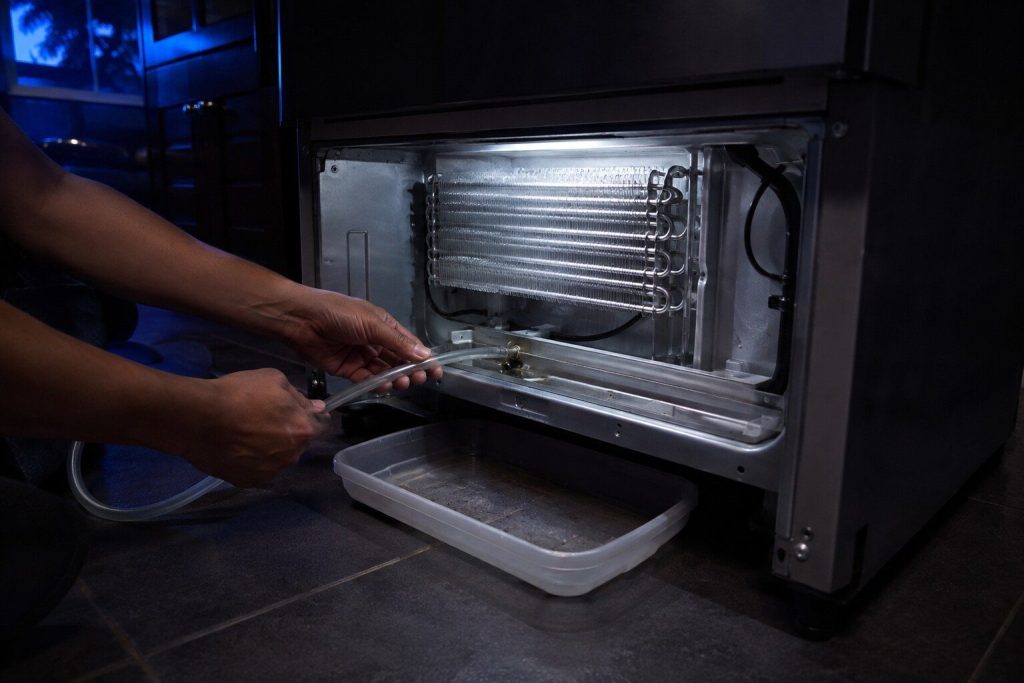
  • Flexible tubing fed into the drain trough at the bottom of an evaporator compartment with a tray under the machine. The blocked defrost drain is the cause of most water under the crispers, which is what this page is called out to.
    from $135

    Refrigerator leak repair

    Water inside the cabinet, under it, or on the floor beside it, and the three have different answers. Inside is nearly always the defrost drain backing up and refreezing; underneath is the drain pan or the tube that feeds it; beside it is the supply line, which is plumbing wearing an appliance complaint. In a kitchen with wood floors or a cabinet run either side, this is a today job rather than a weekend one.

    • Inside, underneath and beside are three different repairs
    • The drain is cleared and the reason it blocked is dealt with
    • The cabinetry is checked before we leave, not after it swells
    What this involves
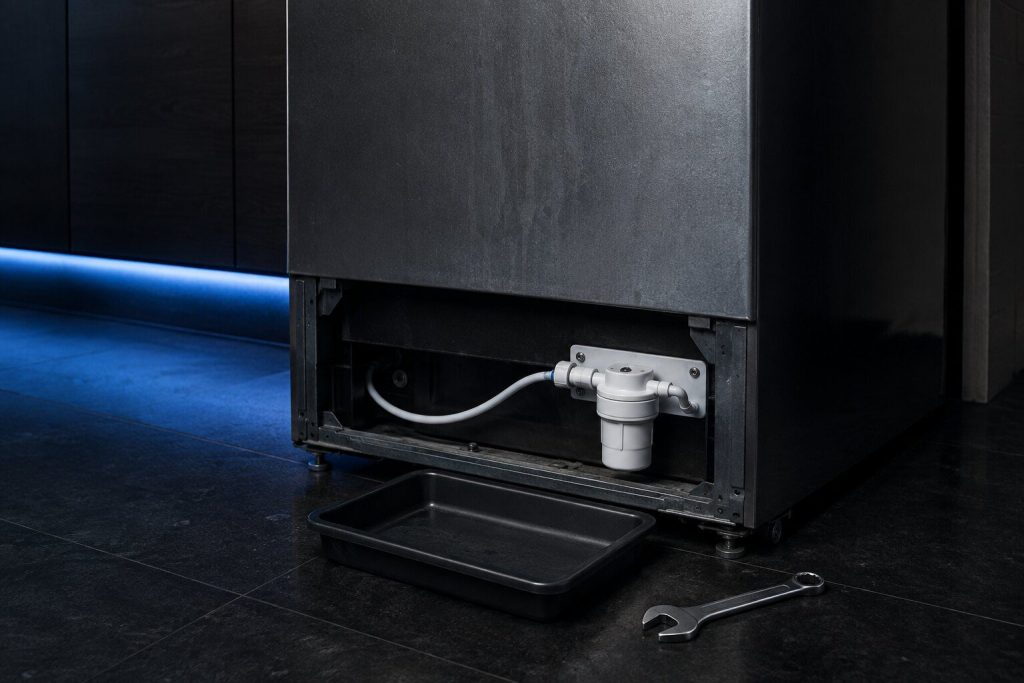
  • A refrigerator pulled forward onto near-black tile with its lower rear panel off, the plastic water line and the filter head visible inside on their bracket, a shallow tray under the fitting and a wrench lying beside it.
    from $109

    Water dispenser and filter service

    No water, slow water, or water that tastes of something. Most of it is upstream of the appliance — the filter, the line and the valve behind the cabinet — and most of it is solved without a part. The one thing worth knowing on this make is that a filter kept past its date starves the ice maker before anybody notices the dispenser, so the two complaints arrive months apart and have one cause.

    • Flow read at the appliance itself, never inferred from how the faucet feels
    • How old the filter is counts here, whatever its label claims
    • The same restriction usually explains the ice maker as well
    What this involves
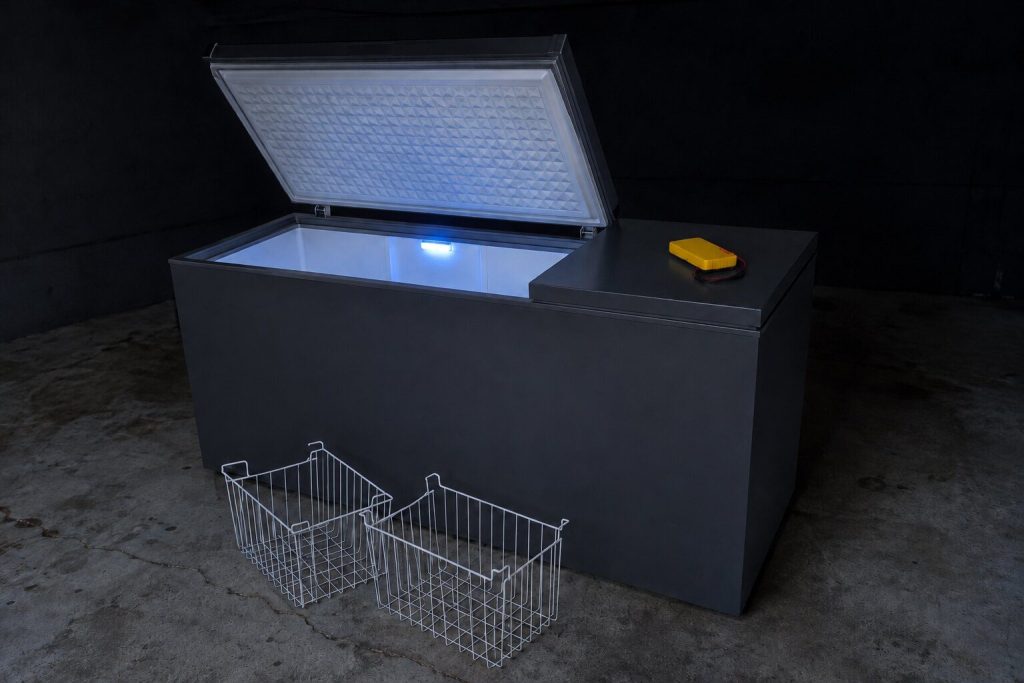
  • A chest freezer standing in a dark garage with its lid propped fully open, two wire baskets lifted out onto the concrete beside it, a multimeter lying on the closed half of the lid with its face turned away.
    from $145

    Upright and chest freezer repair

    One hundred and eighty-four pages in the maker's own base and not one published code — upright, chest and convertible alike. So this is diagnosis by instrument from the first minute, and the single most useful fact is usually where the machine stands. Most of the freezers we open here are in a garage or a utility room that reaches a hundred degrees by afternoon, which is outside what an ordinary cabinet was specified for.

    • No published codes at all: 184 pages of guidance and not one number
    • The room is half the diagnosis — a hot garage is a different machine
    • Seal, thermostat, defrost and condenser, in that order and measured
    What this involves
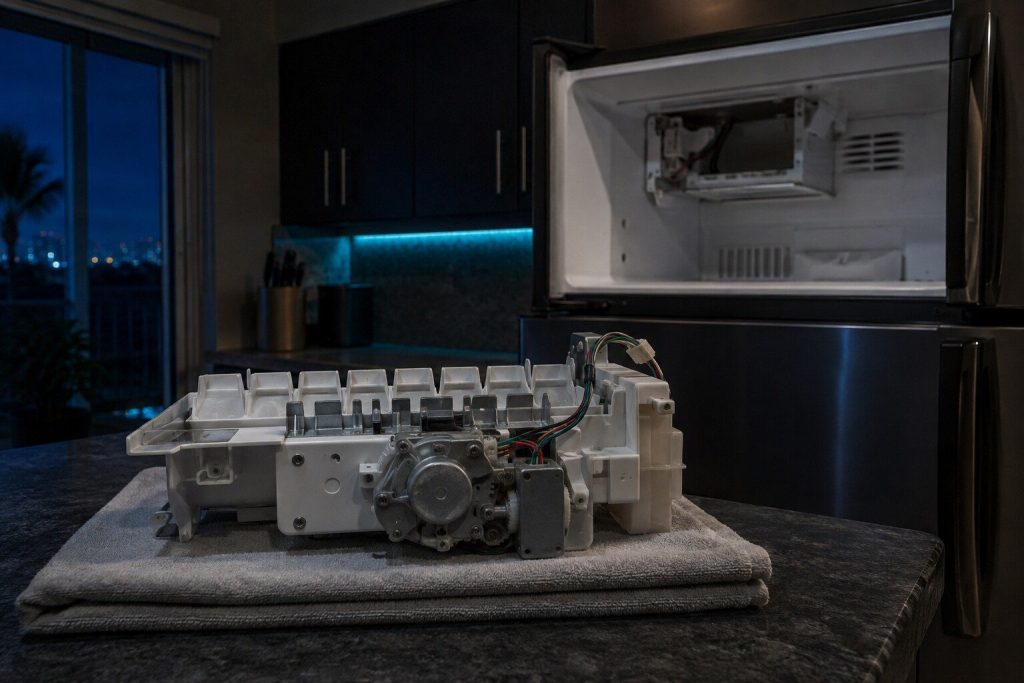
  • An ice maker module lifted out and set on a folded towel, its harvest arm and gearbox to the camera, the empty bracket behind
    from $145

    Ice maker repair

    The module inside a refrigerator — a fill valve, a mold, a heater to let the cubes go, and whatever tells it the bin is full. This badge sells no ice machine of its own, so there is no second version of this job and no page here pretending otherwise. Nothing is published for ice on any cabinet, so the whole diagnosis is measurement, and most of it happens upstream of the module rather than in it.

    • The refrigerator's module: there is no standalone ice machine under this badge
    • No published codes for ice at all — the fill is measured, not inferred
    • The arm or sensor that stops production is checked before the module is blamed
    What this involves
  • A gloved hand holding a warm cloth around the small white fill tube at the back of a freezer wall, a plug of ice half melted at its mouth. The frozen fill tube is the single commonest cause on this page and this is exactly it.
    from $125

    Ice maker water line and fill valve service

    Everything between the shut-off and the mold, which is where most low-ice calls actually end. These modules mind flow rather than pressure, so a tired filter or a saddle valve left half open will starve one gradually enough that nothing ever appears broken — production just falls month by month. This is the least expensive ice job on the list, and the one people most often assume will be the dearest.

    • Flow measured at the machine, not judged from the kitchen tap
    • Filter age is a real variable here and it is treated as one
    • The kink a reinstall leaves in the line is looked for every time
    What this involves
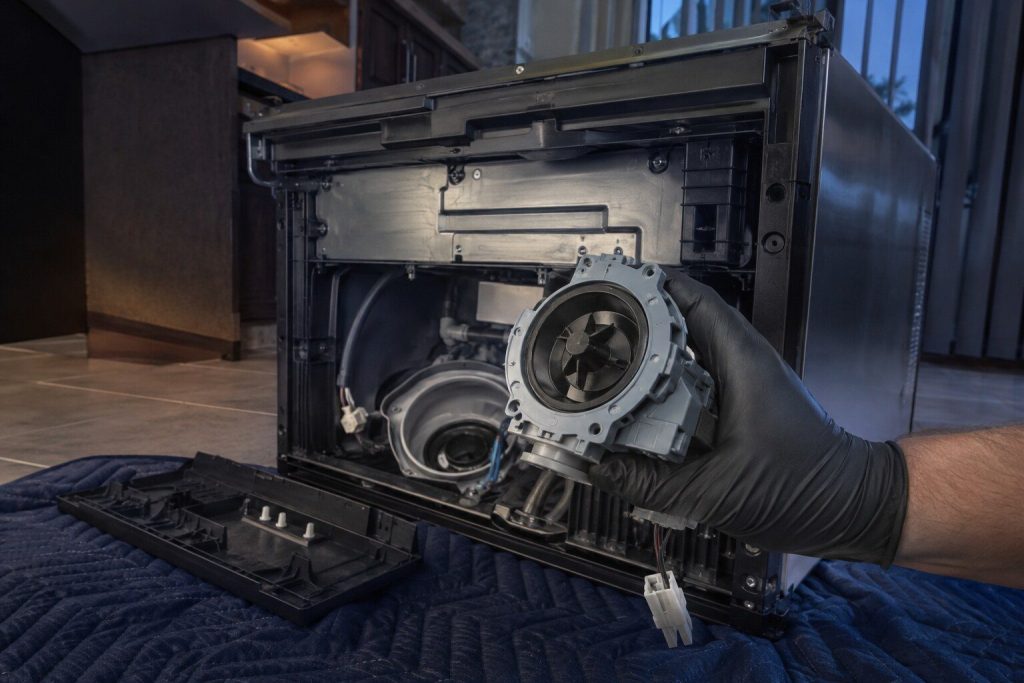
  • A dishwasher on its back with the base cover off and the drain pump lifted clear of the sump on a gloved hand, the impeller housing turned to the camera. The impeller is where the glass ends up, which is the story this page tells.
    from $135

    Dishwasher drain and pump repair

    Water standing in the bottom of the tub at the end of a cycle, and more often than not the cause is outside the appliance. This maker groups almost all its dishwasher diagnosis under a single heading covering codes and blink patterns together, so on a machine without a display the lights are the message — and cutting the power to reset it clears the evidence along with the symptom.

    • Filters and hose before the pump, and they end most of these
    • On a machine with no display, the blink pattern is the code
    • The high loop lost on a reinstall is the commonest installation cause
    What this involves
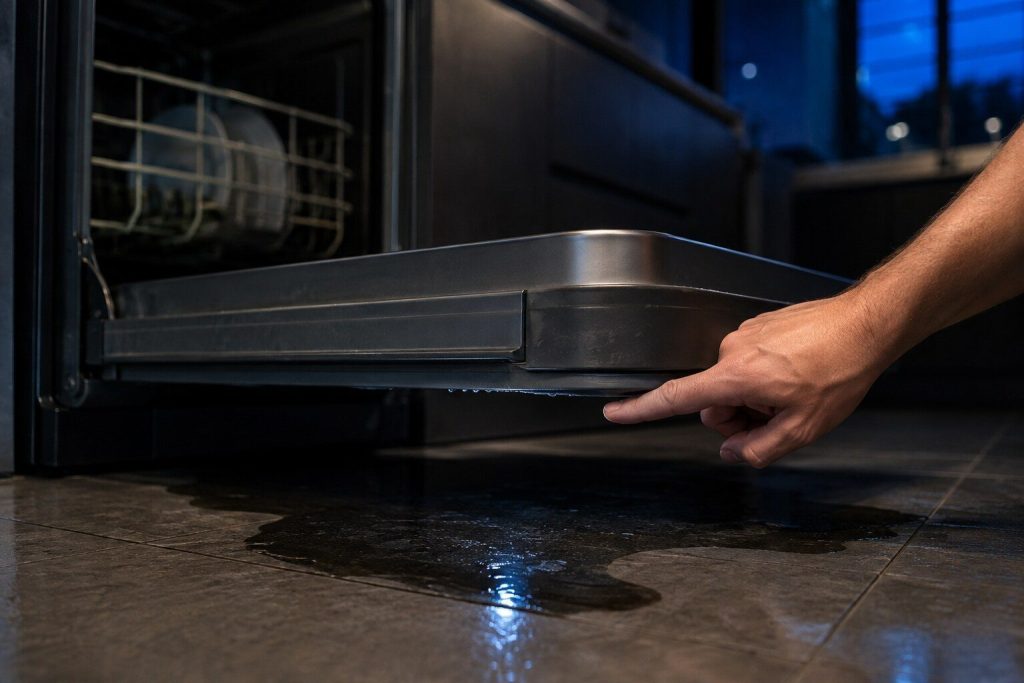
  • A finger tracing a wet line along the bottom edge of an open dishwasher door where the seal meets the tub, a dark puddle on the tile. The door gasket is the first thing checked and the bottom edge is where it shows.
    from $145

    Dishwasher leak repair

    Water on the floor in front of the machine, or under a cabinet run where nobody sees it for months. Finding it costs more than fixing it: a door gasket, a sump seal, a hose that weeps only under pressure at one point in the cycle. In a fitted kitchen the expensive half of this repair is the joinery, so it is dealt with as a today job rather than a weekend one.

    • Found by running the machine and watching, not by guessing at the part
    • A leak that appears at one point in the cycle points at one part
    • The cabinet base is inspected before we leave
    What this involves
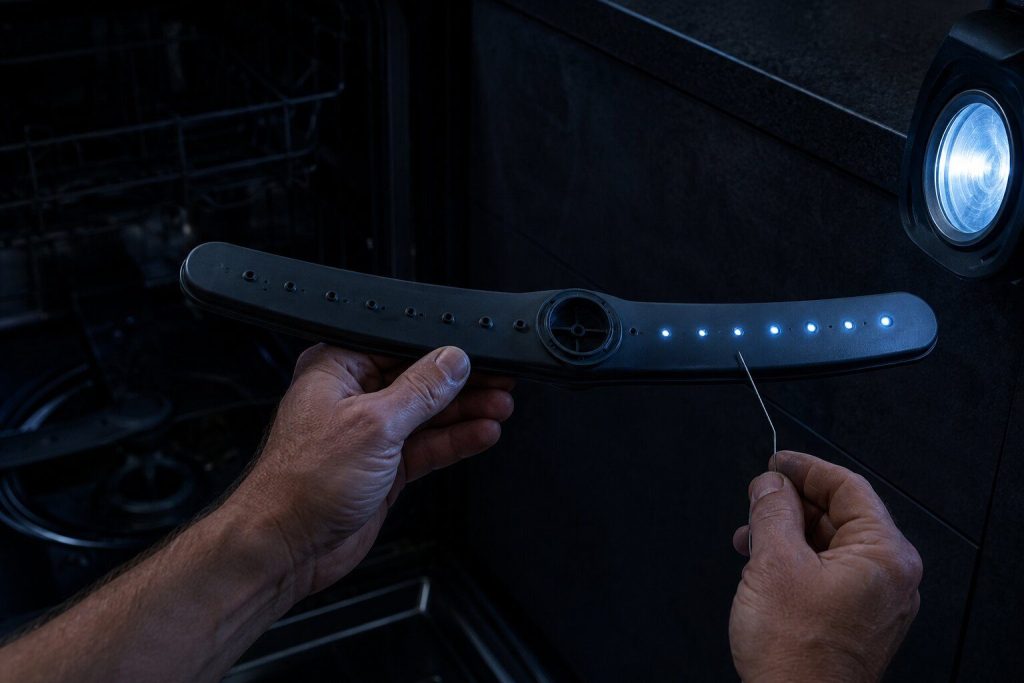
  • A lower spray arm unclipped from a dishwasher and held up against a work light in a dark kitchen so its row of small jets shows as points of light, half of them plainly closed, a length of wire in the other hand.
    from $119

    Dishwasher wash performance service

    The machine fills, runs and empties, and the dishes come out no better than they went in. Which rack is worse is the useful clue and it is one you can read from the kitchen before anybody arrives: one clean rack and one dirty one means water is not being sent to both, and both equally poor with the arms turning freely is a different question entirely.

    • Which rack fails is the clue, and you can read it yourself
    • Spray arms, diverter and filters before anything is replaced
    • This water is hard enough to be part of the diagnosis
    What this involves
  • The latch at the top of a dishwasher door and the strike it closes into, the door held an inch open so both halves read. A latch that reports open intermittently is the machine that sometimes runs and sometimes does not.
    from $135

    Dishwasher door latch repair

    A door that will not latch, will not stay shut, or falls open instead of holding at an angle. The latch and the switch behind it are one repair; the springs that carry the door are another, and they are replaced as a pair or the door pulls out of square within a month. On a machine behind a custom panel the weight is a variable the factory could not know about.

    • Latch, switch and springs — and the springs go in as a pair
    • A door that will not latch is often a door that no longer closes square
    • A custom panel changes the spring tension the factory set
    What this involves
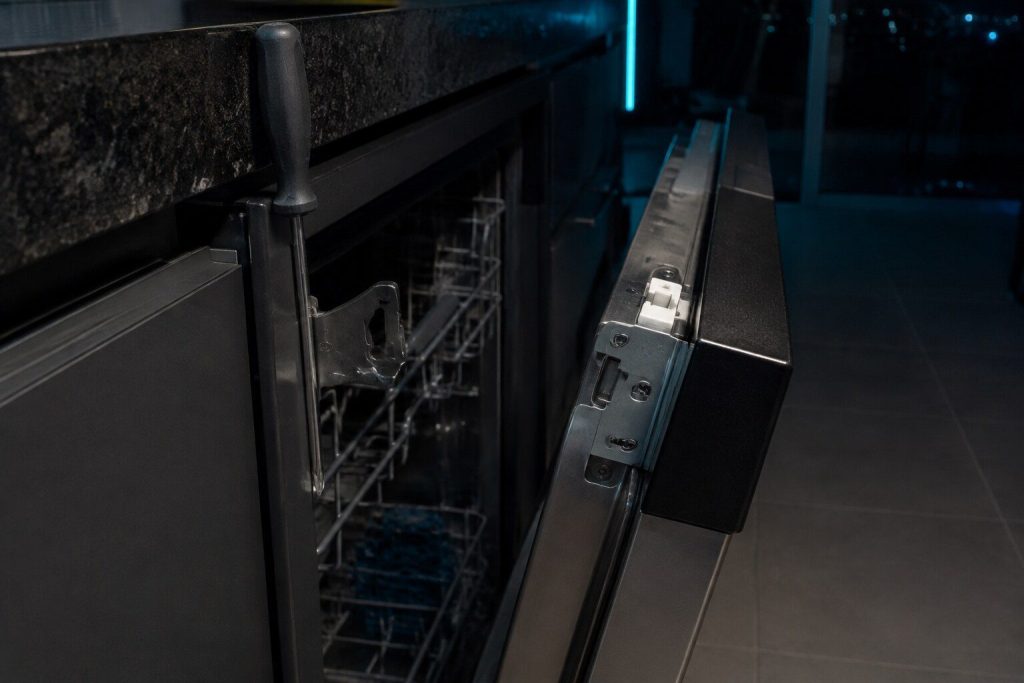
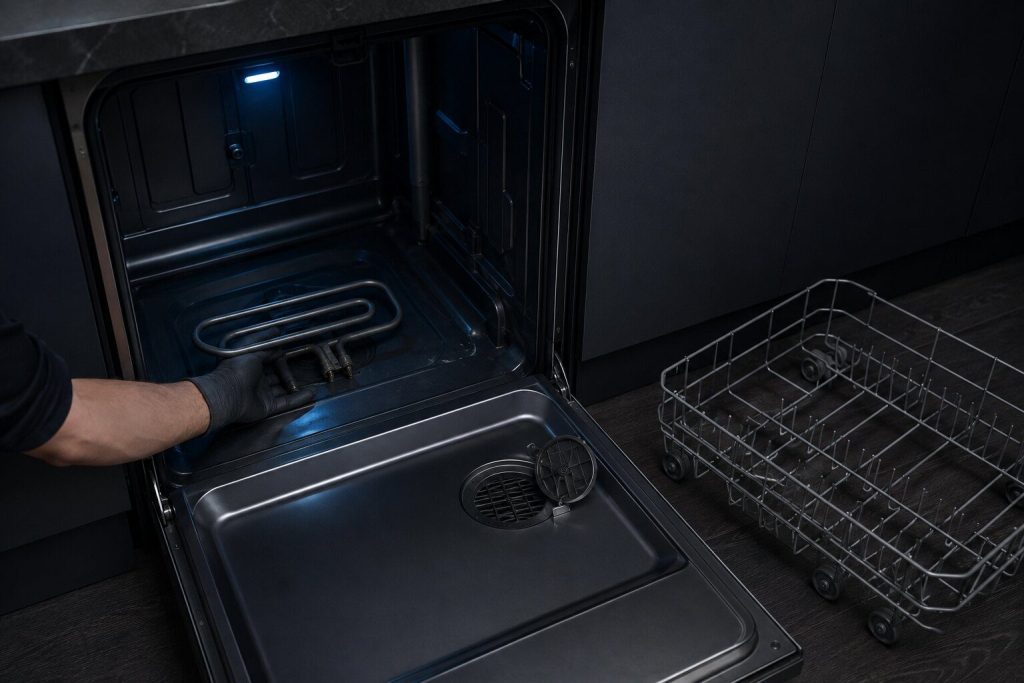
  • The lower rack drawn right out of a dishwasher and set on the floor, the looped heating element lifted a little clear of the tub floor on a gloved hand and the drying vent in the inner door face open beside it.
    from $175

    Dishwasher drying and heat repair

    Dishes that come out wet on a machine that washes perfectly well. On this make the drying and the washing are separate systems, so a machine that cleans and does not dry is telling you which half to look at. Rinse aid is the free version and it is checked first; after that it is the heating circuit and the thermostat, and the difference between them is a fraction of the cost.

    • Rinse aid and load pattern before any part is named
    • Drying and washing are separate systems: one working proves the other's supply
    • Plastics drying last is normal on any residual-heat machine
    What this involves
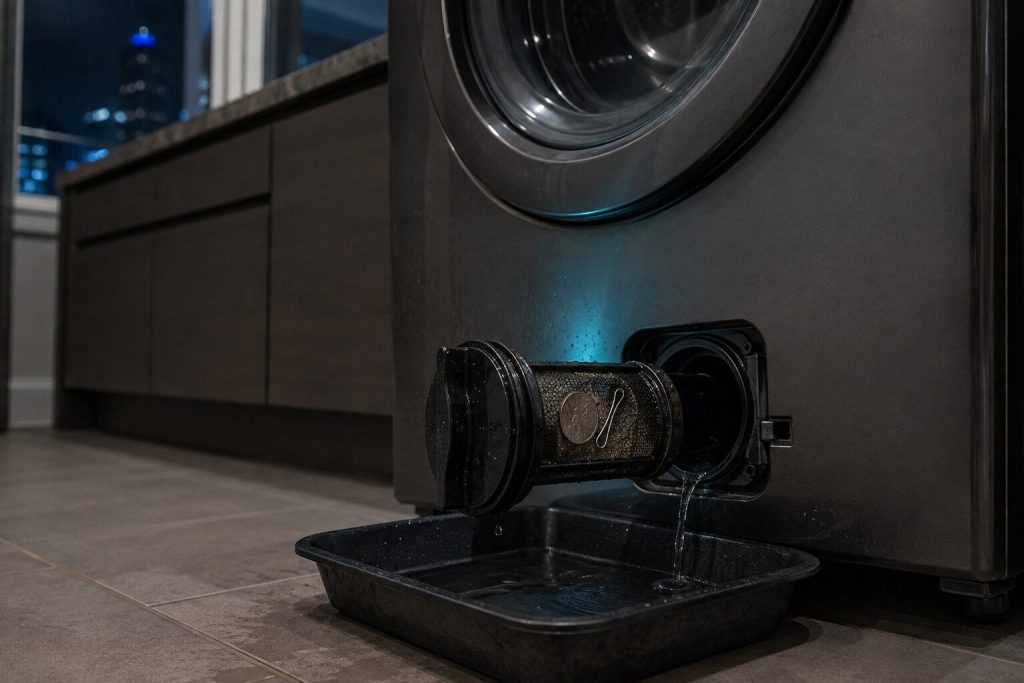
  • A drain pump filter unscrewed out of the bottom front of a washer over a shallow tray, a coin and a hairpin caught in the mesh, water still running. What actually comes out of one of these, which is the sentence the page opens with.
    from $175

    Washer drain pump replacement

    The commonest laundry repair on this make, and one of the cheapest parts behind one of the longer jobs. A machine that stops mid-cycle with a drum of water is usually reporting the pump, the filter in front of it or the hose behind it, and this maker publishes more numbered conditions for washers than for anything else it builds — so there is often something on the panel worth photographing before the power is cut.

    • Photograph the panel first: this is the make's most documented appliance
    • Filter and hose before the pump — and the coin that got there first
    • The standpipe and the sink beside it are checked, because both can defeat the machine
    What this involves
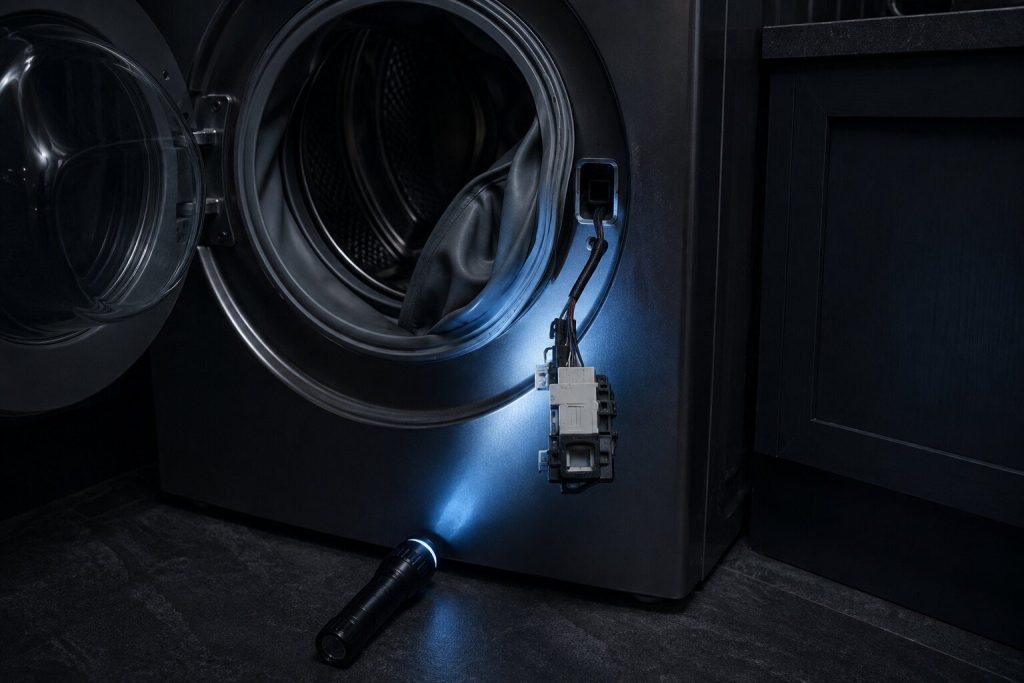
  • The door lock unit of a front-load washing machine drawn out of its cutout in the front panel and hanging on its wiring loom, the rubber boot folded aside, a torch on the floor lighting the opening from below.
    from $145

    Washer door lock repair

    Front-load machines, where the lock has to hold a door that is carrying its own weight on a hinge. A machine that will not start often believes the door is open; a machine that will not open usually still has water in it and is refusing on purpose. Neither is the same repair, and forcing the door is the one thing that turns an inexpensive part into a panel.

    • A door that will not open with water inside is the machine protecting your floor
    • Forcing it is the commonest way this repair gets more expensive
    • A dropped door is fixed with the lock, or the new lock fails the same way
    What this involves
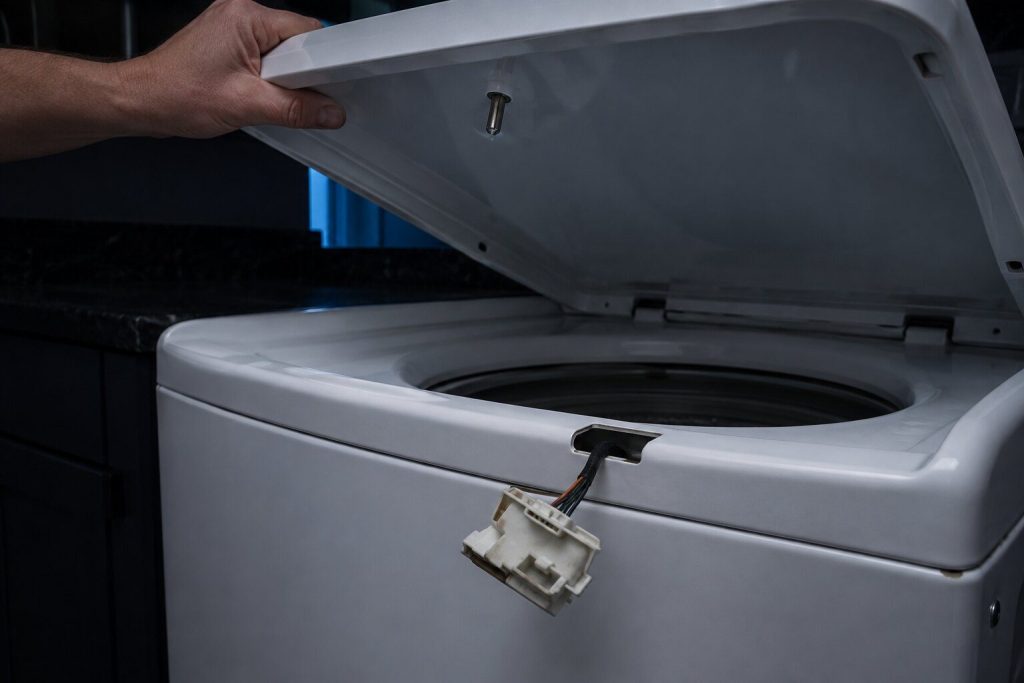
  • The lid of a white top-load washing machine held raised while the lid lock housing hangs out of its cutout in the cabinet rim on its wiring loom, the short metal striker pin on the underside of the lid directly above it.
    from $139

    Washer lid lock and lid switch repair

    Top-load machines, and a different part in a different place from the front-load door lock — which is why it has a row of its own rather than being averaged into one. A top-loader will not spin unless it is sure the lid is shut, so a failed lock arrives as a machine that washes and leaves everything soaking. On the older cabinets this is a console-off job.

    • A separate part and a separate job from the front-load door lock
    • The commonest reason a top-loader washes and will not spin
    • On older cabinets the console comes off, which is where the time goes
    What this involves
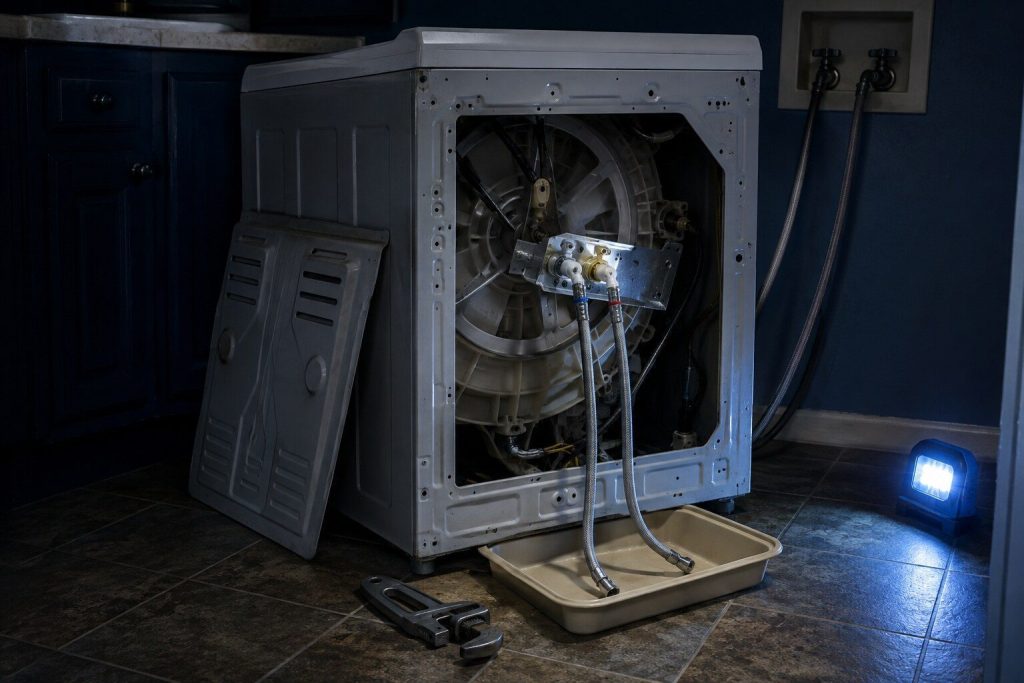
  • A washer pulled out with its upper rear panel off, the inlet valve drawn out on its bracket with both braided supply hoses still attached. Two hoses is the detail: this page is about why a machine fills cold only.
    from $139

    Washer water inlet valve repair

    A machine that fills slowly, fills on one temperature only, or will not fill at all. Most of it is upstream — screens, hoses and shut-offs that have not been turned since the machine was installed — and the valve itself is a modest part. In an older laundry closet the shut-offs are frequently the oldest thing in the room and worth replacing while the machine is out.

    • Screens and shut-offs first: they are older than the machine in most closets
    • Filling on one temperature only points at one half of the valve
    • Measured under pressure, because a valve can pass at rest and stall under load
    What this involves
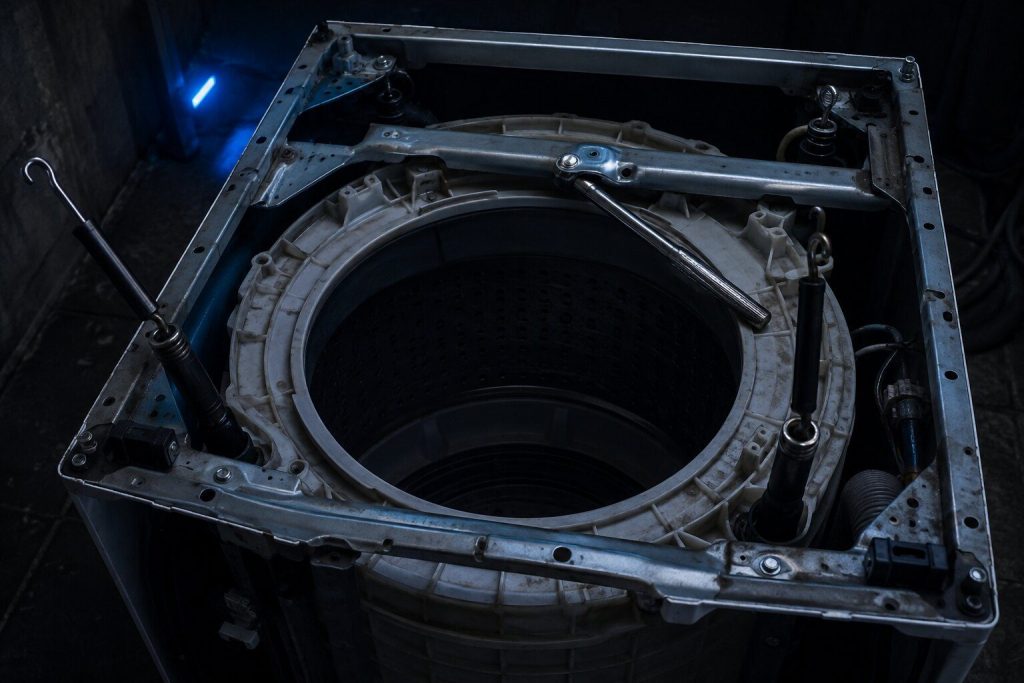
  • The cabinet of a top-load washing machine opened up with two of its four suspension rods unhooked at the top and swung clear of the outer tub, a socket wrench resting across the frame, the basket dark below.
    from $195

    Washer not spinning and balance repair

    A machine that washes and rinses and leaves the load dripping. The first question is whether it is refusing to spin or unable to, and on this make it is refusing far more often than it is failing — a load gathered on one side of the drum will be declined, and a single heavy item has nothing to sit opposite. That is free to demonstrate, and it is demonstrated before anything is quoted.

    • Refusing and unable are different, and the first is usually free
    • It cannot spin until it has drained, so a drain problem arrives as a spin problem
    • Suspension and level are checked on every one of these
    What this involves
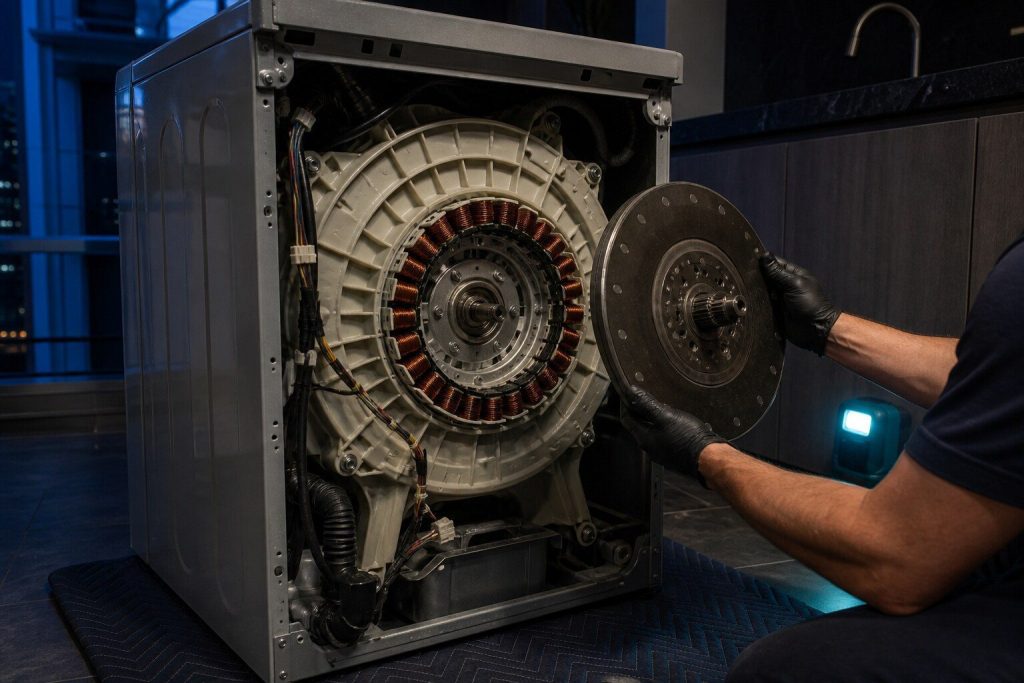
  • A large flat magnet rotor lifted off the back of a washer's outer tub with the stator still bolted behind it. Direct drive is what this generation of the badge uses, so this is the drive rather than a belt from somebody else's machine.
    from $265

    Washer motor and drive repair

    The dearest laundry row and the one where the arithmetic gets said out loud. Motor, drive and the control that runs them, with the drum out on most cabinets, so the job is the strip-down rather than the part. On a machine of the age this badge is usually kept to, that is exactly the point at which somebody deserves a straight answer about whether to do it.

    • The strip-down is the job; the part is a fraction of it
    • Proved by measurement rather than concluded by elimination
    • The arithmetic against the cabinet's remaining life, said before the work
    What this involves
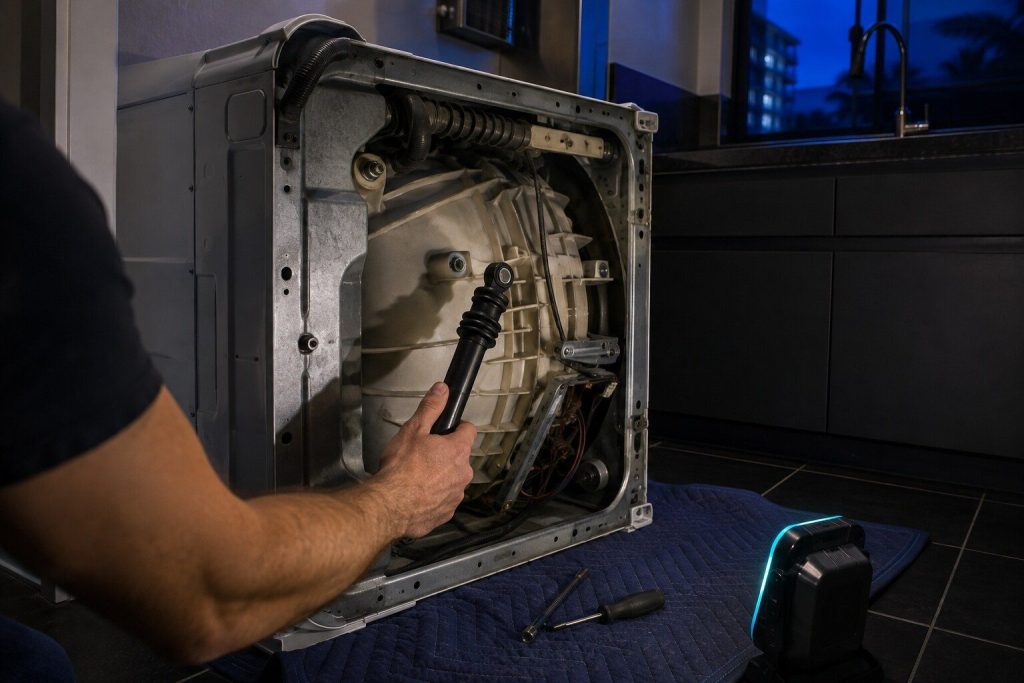
  • A suspension damper unbolted from the outer tub and held clear of its bracket, the machine on its side on a blanket. On its side is the honest part: this is the repair that means the machine comes apart.
    from $285

    Washer suspension and bearing repair

    The repair this make needs and its sister sites rarely quote, because this is the badge people keep. A noise that arrives with the spin and quiets as it slows is the classic bearing signature, and it does not appear overnight — it is usually years of spinning slightly out of balance, on a machine that has outlived two kitchens. Caught early it is a repair in the middle of a life. Left alone, the bearing takes the drum and the shaft with it.

    • Rising with the spin and falling with it: the bearing signature
    • Suspension first, because it is what wore the bearing out
    • Priced against the cabinet's remaining life, honestly, before the work
    What this involves
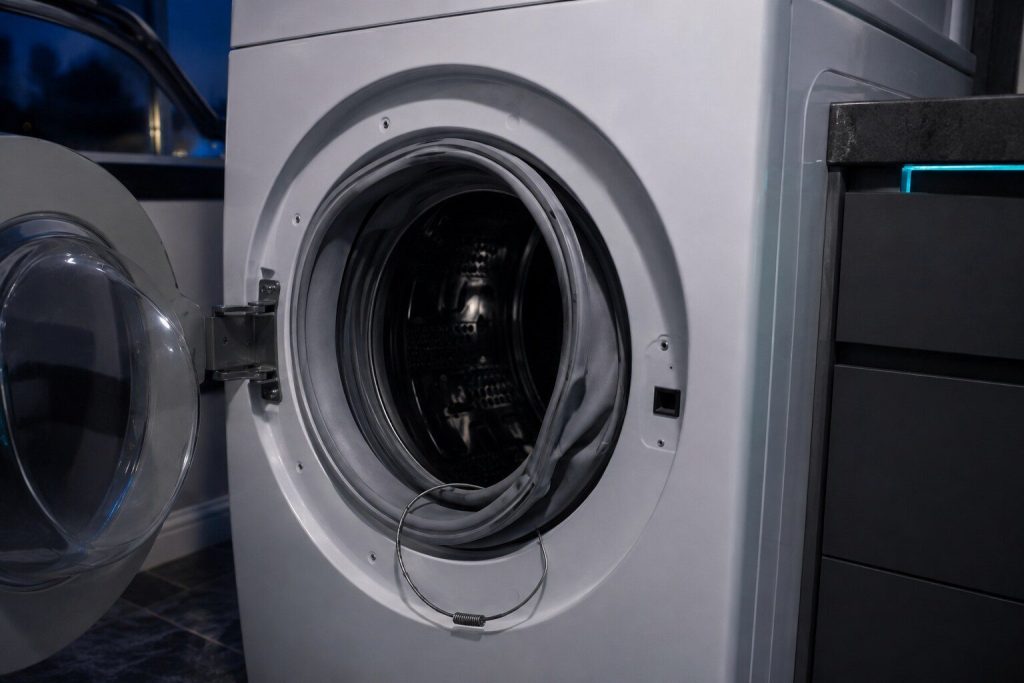
  • The spring clamp sprung off the front of the rubber boot and the lip folded back from the frame, the drum dark behind. The boot is the first place a front-load leak is looked for and the one an owner can check.
    from $155

    Washer leak repair

    Water on the laundry floor, and on a front-loader the door boot is the usual answer — a rubber seal that spends its life wet in a room that never fully dries. On a top-loader it is more often a hose, the pump seal or the dispenser. Which point of the cycle it appears at narrows it before anything is opened, so that is the first question asked on the phone.

    • Which minute of the cycle it leaks at points at which part
    • On a front-loader the boot is the usual answer, and it is a drum-in-place job
    • The floor and the cabinet under it are checked, not just the machine
    What this involves
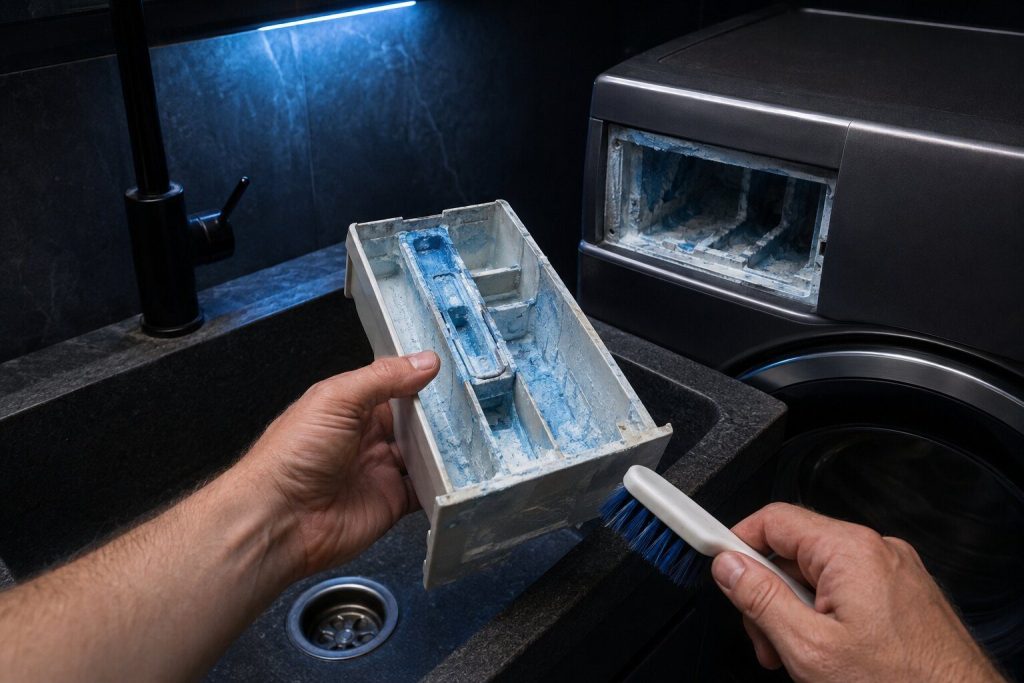
  • A detergent dispenser drawer pulled right out of a washing machine and held over a laundry sink, its compartments and the channels behind it crusted with dried blue-white softener residue, a brush in the other hand.
    from $99

    Washer excess suds service

    The cheapest row on this site, and the one most often solved by explanation rather than by parts. A modern machine uses far less water than the one it replaced, so the detergent dose somebody learned twenty years ago is now several times too much — and this water carries enough mineral to change how it behaves. Suds cushion the load, confuse the level sensing, and produce a machine that runs long, rinses badly and smells.

    • Usually dose and water rather than any part of the machine
    • Suds confuse the level sensing, so this arrives as a cycle-length complaint
    • A maintenance cycle and a dose change, and it is measured afterwards
    What this involves
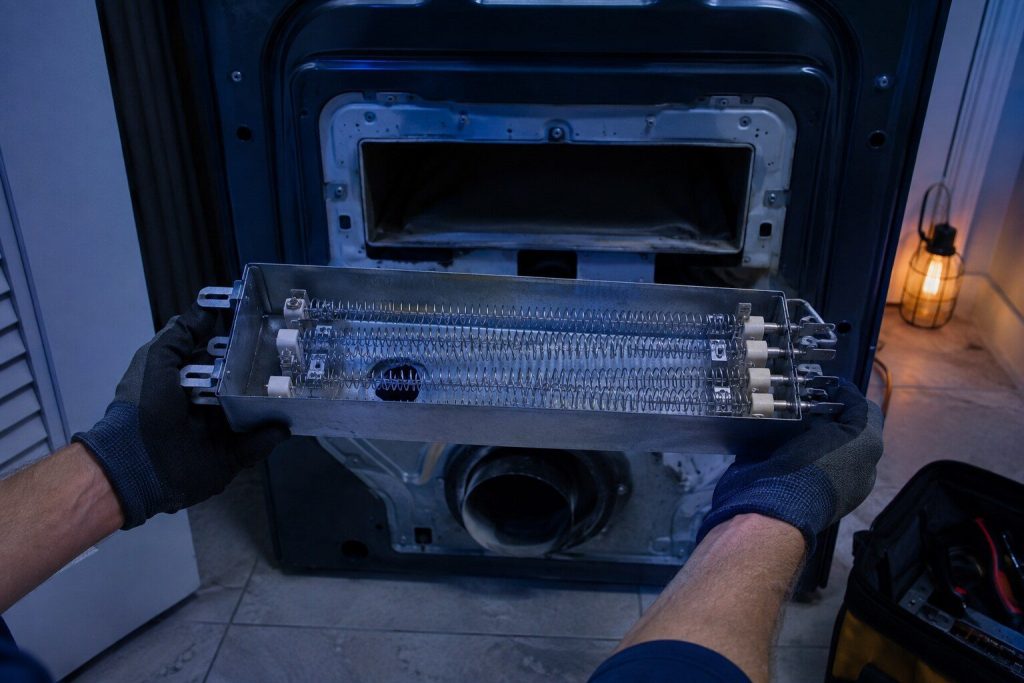
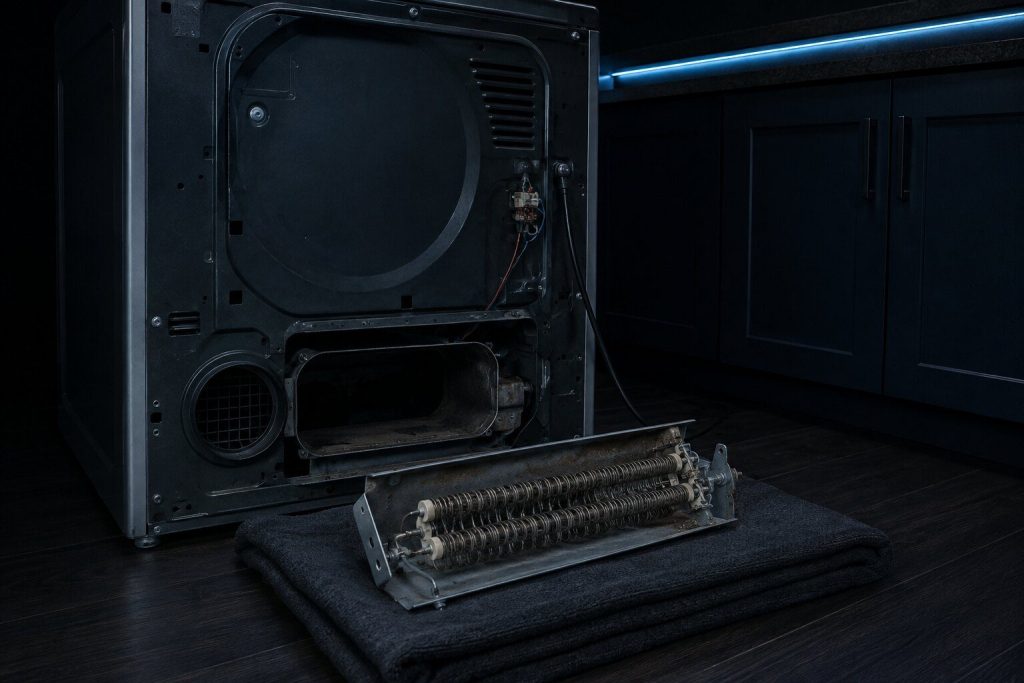
  • The coiled heating element in its open metal can lifted out of the back of a dryer and held level, the empty duct opening behind. The element and the duct in one frame, which is the order this page insists on.
    from $145

    Dryer not heating repair

    Every dryer under this badge is vented — there is no heat-pump machine and no compact one — so this job starts behind the appliance rather than inside it. A run that is long, flat, crushed or full of lint will not let a dryer work however good its element is, and in South Florida those runs carry air that arrived wet. The duct is measured before anything is opened, and that measurement ends a real share of these calls.

    • Vented only: the duct is the appliance's real constraint
    • Measured with a gauge before and after, not judged by hand
    • The thermal cut-out is replaced with the element, because it opened for a reason
    What this involves
  • A dryer pulled forward in a dark laundry room with its rear panel off, the coiled heating element drawn out of its metal can and laid across a folded blanket on the floor, the empty housing dark behind it.
    from $175

    Dryer heating element replacement

    The element, its housing and the thermal cut-out beside it, on electric machines. The cut-out goes in with the element every time — it opened because the machine overheated, and it overheated because the air was not moving. Replacing the element alone gets the dryer hot again for a few weeks and then does exactly the same thing.

    • The thermal cut-out is replaced with it, never left in place
    • The airflow that caused the overheat is cleared at the same visit
    • Measured cold rather than judged by whether the drum feels warm
    What this involves
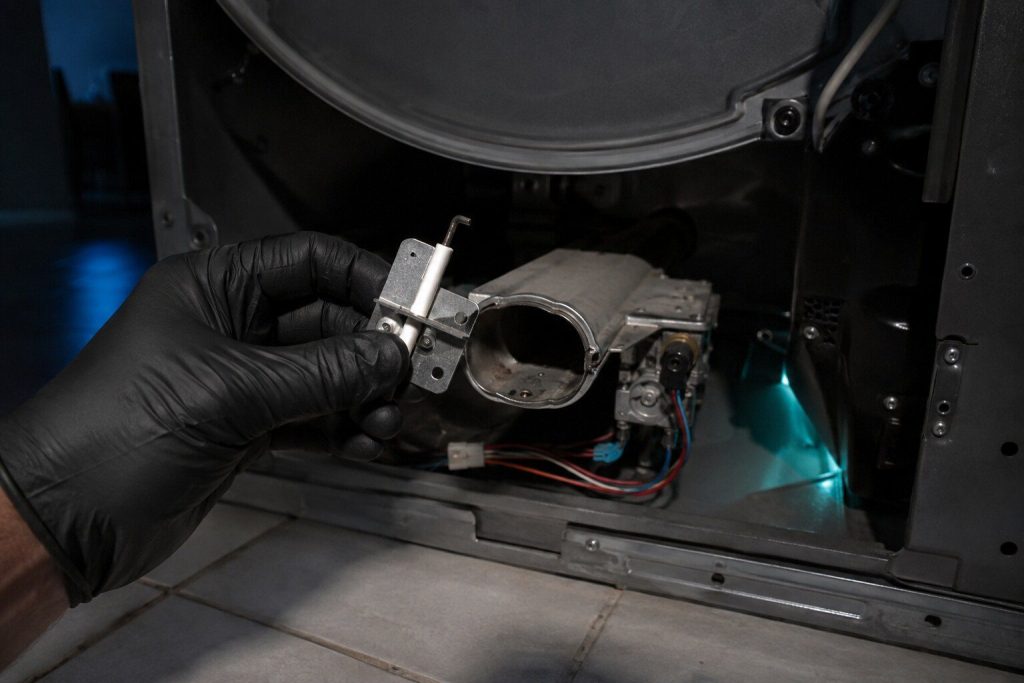
  • A small ceramic igniter on its bracket held in front of an opened gas dryer burner tube. The igniter is the commonest gas dryer repair there is, and the open burner tube behind it is the sequence you listen for.
    from $175

    Gas dryer igniter and valve repair

    On a gas machine the igniter is the usual answer and it fails in a way that looks exactly like no heat at all — it weakens for months before it stops, so the complaint that arrives is a dryer taking two cycles rather than a dryer that is cold. After that it is the flame sensor and the valve coils, and the order matters because two of the three are inexpensive and one is not.

    • A weakening igniter arrives as slow drying, not as no heat
    • Flame sensor and valve coils measured, not swapped in hope
    • The duct is checked here too — a gas machine overheats for the same reasons
    What this involves
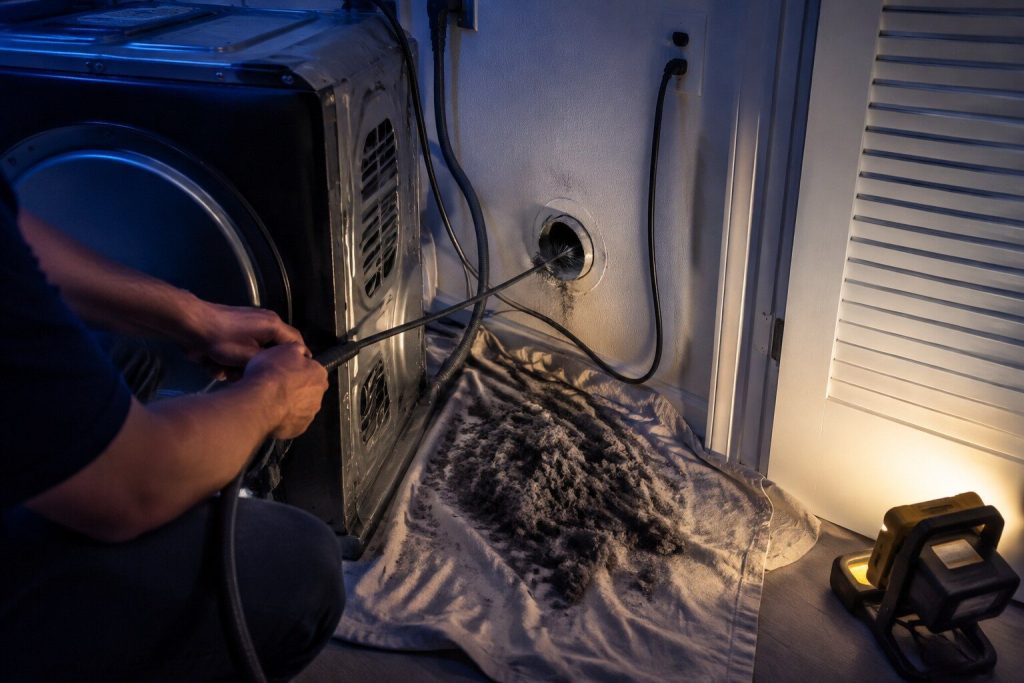
  • A long flexible rod brush fed into the round duct in the wall behind a pulled-out dryer, a heaped mat of grey lint on the dust sheet beneath. The heap is the point — it is what a year of humid lint looks like out of the run.
    from $129

    Dryer vent cleaning

    The whole run rather than the first three feet, and measured before and after so the visit has a number behind it. In this region the runs are long and horizontal more often than short and vertical, and they carry humid air, so lint packs rather than blowing through. It is the cheapest thing that keeps a vented dryer working and the one nobody schedules until the machine has already been called broken.

    • The whole run, and a reading before and after
    • Long flat runs in this region pack rather than clear themselves
    • The outside flap is checked, and it is blocked more often than the pipe
    What this involves
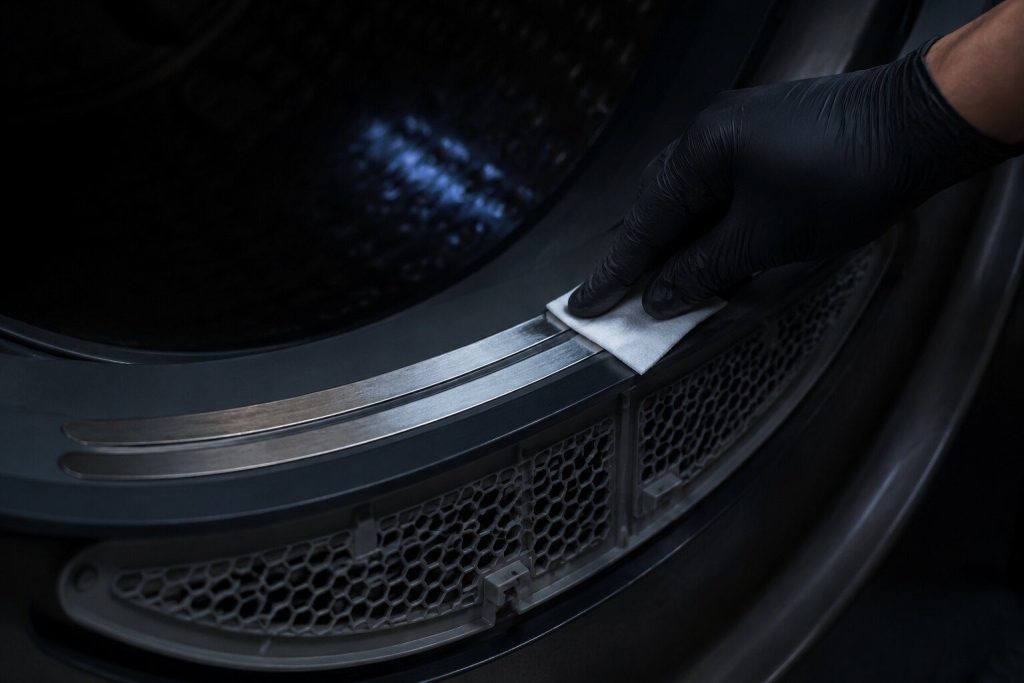
  • Gloved fingers drawing an alcohol pad along the two metal sensor strips just inside the front of a dryer drum near the lint screen opening, a clean band showing behind the pad, the drum otherwise empty and dim.
    from $109

    Dryer moisture sensor service

    Two metal strips inside the drum that decide when the load is dry, and fabric softener leaves a film on them. A coated sensor reads a wet load as dry and ends the cycle early, which arrives as a complaint about heat and is nothing of the kind — the machine is warm, the cycle is short, and the clothes come out damp. It is a two-minute job and it is worth ruling out before anything else is booked.

    • Softener residue on the sensor ends cycles early: it looks like a heat problem
    • Cleaned rather than replaced in most cases
    • Auto cycles behave differently from timed ones, and that difference is the clue
    What this involves
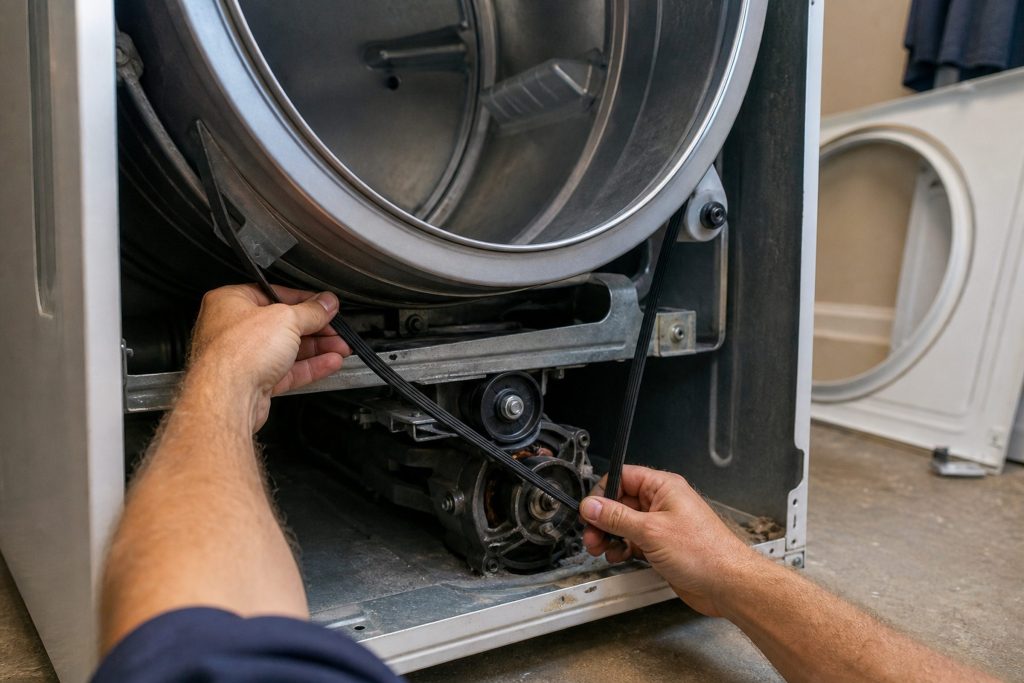
  • Drum rollers and the belt off a dryer. The two parts this page separates — a hum without rotation and a rumble with it — lying together, which is also how they are replaced.
    from $185

    Dryer drum belt and roller repair

    A drum that will not turn, or turns with a rumble that gets worse every week. Belt, idler, rollers and glides go in together on most cabinets because the strip-down is the job and the parts are inexpensive — coming back in a year for the roller that was left in is the expensive version. On the older machines this badge is known for, the rumble has usually been there long enough that the owner has stopped hearing it.

    • Belt, idler, rollers and glides together, because the strip-down is the job
    • A rumble that worsens weekly is rollers, not the motor
    • The drum seals are replaced while the machine is open
    What this involves
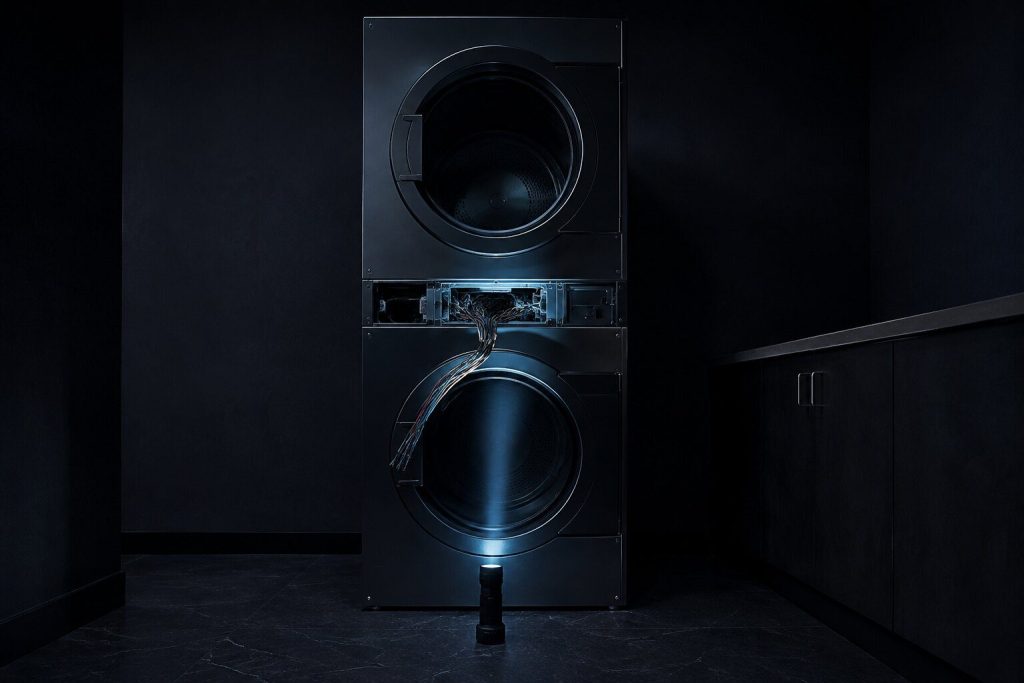
  • A tall stacked commercial dryer in a laundry room at night with the panel between its two drums removed and a loom of wiring drawn out of the gap, a torch standing on the floor throwing light upward.
    from $185

    Commercial dryer service

    The commercial-grade laundry dryer, which is a duty-cycle machine rather than a domestic one with a coin box bolted on. This maker publishes seventy-three pages for it and thirty-nine numbered conditions, so it usually says what has stopped — and in a building laundry that matters, because the machine is earning while it runs and costing while it does not.

    • A duty-cycle machine with its own published codes — 39 of them
    • Scheduled against downtime, not against a convenient window
    • The room is assessed as well: drainage, ventilation and level
    What this involves
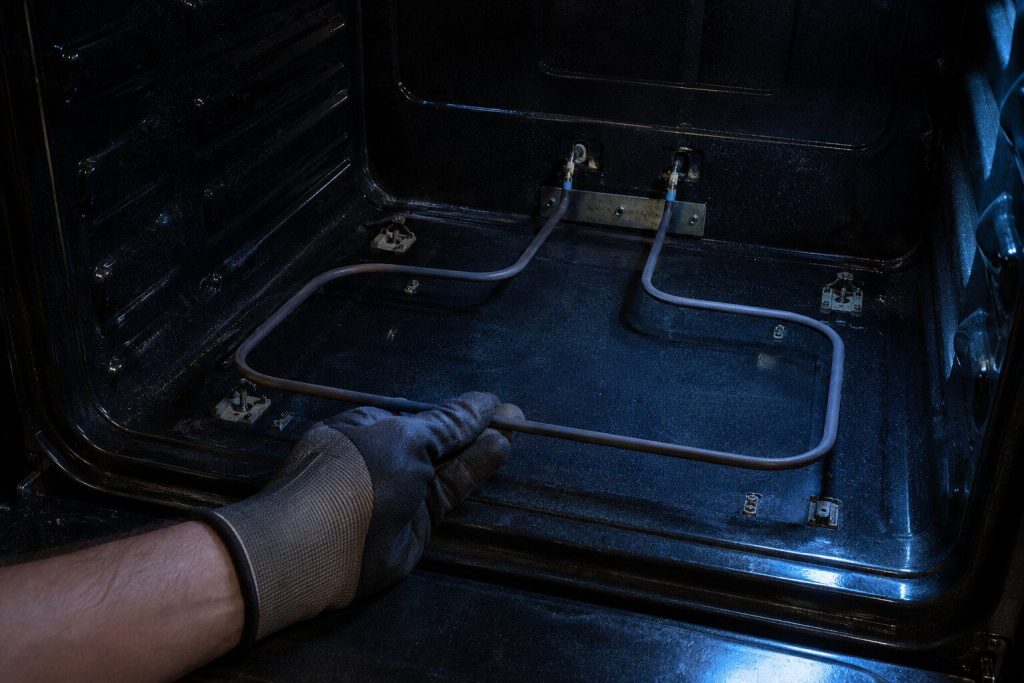
  • A bake element unbolted from the floor of an oven cavity and drawn forward a hand's width on its two leads, held in a gloved hand, the cavity dark behind and one work light raking in from the open door.
    from $155

    Oven not heating repair

    Cold, or heating to the wrong number, and the two are different jobs. This is the most documented appliance the maker builds — a hundred and seventy-five numbered pages out of two hundred and ninety-three on wall ovens — so the display usually names the subsystem before anybody arrives. On a wall oven the price carries the access as much as the part: a tall housing, a heavy cabinet and a run of joinery either side.

    • The display usually names the subsystem: photograph it before switching off
    • Consistently wrong and swinging wrong are different diagnoses
    • On a wall oven the access is most of the cost, so the code decides the first visit
    What this involves
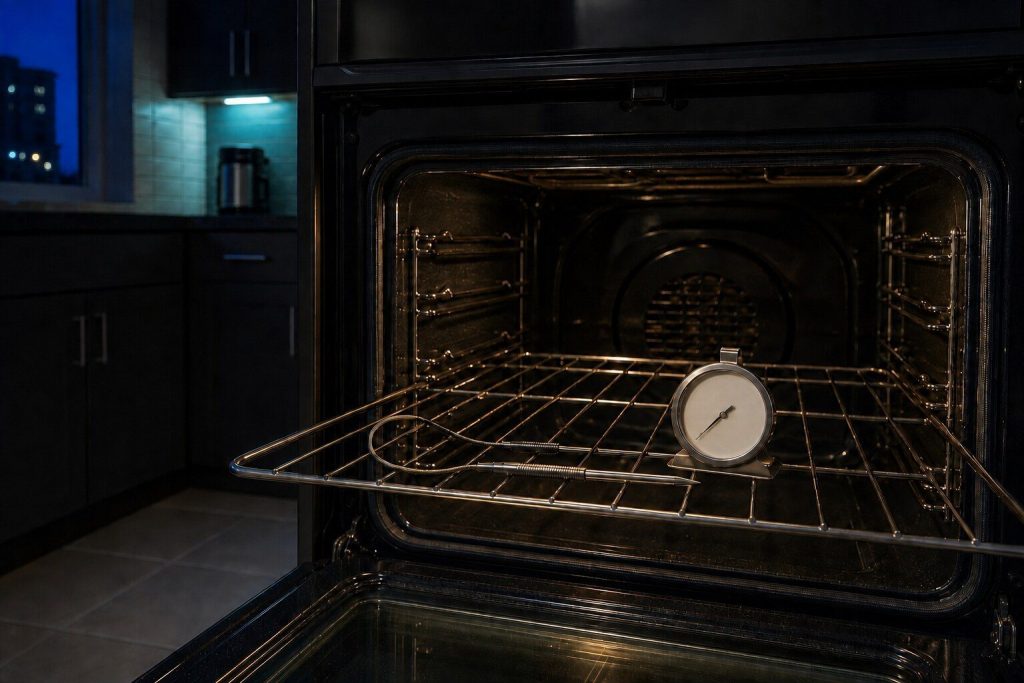
  • A slim oven temperature probe unclipped from the cavity wall and laid alongside a dial oven thermometer on the middle rack, the door open. The probe against an independent measurement, which is exactly how this service is proved.
    from $125

    Oven temperature sensor service

    The cheapest of the oven rows and the correct answer to an oven that is out by a consistent amount. A sensor drifts rather than fails — it reads a little low for a year and then a lot — so the complaint arrives as baking that has gone wrong rather than as an appliance that has stopped. It is measured against the maker's own resistance figure rather than replaced on suspicion.

    • The right answer when the oven is wrong by the same amount every time
    • Measured against the maker's own figure rather than swapped on suspicion
    • The connection behind the cavity is checked as carefully as the part
    What this involves
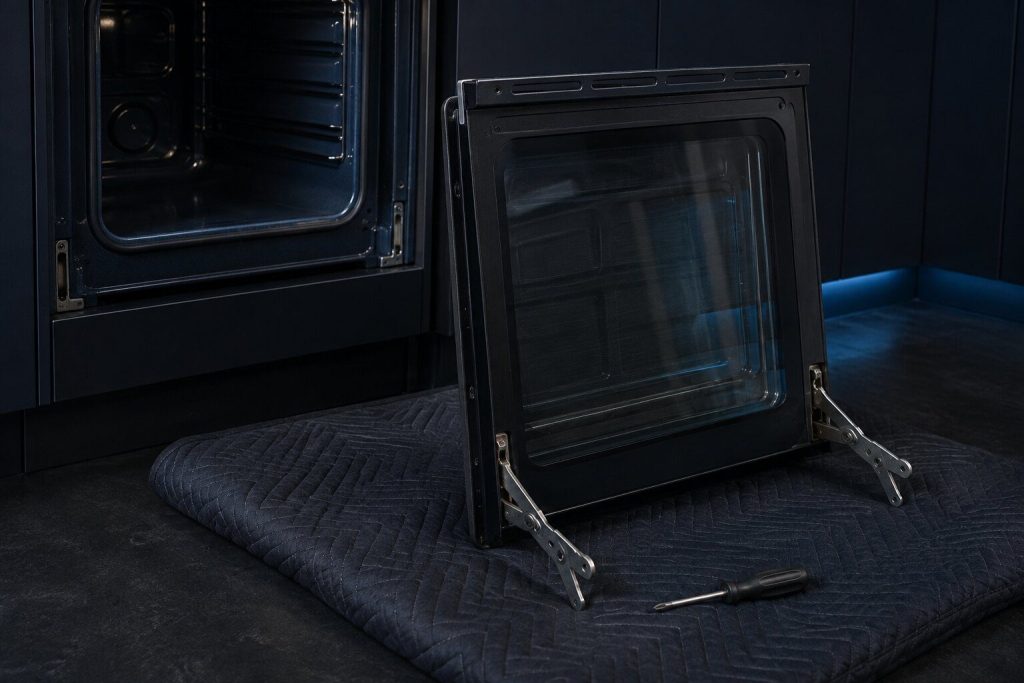
  • An oven door lifted off a range and stood upright against a padded blanket on a near-black floor, both hinge arms locked open and visible, the empty hinge slots in the oven frame behind it, a screwdriver lying on the blanket.
    from $175

    Oven door and hinge repair

    A door that will not close square, has dropped, or has fogged between its panes. On a double wall oven it is a two-person job and that is quoted openly rather than discovered on the day. A door out of true costs heat and evenness before it costs anything else, so an oven that has started browning on one side is worth checking here before the element is suspected.

    • A door out of true costs heat and evenness before anything else
    • Hinges go in as a pair, and the door is set to the cabinetry either side
    • On a double oven this is a two-person job and it is quoted as one
    What this involves
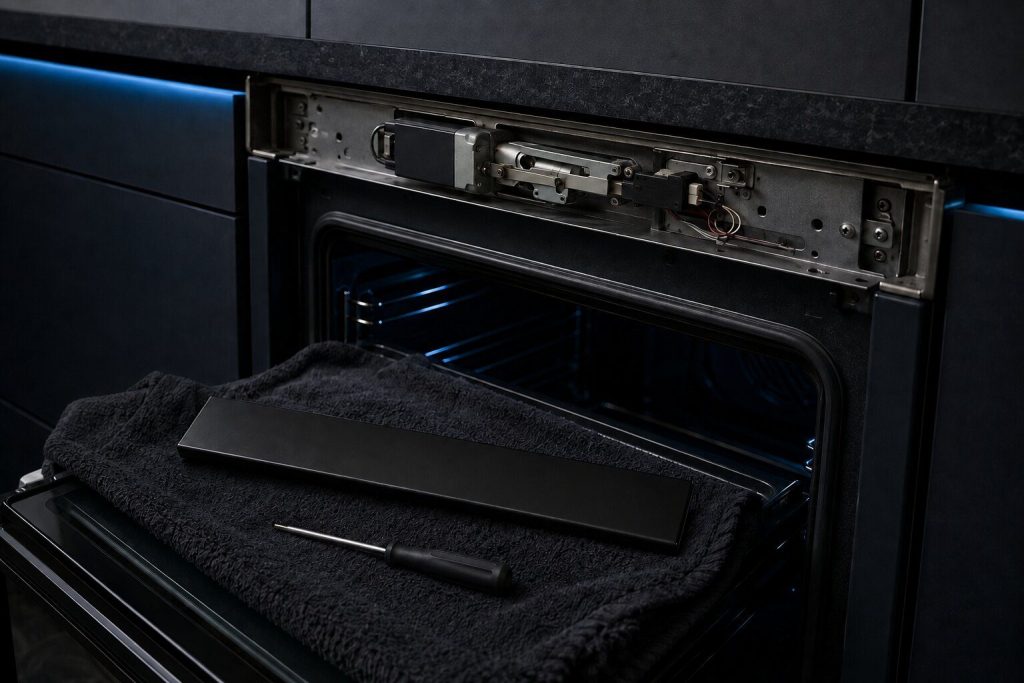
  • The top trim of an oven frame removed to expose the motorized door latch and its switch, the latch arm half across its keeper, a small screwdriver and the removed trim lying on a towel over the open door.
    from $155

    Self-clean and door lock repair

    The oven holds its door shut through a self-clean and releases as it cools. When it does not, that is the motorized latch, and it is a same-day call rather than something to live with — an oven you cannot open is a kitchen missing an appliance. The one thing not to do is run the cycle again: a stalled latch put through the same heat is how this gets more expensive.

    • A same-day job: an oven locked shut is a kitchen missing an appliance
    • Do not run the cycle again — that is how the latch gets worse
    • The reason the clean stopped early is found too, not just the latch
    What this involves
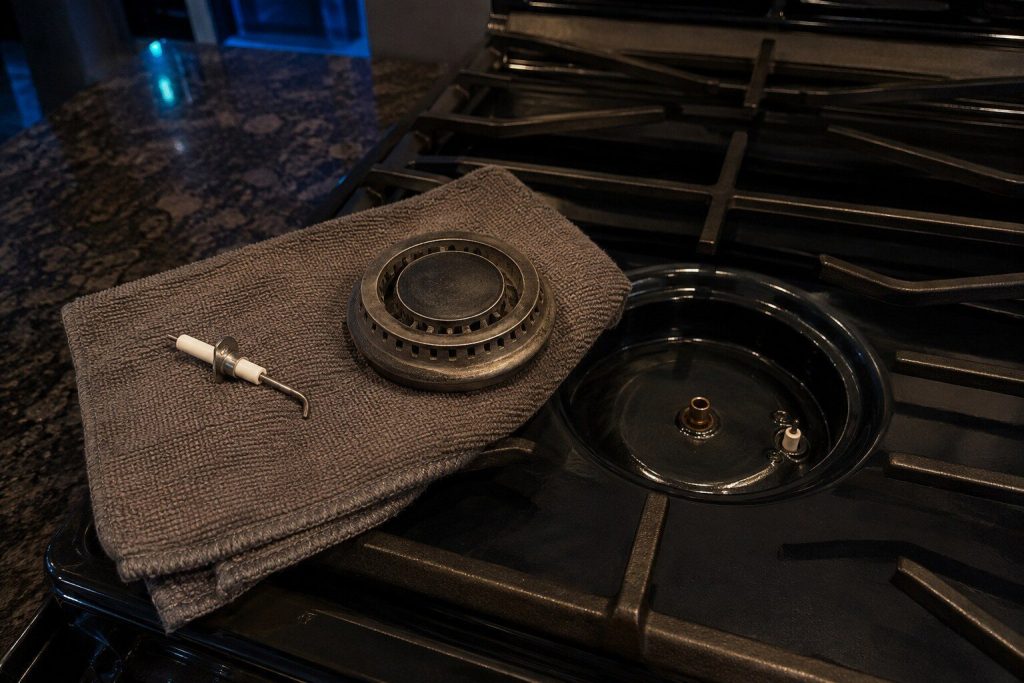
  • A spark igniter and a burner head lying apart on a folded towel on a cooktop, the empty burner base and its orifice beside them. The endless click is one of these two and the frame shows both.
    from $165

    Gas burner and igniter repair

    This maker publishes no numbered codes for gas surfaces at all — not one, on any cabinet — so the whole diagnosis is what the burner does. Whether it clicks, whether it lights and dies a few seconds later, whether it burns yellow, and whether it is one burner or all of them. Those four answers name the part between them, which is why a gas call here is a longer conversation on the phone than an electric one.

    • No published codes on gas: behavior is the entire diagnosis
    • A cap set back a fraction after a clean is free to correct and very common
    • Lighting and then dying is flame sensing, not ignition
    What this involves
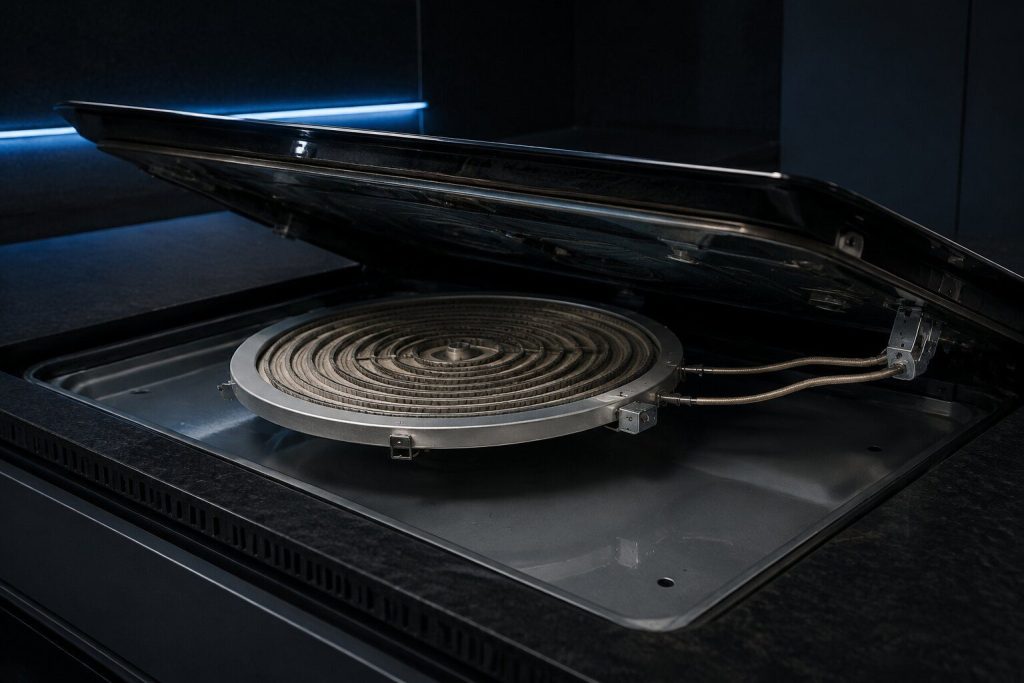
  • A flat radiant coil element unhooked from its bracket and lifted a few inches beneath a raised ceramic cooking top in a dark kitchen, its two leads stretched, the empty reflector pan below it.
    from $175

    Electric cooktop element repair

    The half of the cooking line that does report numbers — eighty-three numbered pages across a hundred and fourteen — so an electric surface will usually say something before anybody lifts the glass. Most of what it says points at an element, a switch or the control underneath, and the awkward part is not the diagnosis but the top: the glass comes up, and it goes back onto seals and clamps that must not be over-tightened.

    • 83 numbered pages behind this surface — it usually reports something
    • The glass comes up and goes back on seals that are not over-tightened
    • A zone switching itself off is usually the protection working, not a part
    What this involves
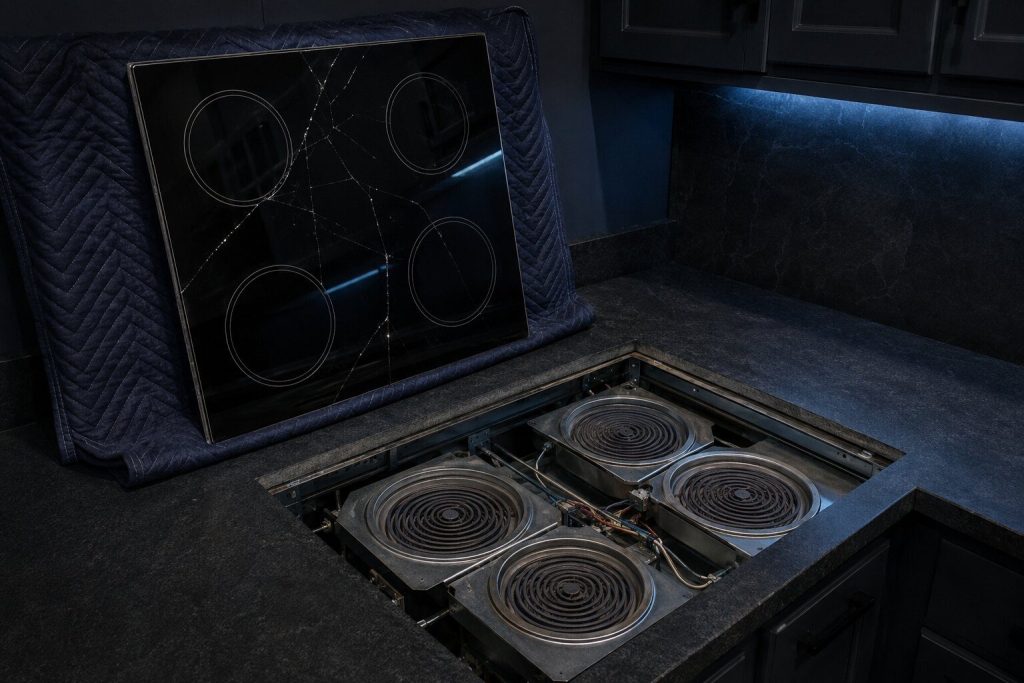
  • A cracked smooth black ceramic cooking top lifted clear of its counter opening and turned on edge against a padded blanket, the empty frame below showing flat radiant coil elements in their reflector pans.
    from $265

    Cooktop glass replacement

    The one repair on this site where we ask you to stop using the appliance now. That sheet of glass is what keeps a spill off the electronics beneath it, and a crack that reaches an edge is an open path from the hob to the live half of the machine. Thermal shock causes most of them; a top clamped a fraction too tight at installation causes the rest, and a new panel fitted into the same over-tight opening is a repair with a date on it.

    • Stop using it today: a crack to the edge is a path for liquid into the electronics
    • Thermal shock and over-tight clamping cause most of them
    • The fitting is corrected with the glass, or the new panel goes the same way
    What this involves
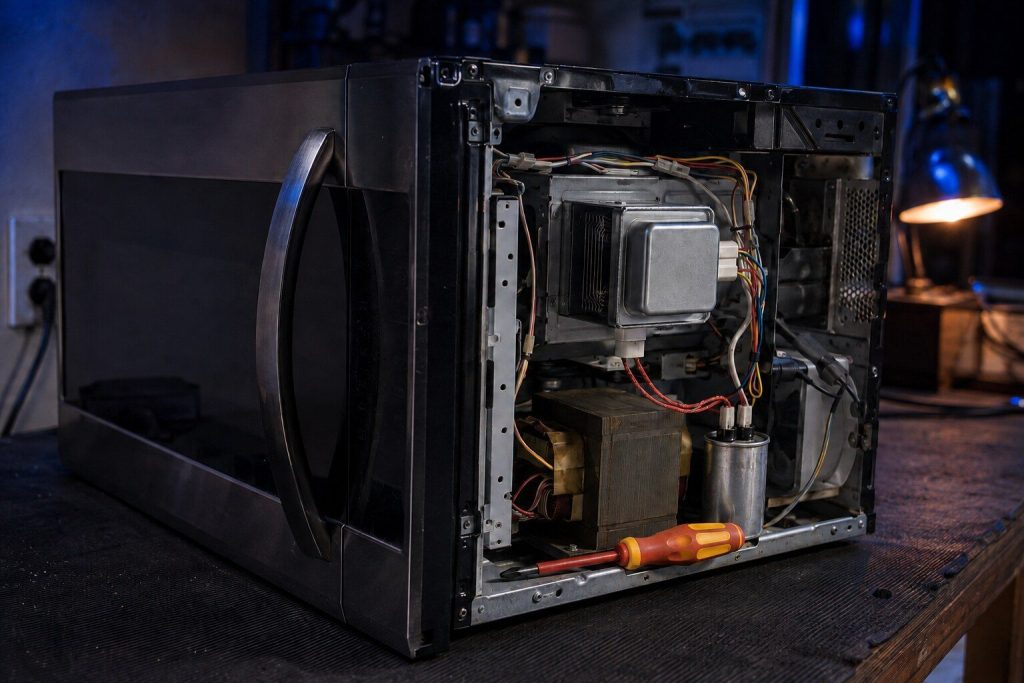
  • The side cover of an over-the-range microwave off on a bench showing the magnetron block, the capacitor and the transformer, an insulated screwdriver laid by. The capacitor is the reason this page tells owners to stop, and it is in the frame.
    from $165

    Microwave repair

    Sixty-seven of this maker's seventy-six microwave code pages belong to the over-the-range machine, which is the one worth repairing. It is fitted, wired, often ducted, and it carries the ventilation for the range beneath it — so replacing one is a carpentry job on top of an appliance one and the repair usually wins. On a countertop machine the arithmetic runs the other way and we say so on the phone rather than after a visit.

    • Over-the-range machines: fitted, ducted, and the hood as well
    • On a countertop machine we will usually tell you not to bother
    • The high-voltage side is the last thing opened, not the first
    What this involves
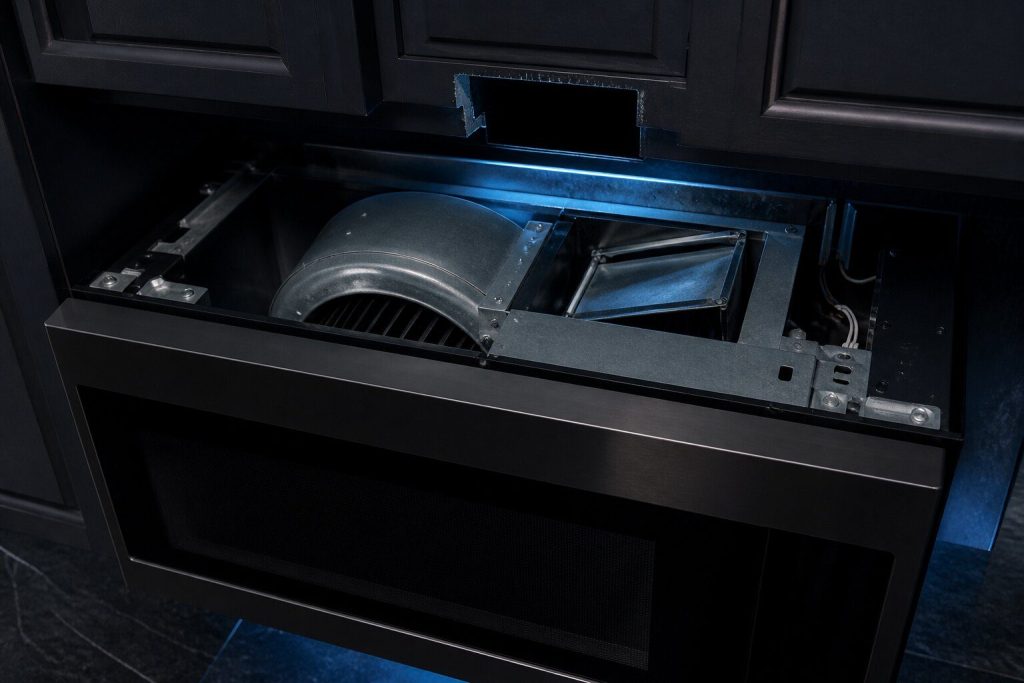
  • The top cover removed from an over-the-range microwave still on its mounting, the squirrel cage blower and its vent flap visible inside from above with the flap turned to the other setting, the duct opening in the cabinet above it.
    from $145

    Over-the-range microwave vent service

    On most Maytag kitchens this appliance is the hood, which is why it gets a row of its own. Blower, damper, grease filters and — on a recirculating installation — the charcoal filter that nobody is told is a consumable. Most of the calls that arrive as smoke in the kitchen are about this half of the machine rather than the cooking half, and most of them are cheaper than the owner expects.

    • This is the hood on most kitchens with this badge in them
    • Grease filters and the charcoal filter first — both are consumables
    • A fan that starts by itself is usually the appliance working correctly
    What this involves
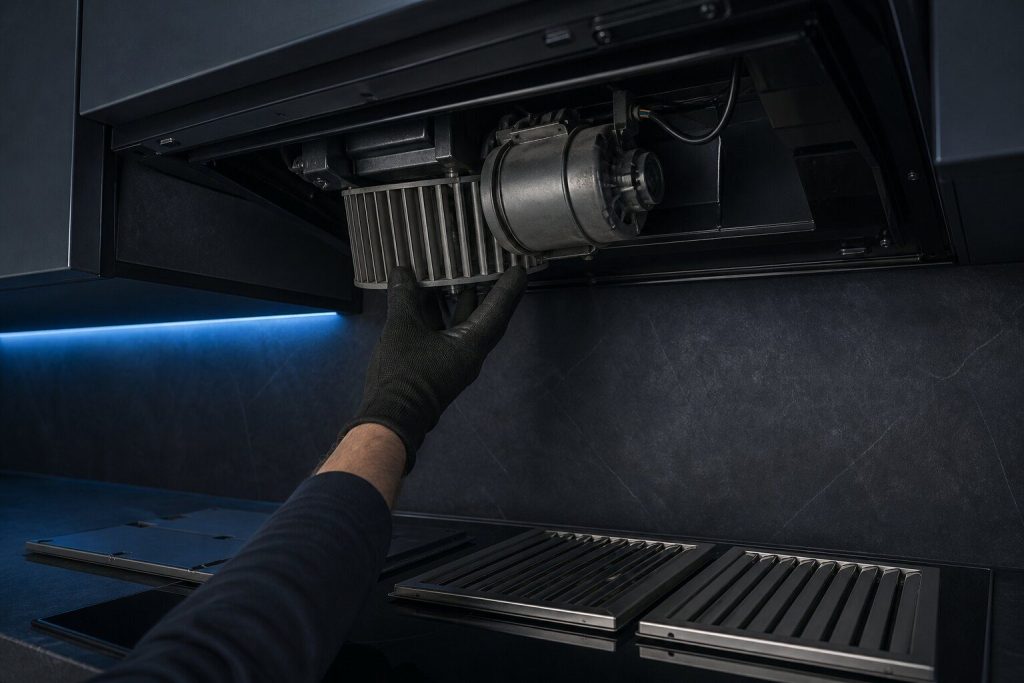
  • The underside of a wall-mounted hood with its cover and baffle filters taken out and laid on the cooktop below, the blower housing and its motor exposed inside the canopy, a gloved hand supporting the wheel.
    from $145

    Range hood repair

    Three published conditions across forty-three pages, so this is diagnosis rather than reading. The failures are ordinary and mostly mechanical — motor, capacitor, switch, lamps and the duct — and the first question is which appliance is actually over your cooktop, because on this make it is more often the microwave doing hood duty than a hood.

    • 43 pages and three published conditions: nothing to read, so it is measured
    • The first question is which appliance is actually over the cooktop
    • A recirculating hood with a spent charcoal filter is not a repair
    What this involves

Where this badge is deepest

The laundry room, and it is not close

This maker publishes 105 numbered conditions for its washers and 48 for its dryers — and its own support base splits them further, 183 pages on the front-load machine and 162 on the top-load. Nothing else on the badge comes near it. That is why 16 of the jobs on this list are laundry jobs rather than the four or five a kitchen-led make would carry, and it is why a washer complaint here usually arrives with a code already attached to it.

It also reflects what is actually in the buildings. A laundry closet behind a louvered door, a stacked pair in a hallway, a machine that came with the condo and has outlived two owners — that is the ordinary case on this coast, and it is a machine worth repairing rather than one worth arguing about.
Washer and dryer work
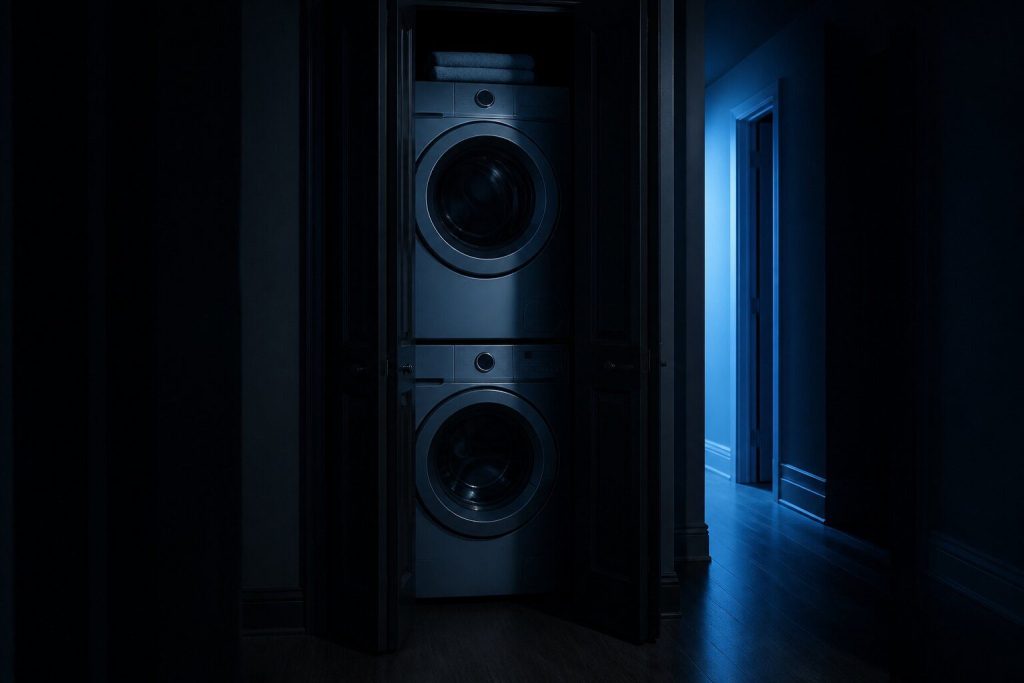
A laundry closet behind half-open bifold doors in a dark hallway, a stacked washer and dryer inside, a folded towel on top and one cold light from the room beyond

The other half of the list

Commercial machines, on purpose

This is the badge you find in a coin laundry, in a condominium laundry room and in the back of a small business, and the list carries jobs for them rather than pretending every call comes from a kitchen. A commercial dryer run twenty hours a day is not a domestic dryer used harder; it has a different duty cycle, a different vent load and a different definition of an acceptable amount of downtime.

If the machine you are calling about earns money while it runs, say so when you book. It changes what we bring and it changes how we schedule, and neither of those is something we would rather work out at the door.

Commercial work
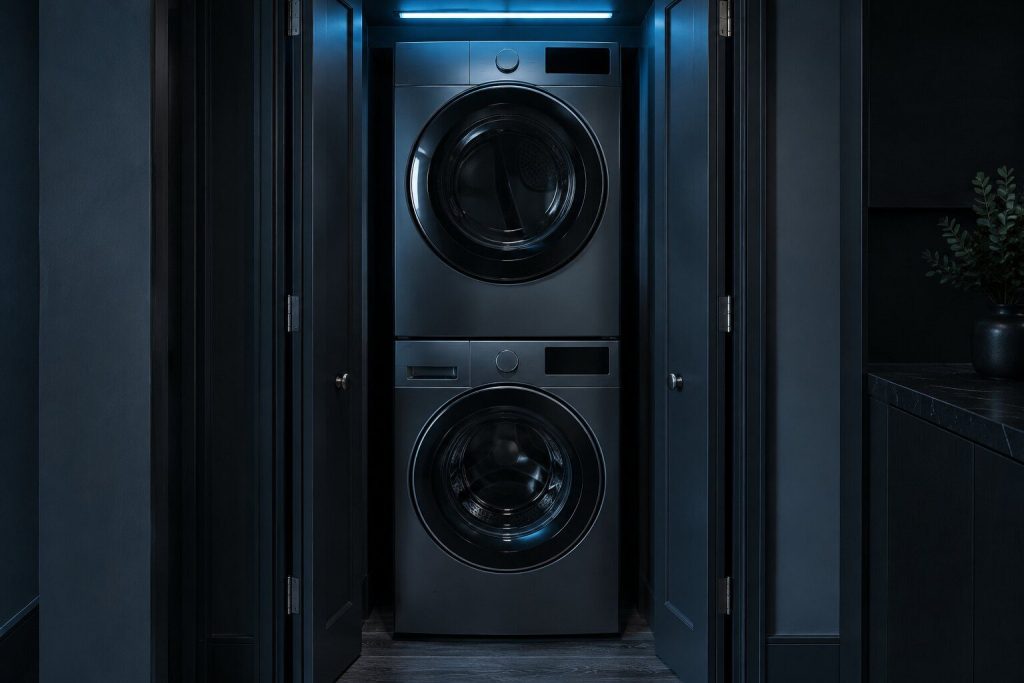
A tall stacked laundry pair filling a narrow closet from wall to wall, both doors closed, seen straight on with the folding doors open

Before you book

Two things that shorten the visit

The model number, off the machine

  • Top-load washers: under the lid, on the rim of the opening.
  • Front-load washers and dryers: inside the door opening, or on the back panel.
  • Refrigerators: on the inside wall of the fresh food side, usually near the crisper.
  • Ranges and wall ovens: on the frame behind the storage drawer, or on the door frame.

What the machine is showing

  • Copy the display exactly, including any space or dash between the characters.
  • Photograph it. A display alternating between halves of a report is easier to read back from a photograph than from memory.
  • If it blinks rather than prints, count the flashes and the pause before you reset it.
  • Say which appliance it is on — the same characters mean different things on a washer and a range.

Or start from the machine

Every appliance we take on this badge

Eleven types, each with what typically goes wrong on it and what the repair usually involves.

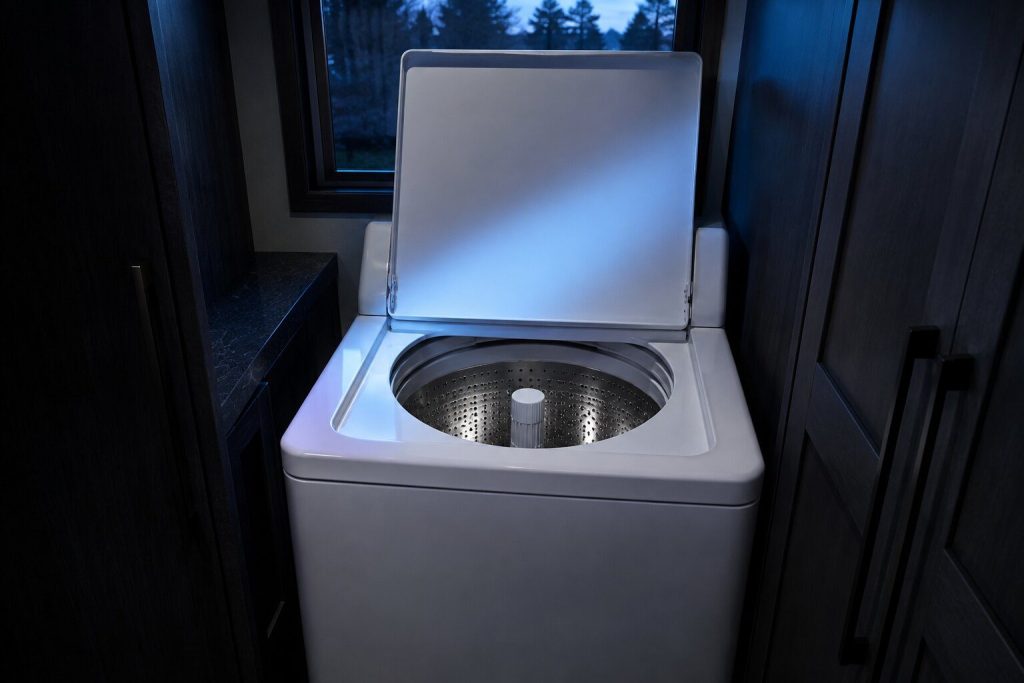
  • A white top-load washing machine standing in a narrow laundry closet at dusk with its lid raised, an empty stainless basket below and a tall finned center agitator post rising from the middle of it.
    Top load · front load · commercial-grade residential

    Washers

    This is the deepest branch of Maytag's own support base and the oldest thing the badge does — the company has been building washing machines since 1907. 479 pages, and 158 of them are code pages: 86 on the top-load machine, 62 on the front-load. That is more numbered diagnosis than the whole refrigeration half of the catalog gets, and it changes how a washer call starts. On most makes we ask what the machine is doing; here we ask what it is showing, because it will usually be showing something. The top-loader is the one Maytag is bought for and the one that outlives its kitchen — which is also why so many of the machines we open here are older than the room around them.

    • Top-load, front-load and commercial-grade residential machines
    • 86 code pages on top load, 62 on front load — the make's most documented appliance
    • Older machines are normal here: the badge is bought to be kept
    Washer repair
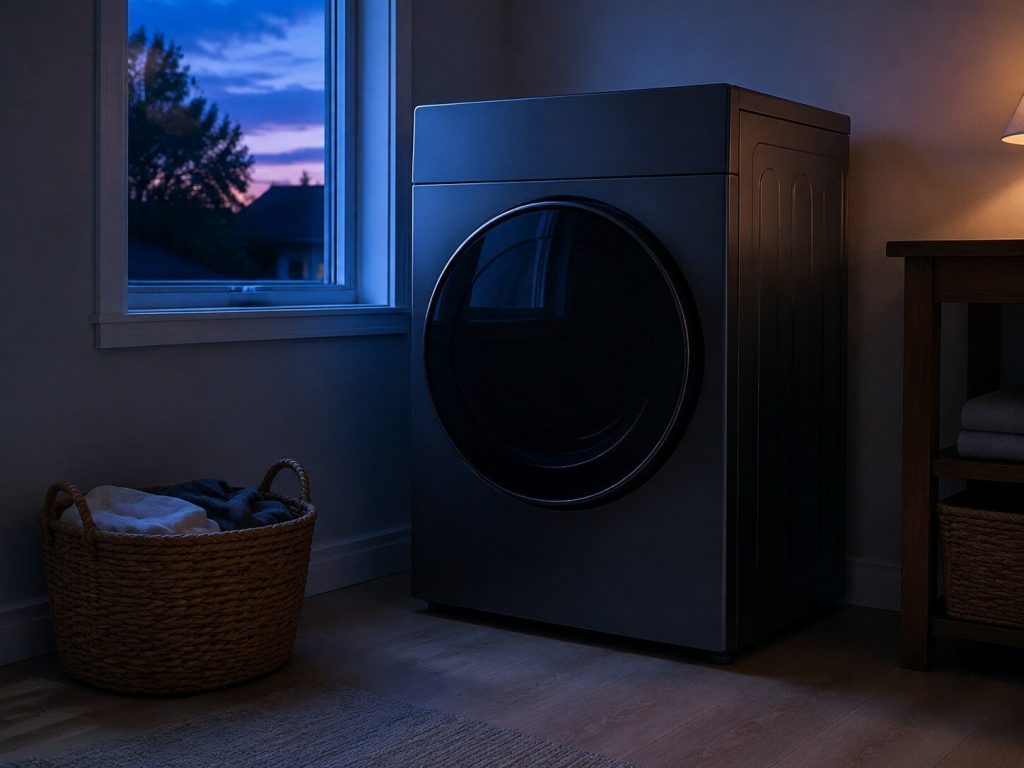
  • A front-load dryer beside a small laundry-room window at dusk, blue light across its flat front
    Electric and gas · vented · commercial-grade residential

    Dryers

    189 pages and 56 of them numbered, plus a commercial branch of 73 pages with 39 more. Every dryer under this badge is a vented machine — there is no heat-pump model and no compact one, which is a real difference from the sister brands in the same corporation and it decides the whole diagnosis. A vented dryer lives or dies by the duct behind it, and in South Florida that duct is more often long and horizontal than short and vertical, and it carries air that arrived with plenty of moisture of its own. So a dryer here gets slower every season until somebody finally counts the cycles, and the machine at that point is usually fine.

    • Vented electric and gas dryers, and the commercial-grade residential machines
    • 56 code pages, and 39 more on the commercial dryer
    • No heat-pump and no compact model — the duct is the diagnosis
    Dryer repair
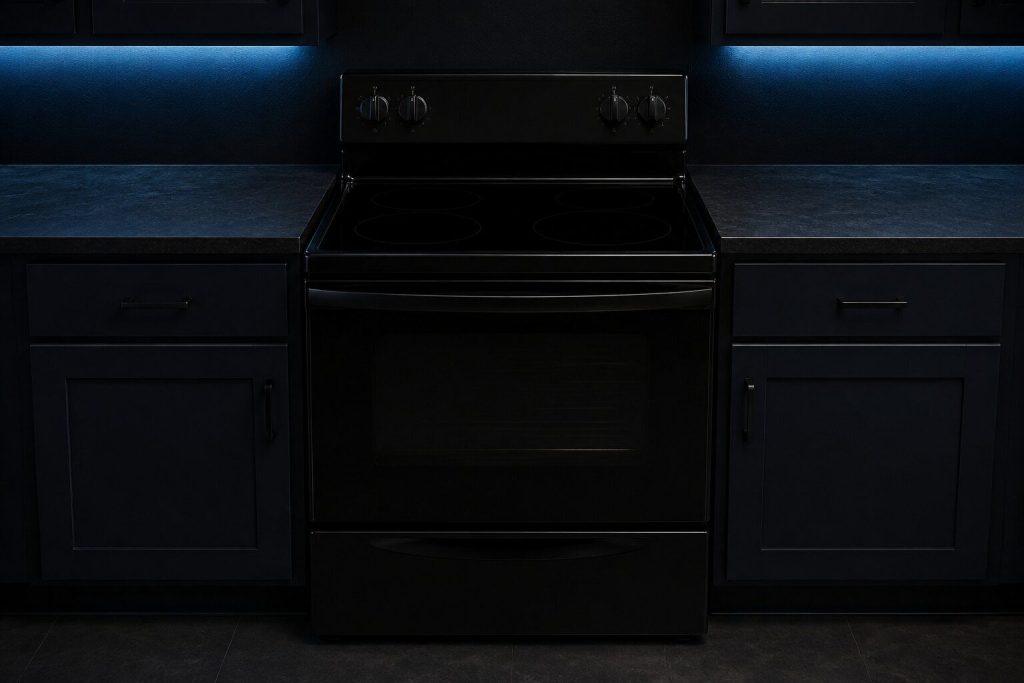
  • A freestanding electric range standing between two runs of dark base cabinets in a near-black kitchen at night, its smooth black ceramic top empty and unlit, the oven door closed, a plain back console with unreadable knobs.
    Freestanding, slide-in and drop-in · gas or electric

    Ranges

    355 pages, 170 of them numbered — the second most documented appliance this make builds, and the one most likely to tell you what is wrong before anybody arrives. A range is also the appliance where the two halves of a Maytag kitchen meet: the oven cavity below, which this make documents heavily, and the surface on top, which it documents unevenly. An electric surface has 83 code pages behind it. A gas surface has none at all, on this make, in this base — so a gas range call is a longer conversation on the phone by necessity rather than by preference.

    • Freestanding and slide-in ranges, gas and electric
    • 170 code pages — the oven half of the machine is heavily documented
    • Gas surfaces publish no codes at all: what the burner does is the whole diagnosis
    Range repair
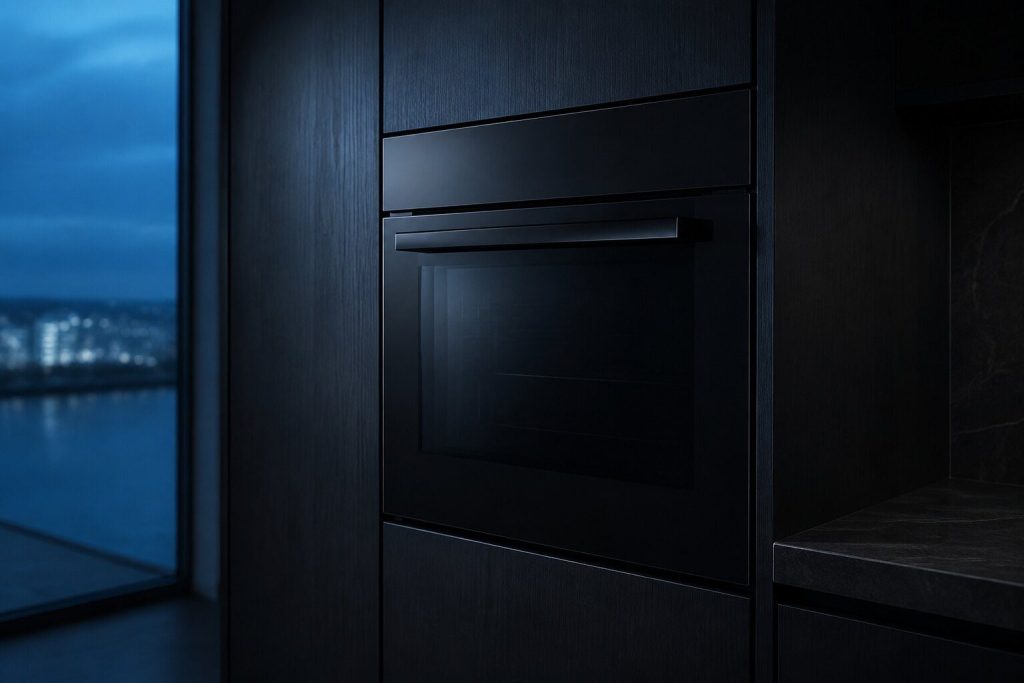
  • A single built-in wall oven set at chest height into a tall column of near-black cabinetry, door closed, plain handle, the glass dark and the fascia unreadable.
    Single and double wall ovens · built into the cabinetry

    Wall ovens

    175 code pages out of 293 — proportionally the most documented appliance in this catalog, and the one where the display is most likely to have already done the diagnosis. A wall oven is also the appliance where getting to the part costs more than the part: it is built into a tall housing, it is heavy, and on a double oven it is heavier still. So the visit is planned differently. We want the code and the model before the van is loaded, because a wall oven pulled out twice is a wall oven pulled out once too often.

    • Single and double wall ovens, built into a run of cabinetry
    • 175 code pages of 293 — the most numbered appliance this make publishes
    • Access is the expensive half: the code decides what comes on the first visit
    Wall oven repair
  • A smooth black ceramic cooktop set into a dark stone counter, photographed from above and slightly to the side in a near-black kitchen, two radiant coil zones glowing dull orange beneath the glass and the other two dark.
    Electric radiant and gas · no induction in this catalog

    Cooktops

    211 pages, and the split inside them is the story: 83 code pages on the electric surface and zero on the gas one. There is no induction cooktop under this badge at all — that is a sister brand's product, not this one's — so a Maytag surface is radiant electric or it is gas, and which it is decides whether the appliance can tell you anything. The electric top talks. The gas top does not, and never has, so the diagnosis is what the burner does and how it does it.

    • Radiant electric and gas surfaces — no induction in this catalog
    • 83 code pages on electric, none at all on gas
    • A cracked glass surface is the one thing here we ask you to stop using immediately
    Cooktop repair
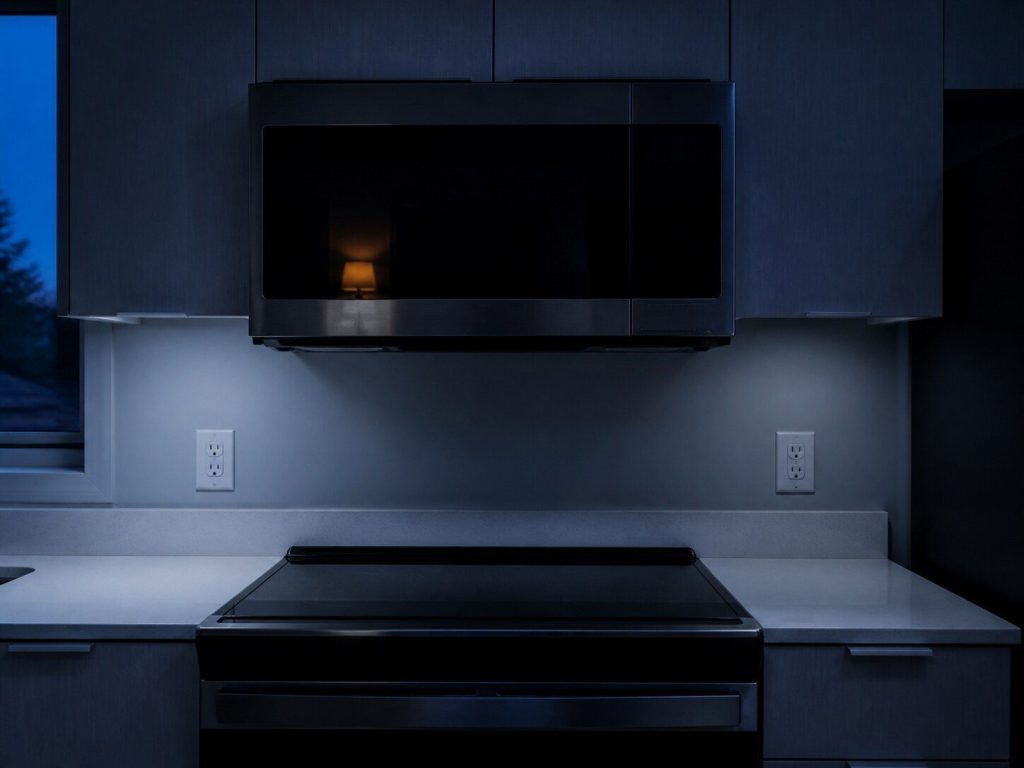
  • An over-the-range microwave mounted above a cooktop in a dark kitchen at night
    Over-the-range and countertop · no built-in in this catalog

    Microwaves

    235 pages and 76 code pages, and they are not spread evenly: 67 of them belong to the over-the-range machine and 9 to the countertop one. That matches what these appliances actually are. An over-the-range microwave is also the kitchen's hood — it carries a fan, a damper, a light and a duct — so it fails in ways a countertop machine cannot, and this make documents it accordingly. There is no built-in microwave in this catalog: that branch belongs to a sister brand, and on that sister's own base every page of it now answers 404.

    • Over-the-range machines, which are also the hood, and countertop machines
    • 67 code pages on over-the-range, 9 on countertop
    • No built-in microwave under this badge
    Microwave repair
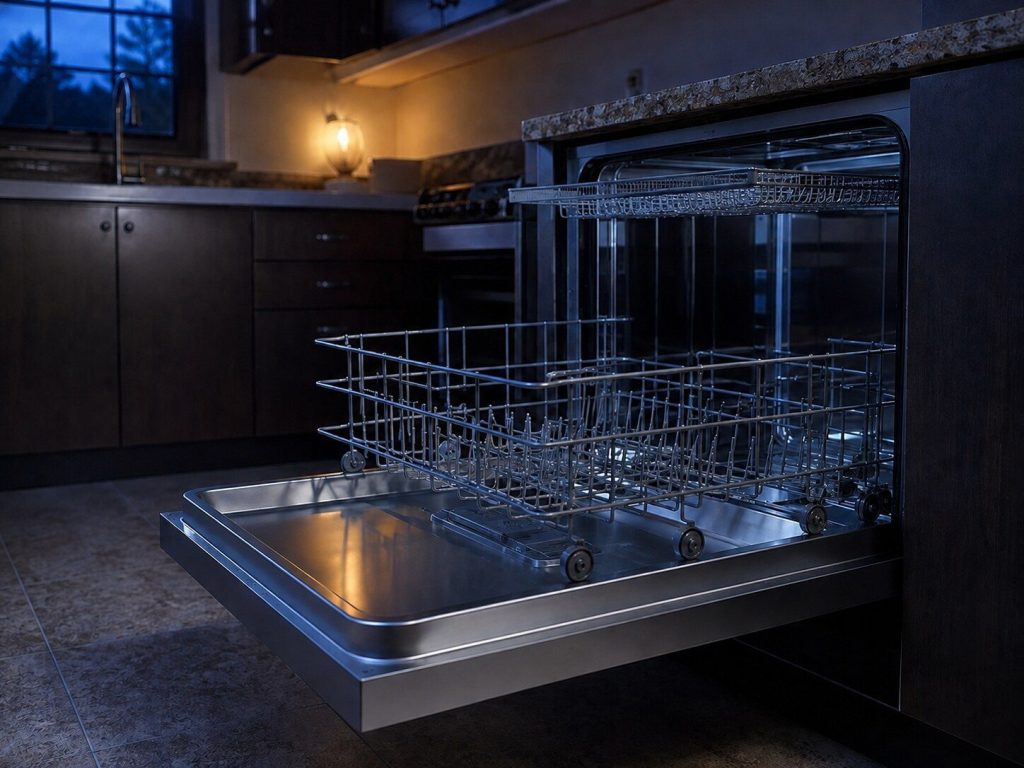
  • A dishwasher door open to horizontal in a dark kitchen with the lower rack halfway out, a plain stainless front in a dark cabinet run
    Front control and top control · stainless and plastic tubs

    Dishwashers

    296 pages with 42 numbered conditions, and a code branch of its own — 38 of those 42 sit under a single heading the make calls Error Code or Flashing Lights. That last phrase is the useful part: on a machine with no digital display the diagnosis is a pattern of blinking lights, and the pattern is the whole message. It disappears the moment the power is cut, which is why we ask what the lights were doing before anybody reached for the breaker.

    • Front-control and top-control machines, stainless and plastic tubs
    • 42 code pages, 38 of them under one Error Code or Flashing Lights heading
    • On a machine with no display, the blinking pattern IS the code
    Dishwasher repair
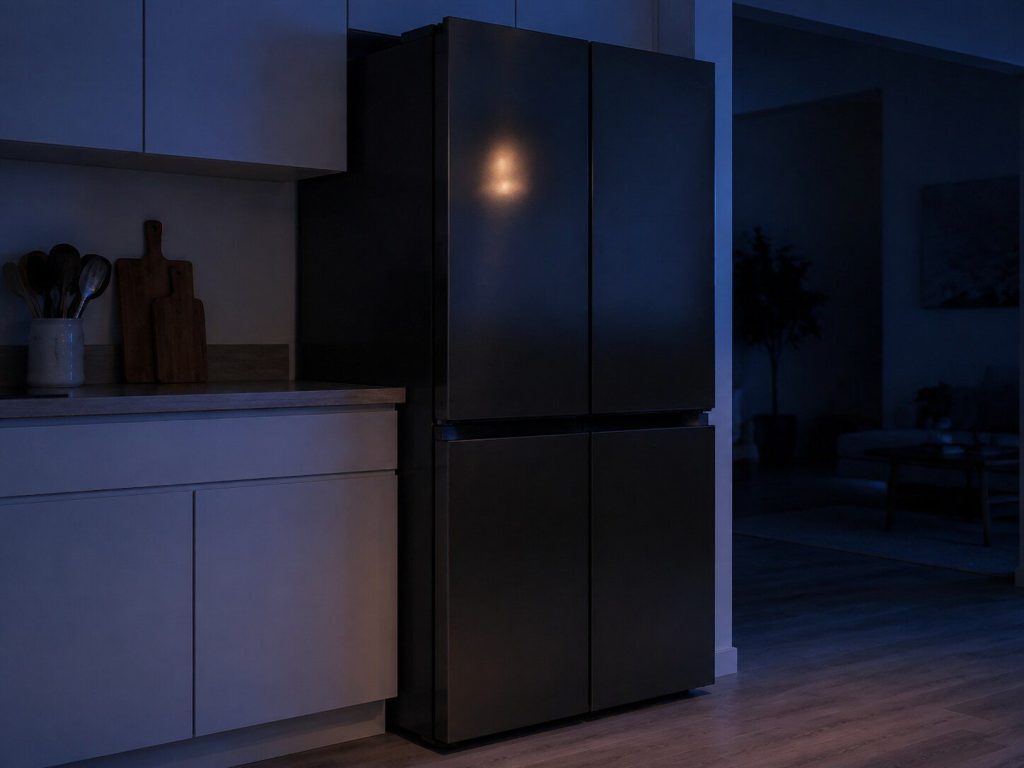
  • A tall four-door French door refrigerator standing flush at the end of a run of slab-front cabinets in an evening kitchen
    French door · side-by-side · top freezer

    Refrigerators

    Five hundred and nine pages in the maker's own base, and twenty-six of them numbered. Hold those two figures next to the seventy-five percent of wall-oven pages that carry a code and you have the whole character of this make in one comparison. Cold is where it stops explaining itself: seventeen numbered pages behind the French door cabinet, nine behind side-by-side, and on the top-freezer cabinet — eighty-four pages of guidance — not one. A visit here is therefore an hour with instruments rather than ten minutes with a panel, and that is worth knowing before you book. There is no quad-door cabinet and no all-refrigerator under this badge; both belong to a sister brand.

    • French door, side-by-side and top-freezer cabinets
    • Seventeen numbered pages on French door, nine on side-by-side, none on top freezer
    • Instruments rather than a panel: this half of the catalog explains very little
    Refrigerator repair
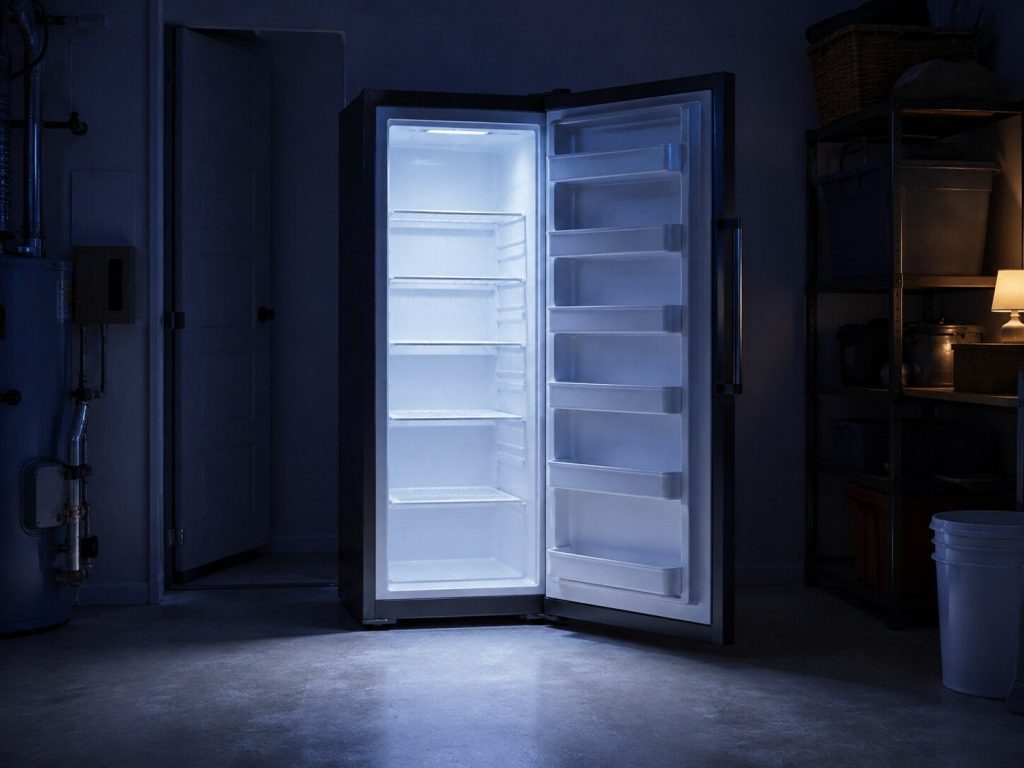
  • A tall single-door upright freezer standing against a utility-room wall with its door open on empty shelves
    Upright · chest · convertible chest

    Freezers

    184 pages in the maker's base and **not one numbered code** — upright, chest and convertible chest alike. A freezer under this badge is a deliberately simple machine and it is diagnosed the way simple machines are: by temperature, by airflow, by the seal, and by where it stands. That last one matters more here than anywhere. Most of the freezers we open in South Florida are in a garage or a utility room that reaches a hundred degrees by afternoon, and an ordinary cabinet asked to hold zero in that ambient is working far outside what its specification assumed. Garage-ready is a specification with a number behind it, not a slogan.

    • Upright, chest and convertible chest freezers
    • No published codes at all — 184 pages of plain guidance
    • Where it stands is half the diagnosis: a hot garage is a different machine
    Freezer repair
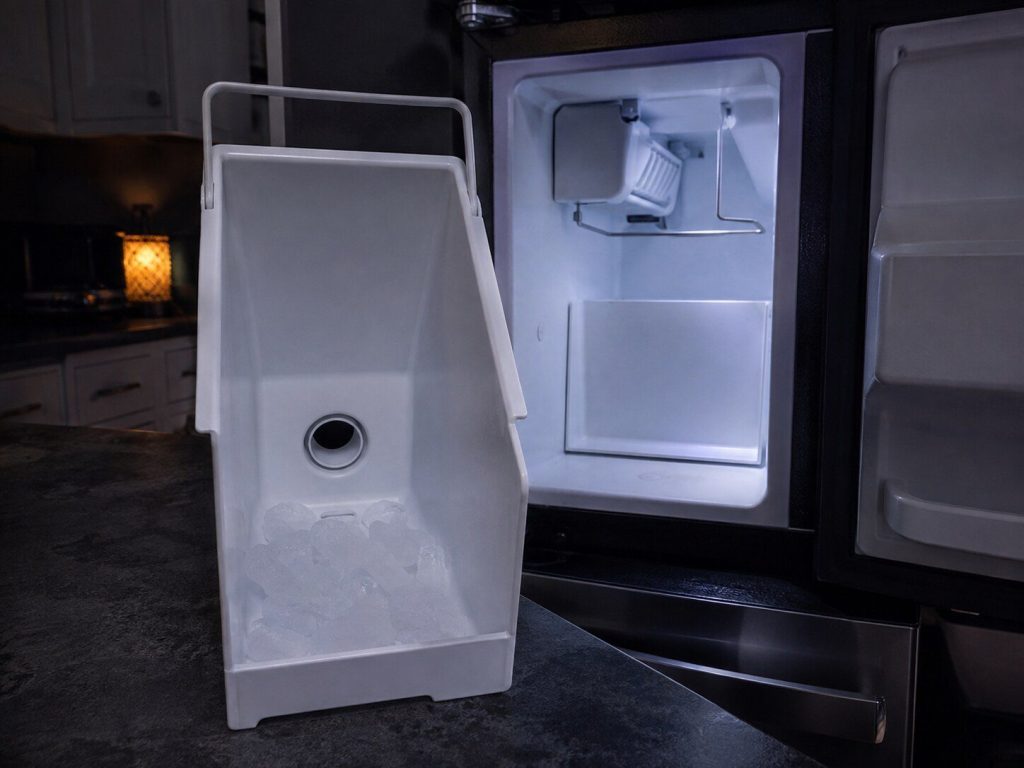
  • The ice storage bin lifted out of a refrigerator with the empty ice compartment behind it
    The ice maker inside the refrigerator — in the door or in the freezer

    Ice makers

    Maytag builds no ice machine of its own, and this page is honest about that instead of describing a sister brand's product. Every one of the 120 ice pages in the maker's base is filed under a refrigerator, beneath headings it calls Ice and Water Concerns and Ice Production, and not one of them carries a number. So there is nothing here to read off a panel. What there is, in a city that gets through ice the way this one does, is a module that spends August at the edge of what it was specified to do — and a short list of reasons it falls off that edge, most of which are about the supply rather than the module.

    • The refrigerator's own ice maker, in the door or in the freezer compartment
    • No ice machine under this badge, and no published codes for ice at all
    • The usual answer is upstream of the module: filter, line, valve, pressure
    Ice maker repair
  • A wall-mounted stainless chimney hood above an empty cooktop, seen from below along its underside and flue
    Under-cabinet and wall-mount · ducted or recirculating

    Range hoods

    The smallest branch in this catalog — 43 pages and three numbered conditions — and the appliance most likely to be the microwave above the range rather than a hood at all. On this make the over-the-range microwave carries the ventilation for most kitchens, so a hood call here begins by establishing which appliance is actually over the cooktop. Where there is a dedicated hood, the failures are ordinary and mostly mechanical: the fan motor, the switch, the light, the damper and the duct behind it.

    • Wall-mount and under-cabinet hoods, ducted and recirculating
    • 43 pages and three published conditions — the least documented appliance here
    • On most Maytag kitchens the over-the-range microwave IS the hood
    Range hood repair

Worth saying

This list is not the limit of what we repair

It is the list of jobs common enough to be worth a page of their own. If what your machine is doing is not on it, that is a gap in our writing rather than a gap in our work — call and describe it. The only things we genuinely do not take on are water heaters, air conditioning and anything outside the kitchen and the laundry room, which are separate trades with separate licensing.

Before you book

The questions this list gets asked

Is the diagnostic fee credited if I go ahead?

Yes. It covers the visit and the diagnosis, and it comes off the repair when you approve the work. If you decide not to go ahead you have paid for a proper answer and a written figure, which is worth having either way.

Do you carry parts on the van?

For this badge, more than for most. The drain pumps, lid locks, door switches, rollers, belts and igniters that make up the bulk of this list are commodity parts, and that is the practical reason a Maytag repair closes on the first visit more often than a specialist badge does.

Do you work on commercial machines?

Yes, and there are jobs on this list written specifically for them. Tell us when you book that the machine is in service rather than in a house, because the scheduling and the parts both change.

How is the figure on each card worked out?

It is the floor for that job in this region — the point below which the work cannot be done properly. Each job's own page sets out what moves it upward, and nothing is committed to until somebody has looked at the machine.

In more detail

What this badge is, and what it changes about a repair

Bought to be kept

Every make occupies a position, and this one’s is durability rather than novelty. It is not the badge on the most expensive kitchen in the building; it is the badge somebody chose fifteen years ago expecting not to think about it again, and a good share of the machines we see have delivered exactly that. What follows from it is practical: the parts are common, a technician has seen the same assembly this month, and a repair on a ten-year-old machine is usually the sensible choice rather than a sentimental one.

Where that stops being true

It stops at the large repairs on the oldest machines — a basket bearing, a sealed system — and we will say so plainly when it does. An honest conversation about whether a fifteen-year-old washer is worth a bearing job is more use to you than a quote, and it is the conversation we would want on the other side of the door.

Tell us the appliance and the model number.

With those two we can usually say what is likely before anybody sets off, and bring the part rather than come back for it.

This article is based on:

  • Official manufacturer documentation
  • Internal repair procedures
  • Technician repair history
  • Company quality standards
Call (305) 853-8839