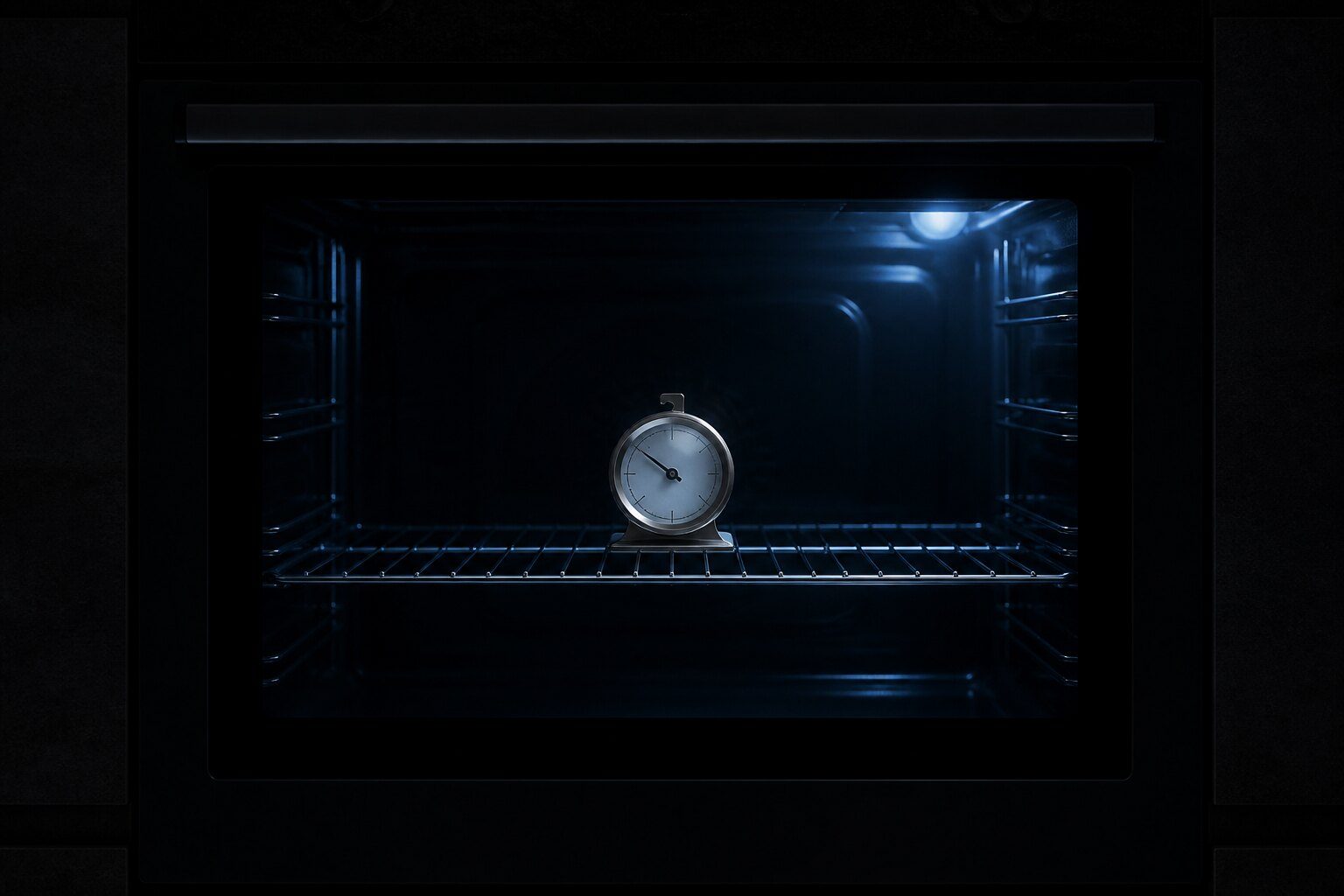
- “Measure it before you judge it — an oven thermometer settles the argument in half an hour”
- “These ovens have an owner-adjustable calibration and it is a menu item, not a repair”
- “A large and steady error is a sensor; a wandering one is a control”
Symptom
Maytag oven runs hot or cold
An oven that heats but heats wrongly is the hardest complaint to describe and the easiest to measure. Before anything is called a repair, it is worth finding out whether the oven is actually wrong and by how much, because ovens drift over years and this one may only need telling.
- From $89 diagnostic, credited to the repair
- 59 cities and neighborhoods covered
- OEM parts available on order
- In writing the price, before anything is opened
Five ordinary causes
What this usually turns out to be
Cheapest and commonest first, which is also the order we check them in. They sit hundreds of dollars apart, and only the unit settles which one is yours.
-
Calibration drift
The oven is steadily out by twenty-five or so. There is an owner adjustment in the settings and no part is involved.
Oven temperature sensor service from $125 -
The temperature sensor
Reading high or low by a consistent amount. Small part, quick fitting, and it is the usual answer to a large steady error.
Oven temperature sensor service from $125 -
A door that no longer seals
Heat leaves at the top of the door and the oven works harder without ever getting there. Usually with a hinge that has dropped or a gasket that has hardened.
Oven door and hinge repair from $175 -
A weak element
It heats, just not enough, so the oven takes an age and runs below the setting. It shows up as long preheats before it shows up as bad baking.
Oven not heating repair from $155 -
The control
Least common. It is what is left when a steady, measurable error survives calibration and a new sensor.
Appliance control board repair from $265
In five minutes
Before you call anybody
None of it needs tools, and all of it makes the visit shorter.
-
01
Use a real thermometer
Not the display and not the chime. A five-dollar oven thermometer is the whole test.
-
02
Wait thirty minutes
Read after the oven has settled, not when it first beeps. Preheat overshoot fools everybody.
-
03
Take several readings
Steady error and wandering error are different repairs and only repeat readings tell them apart.
-
04
Check the door closes tightly
A sheet of paper shut in the door should hold firmly all the way round. Where it slides out easily, heat is leaving.
How it shows up
What people describe when they call
A shortcut
Narrow it down before anybody arrives
A description of the behaviour leaves a few possible causes. A code names the subsystem before anybody opens anything, which is why it is worth photographing before it clears.
If there is no code at all
MEW6527DDQ
MMW5530BAB
MBR1415AGS
MER4351AAW
MERH661WB
MERS751BAS
MES5770AAQ
MGR4451ADW
MGS5770ADC
MLR1415AJQ
PER3724ACB
YMER7685BS
The data plate is inside the cabinet, upper left wall or behind the grille. All models
In more detail
About Maytag oven runs hot or cold
Measure it properly
Put a standalone oven thermometer in the middle of the center rack, set the oven to 350, and leave it a full half hour after the preheat beep — most people read it too early and see the overshoot rather than the truth. Write down the reading, then take three more over the next twenty minutes. Four numbers tell you whether the oven is steadily wrong, which is fixable with calibration or a sensor, or swinging wildly, which is not. Do not trust the preheat chime; on most ovens it sounds before the cavity has settled.
What it usually means, by the kind of machine
One complaint, several machines. This maker still sells a top-load washer with an agitator alongside one without, a front-loader, and a stacked pair, and it sells the same oven as a range and as a wall unit in gas and in electric. The behavior you can describe is identical on all of them; the first hour of the repair is not. A front-load washer has a drain filter the owner can open and a top-loader has nothing to reach from the front, and that single difference decides how the same afternoon goes.
- Electric wall oven — Steadier by nature, so a consistent error of twenty-five or fifty degrees here is nearly always calibration or the sensor rather than anything intermittent.
- Electric range — Add the fact that a range oven sits under a cooktop that is also making heat. Baking directly after a long stovetop session gives a genuinely different result and it is not a problem.
- Gas range — Cycles between the burner being on and off, so the swing is naturally wider. Judge it by the average over half an hour rather than by any single reading.
- Double wall oven — Compare the two cavities against each other with the same thermometer. If one is right and one is not, everything shared is eliminated in one test.
Steady against wandering
This is the whole diagnosis and it takes half an hour of your time to establish. An oven that reads 325 when it is set to 350 every single time is telling us something simple, and it is corrected by calibration or by a sensor. An oven that reads 300 then 400 then 340 is doing something else entirely, and no amount of adjustment will settle it. Arriving with four written readings turns a vague complaint into a specific one.
Baking is the strictest test
Roasting forgives a lot and baking forgives nothing, which is why this complaint almost always arrives from someone who bakes. If cakes have started coming out flat or cookies are done in two-thirds of the time, that is a genuine measurement rather than an impression, and it is worth taking as seriously as a code on a display.
This article is based on:
- Official manufacturer documentation
- Internal repair procedures
- Technician repair history
- Company quality standards

Before you book
Questions about Maytag oven runs hot or cold
Can I just set it higher?
For a small steady error, honestly, yes — plenty of people cook happily on an oven they have learned. But the calibration setting exists precisely so you do not have to, and it takes a minute.
It only burns things on the bottom.
That is a heat distribution question rather than a calibration one, and it points at the bake element or the rack position rather than at the thermometer reading.
The oven says preheated but it is not.
Very common and not a defect on most ovens — the chime is timed rather than measured. Give it another ten minutes before the food goes in.
Where we do it
Across Miami-Dade, Broward, and Palm Beach
Same terms everywhere we go: an on-site diagnostic first, the price agreed in writing, and the exact figure confirmed once we have seen the unit.
Neighborhoods people ask for by name