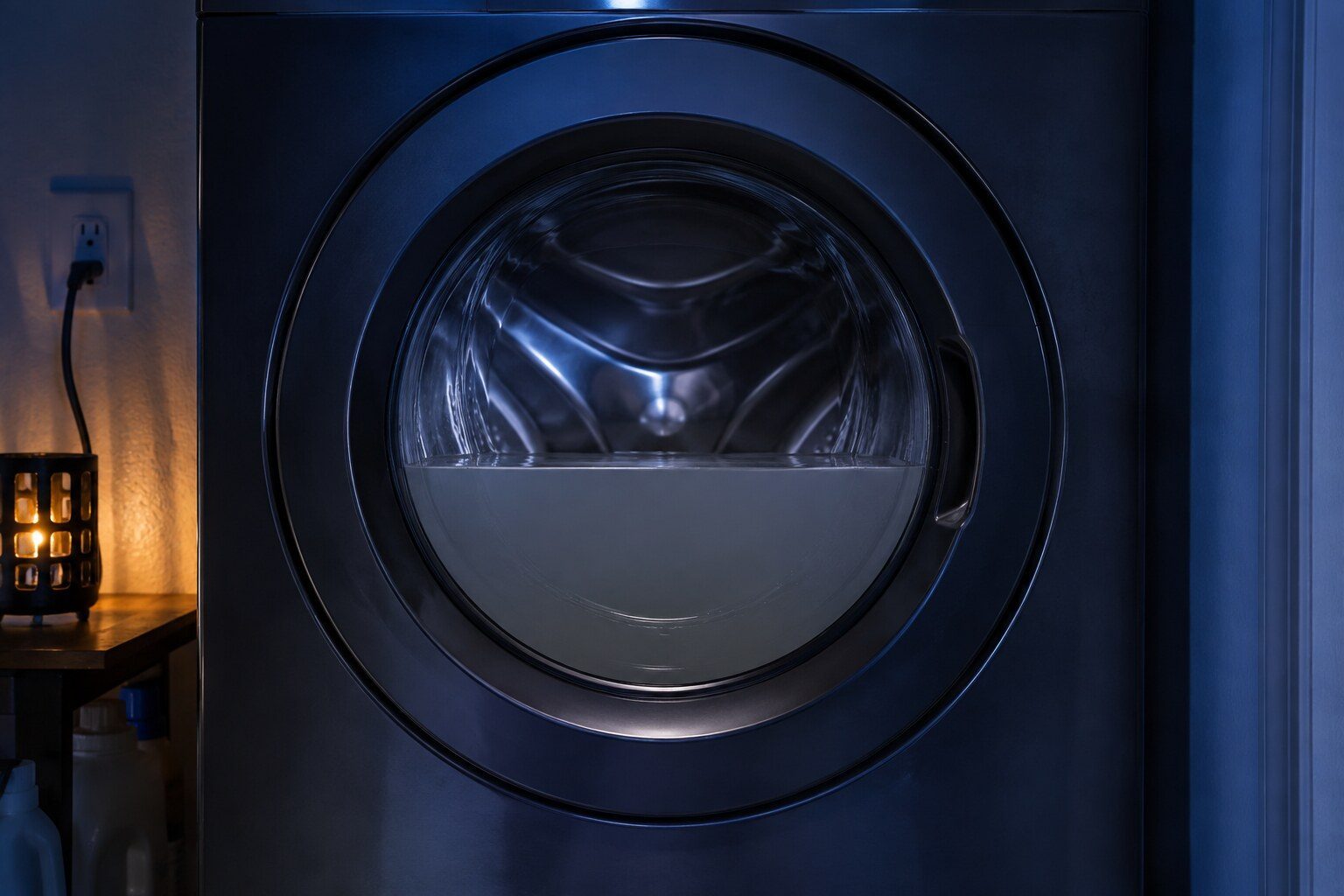
- “drn, F9E1 and LF are three labels for the same measurement — water that did not leave on schedule”
- “A tub that is full at the end of a cycle is a pump or a hose question, and it stays that way until both are cleared”
- “Front-load machines carry a filter behind the lower panel that most owners have never opened”
Symptom
Maytag washer will not drain
A Maytag washer counts the seconds it spends emptying, and when the water has not gone by the time the cycle expected it to, the machine stops and prints a name for it. That name is worth more to us than the puddle is. Get it written down before the power goes off at the breaker, because the display forgets and the standing water does not.
- From $89 diagnostic, credited to the repair
- 59 cities and neighborhoods covered
- OEM parts available on order
- In writing the price, before anything is opened
Five ordinary causes
What this usually turns out to be
Cheapest and commonest first, which is also the order we check them in. They sit hundreds of dollars apart, and only the unit settles which one is yours.
-
Something solid at the impeller
Coins, buttons and the wire out of a bra clear the basket and stop at the pump. You hear the pump run, nothing moves, and the water stays where it is.
Washer drain pump replacement from $175 -
The hose rather than the machine
Folded behind the cabinet, pushed too deep into the pipe, or packed with lint at the bend. It is free to look at, so it is looked at before anything is opened.
Diagnostic visit from $89 -
A filter that has never been opened
Only the front-load machines have one, and it is the single most productive thing to check on them. What comes out is usually the whole answer.
Appliance maintenance from $119 -
Foam the pump cannot move
Maytag calls this one Sud, and it is nearly always dose rather than damage. A pump pushing foam moves no water and the machine reads that as a blockage.
Washer excess suds service from $99 -
The pump motor itself
Either dead quiet or running without moving anything. On a machine kept fifteen years this is ordinary wear, and the part is a stocked one rather than a special order.
Washer drain pump replacement from $175
In five minutes
Before you call anybody
None of it needs tools, and all of it makes the visit shorter.
-
01
Read the display before anything else
drn, F9E1 and LF are the same finding written three ways. Which one appears tells us the control generation without opening the console.
-
02
Listen at the moment it should empty
A pump that hums and shifts nothing is blocked. A pump that makes no sound at all is an electrical question. That one noise halves the job.
-
03
Look at the standpipe
The hose end belongs in the mouth of the pipe, not driven down it. A machine that drains all the way through the cycle and never holds water is siphoning.
-
04
Open the front filter if the machine has one
Towels on the floor first and a shallow pan underneath — there is more water behind that door than the size of it suggests.
How it shows up
What people describe when they call
A shortcut
Narrow it down before anybody arrives
A description of the behaviour leaves a few possible causes. A code names the subsystem before anybody opens anything, which is why it is worth photographing before it clears.
If there is no code at all
The data plate is inside the cabinet, upper left wall or behind the grille. All models
In more detail
About Maytag washer will not drain
Before you bail it out
Copy the display down exactly as it reads, including whether there is a space in it — that space tells us which control generation the machine is on and it decides what we bring. Then cancel the cycle and leave the machine alone while it stops; a Maytag washer asked to cancel mid-spin can take the better part of half an hour to wind down and try its drain again, and a good number of calls come in during that half hour. If the tub is still full when it has genuinely finished, look at where the drain hose meets the standpipe. A hose shoved too far down siphons, and a hose folded flat behind a machine pushed back into a hall closet is the repair that costs nothing.
What it usually means, by the kind of machine
One complaint, several machines. This maker still sells a top-load washer with an agitator alongside one without, a front-loader, and a stacked pair, and it sells the same oven as a range and as a wall unit in gas and in electric. The behavior you can describe is identical on all of them; the first hour of the repair is not. A front-load washer has a drain filter the owner can open and a top-loader has nothing to reach from the front, and that single difference decides how the same afternoon goes.
- Top-load agitator — The pump lives under the tub with nothing to reach from the front, so anything that got past the basket is already sitting against the impeller. On this design the wash plate and agitator come out before the pump does, which is why these calls run longer than the front-load ones.
- Top-load impeller (HE) — No agitator post, a shallower basket, and a pump that reports a long drain rather than simply giving up. These are the machines most likely to show drn on the display instead of stopping in silence.
- Front load — There is a filter and a small drain spout behind the panel at the bottom of the door opening, and Maytag expects it to be opened. Ten years of lint, hair ties and change collect there before a cycle finally refuses.
Why we ask for the code first
Laundry is where this maker publishes in the most detail, and a drain problem is where that detail earns its keep. The machine is not guessing at a symptom: it opens the pump, watches the level fall, and stops when the fall is slower than the cycle allowed. That is a measurement. It means the water is genuinely staying put rather than leaving quietly, and it rules out half of what we would otherwise have to check by hand.
What the visit looks like
The pump and its housing come out together, the hose is followed from the machine to the wall, and the level sensing is read before a number is put on anything. These are common parts on a common machine, which is the practical advantage of this badge — a drain pump for a Maytag top-loader sits on the shelf rather than being ordered from a specialist, and most of these jobs close on the first visit.
This article is based on:
- Official manufacturer documentation
- Internal repair procedures
- Technician repair history
- Company quality standards

Before you book
Questions about Maytag washer will not drain
Can I empty it myself and run it again?
Empty it — in this climate you do not want a tub of gray water standing overnight in a warm laundry closet. Running the same cycle again on top of whatever stopped it just asks the pump to fight it a second time, and that is how a pump that was fine becomes a part.
It does drain, only very slowly.
That is a partial blockage and it generally becomes a complete one. It also leaves water sitting in the machine between loads, which is how a washer in a South Florida closet starts to smell inside a week.
There is water on the floor as well.
Then say that when you book, because it changes what we bring. Water escaping at the pump or a hose joint is a different repair from water that will not leave at all, even when both show up on the same afternoon.
Where we do it
Across Miami-Dade, Broward, and Palm Beach
Same terms everywhere we go: an on-site diagnostic first, the price agreed in writing, and the exact figure confirmed once we have seen the unit.
Neighborhoods people ask for by name