Common Problems
A Maytag Freezer Frosting Up Is Warm Air Getting In, or Defrost Not Getting Out
Look at where the ice is. Frost on the food, on the walls and on the shelves is warm damp air arriving from the kitchen and giving up its moisture on the coldest thing it can find, which means a door seal that is no longer sealing or a door held open by a package. In this climate a marginal gasket produces visible ice inside a week. Frost in a solid sheet across the back panel, behind the shelves, is something else entirely: the defrost circuit has stopped clearing the coil, and the ice is accumulating where the air is supposed to pass. The first is often a slip of paper and a gasket. The second is a defined repair. This maker publishes no condition for either, so the look is the diagnosis.
The full guide
Why is my maytag refrigerator freezer frosting up has two answers that look similar from the doorway and are separated entirely by where the ice has settled.
Why is my Maytag refrigerator freezer frosting up? Frost on the food is air from the kitchen
Every time the door opens, room air comes in. It carries water, and the moment it meets a surface below freezing it gives that water up as frost — on the packages, on the shelves, on the walls, on whatever is coldest and nearest.
In a dry climate this is a slow, mild process that nobody notices. Here it is not. Air in a South Florida kitchen in August carries several times the moisture of the same air in a northern winter, and a freezer that is admitting even a small amount continuously will show visible ice within a week.
Continuously is the key word. Normal door openings do not do this. What does it is a seal that no longer seals, or a door that is being held a fraction open by something inside.
The paper test, which takes two minutes
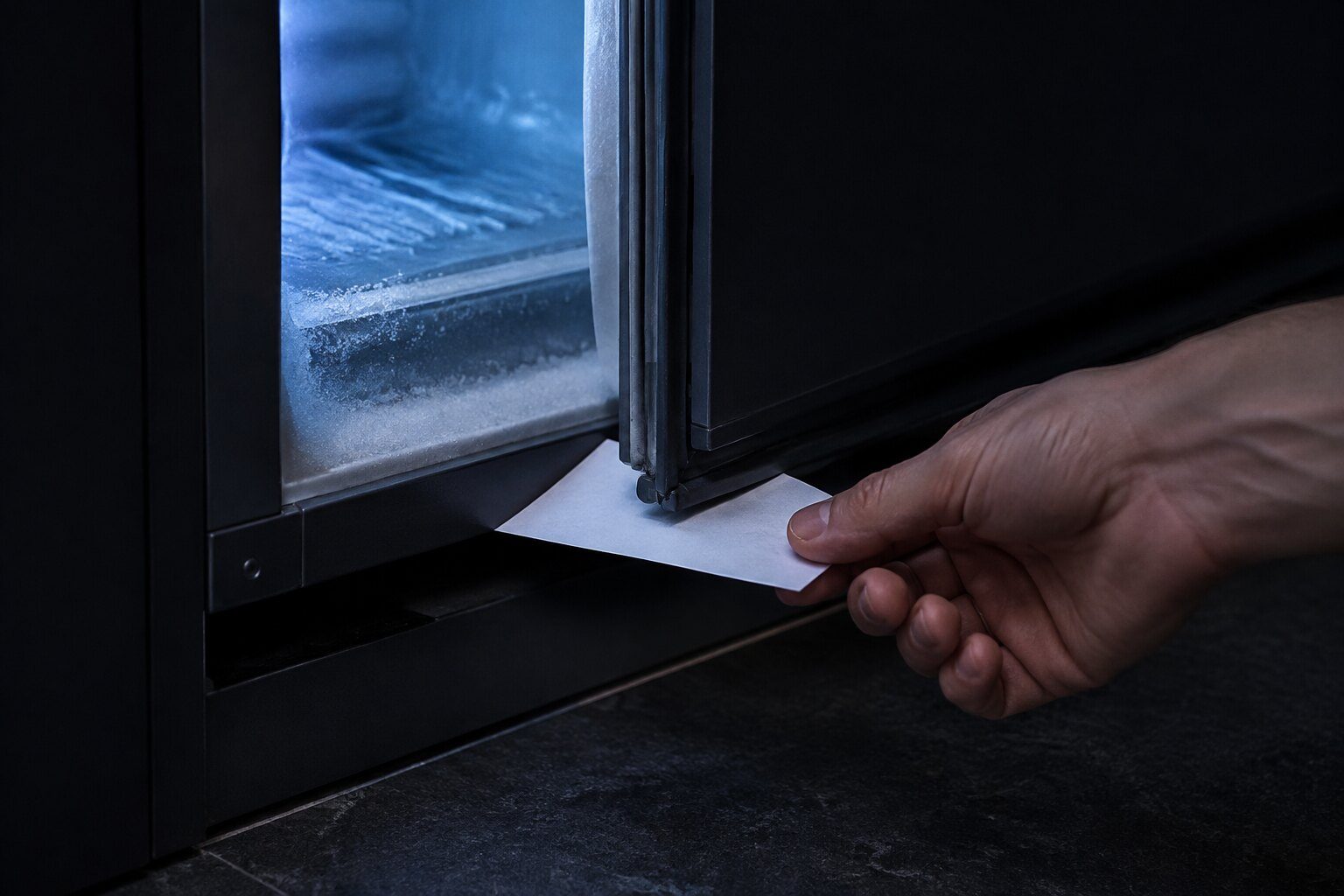
Take an ordinary slip of paper, shut it in the door, and pull it out. Do this at six or eight points all the way around, including the corners and the bottom edge, which are where gaskets fail first.
Everywhere it should hold firmly enough that you feel resistance. Anywhere it slides out with none, the door is not closing on the seal at that point and air is arriving there continuously.
Then look at what is inside. A box at the back of a drawer, a bag of vegetables caught in the seal, a shelf pushed too far back — all of these hold a door open by a millimeter or two, which is plenty. On a bottom-freezer cabinet the drawer version of this is by far the most common and it is free to correct.
Frost on the back panel is a different appliance problem
Behind the shelves at the back of the freezer there is a panel, and behind that is the coil that makes all the cold in the cabinet.
That coil accumulates ice as part of normal operation, and the appliance clears it on a schedule — a heater runs briefly, the ice melts, the water goes down a drain, and the cycle starts again. When that clearing stops, ice builds until air can no longer move through the coil.
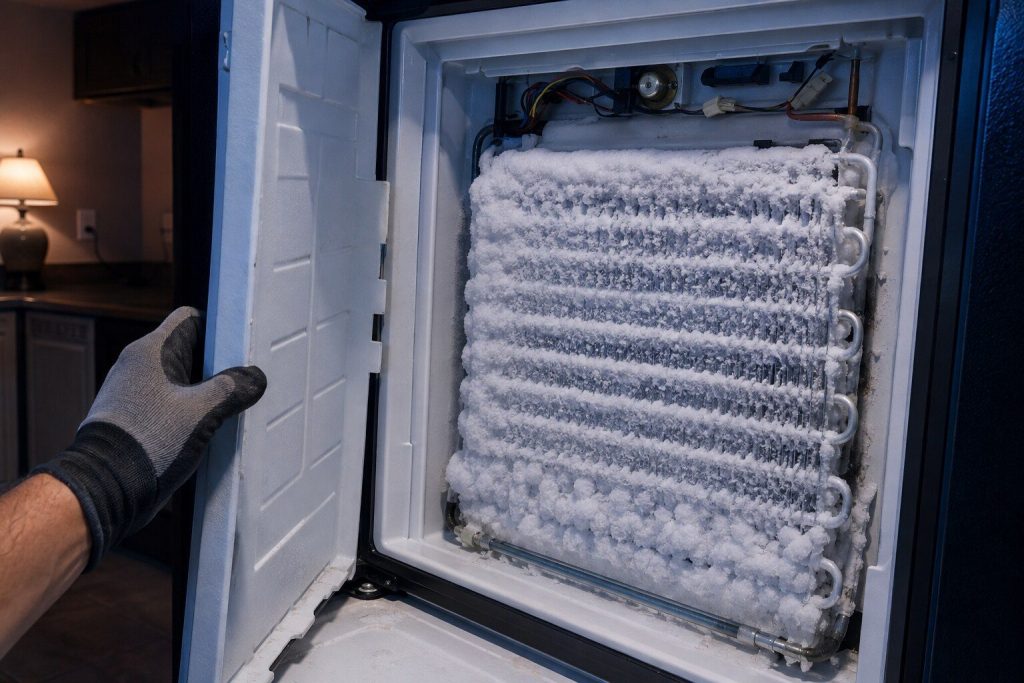
The visible sign at the front is a solid sheet of frost across the back panel rather than scattered ice on the contents. The second sign is the timing: it returns on a schedule, usually within a fortnight of being cleared, because the mechanism that should be preventing it is not running.
This is a defined repair with defined parts, and it is the one this page exists to separate from the seal.
Why there is no code to look for
This maker publishes no numbered or lit condition for a freezer anywhere in its support base, and none for a refrigerator defrost circuit either. We counted, and the number is zero.
So there is nothing to type into a search box, and any page that offers you one has borrowed it from somewhere else. What replaces it here is the look and the timing, and between them they are more reliable than a code would be — an ice pattern does not clear itself when somebody cycles the breaker.
Manual defrosting, and what it is worth
Emptying the freezer and leaving the door open for a day clears everything, and the cabinet works normally afterward. That is genuinely useful when there is food at stake or when you want to see the panel clearly.
What it is not is a repair. If the defrost circuit is the cause, the ice comes back on the same schedule it came back on last time, and households that have defrosted three times usually conclude the appliance is finished when in fact one part has been failing repeatedly.
Do it to buy time. Do not do it and call the problem solved.
Which cabinet you have changes where to look
On a side-by-side the coil is behind the tall back wall of the freezer half, and the seal that matters is the long vertical one down the middle where the two doors meet. On a French door cabinet with a bottom drawer, the coil is behind the drawer at the back and the seal that fails is the drawer's own, which is harder to see and easier to hold open with a package.
On a top-freezer cabinet, the simplest of the three, both the coil and the door are within easy reach and this is the quickest version of the diagnosis. It is also the layout this maker documents least — there is not a single numbered condition published for one anywhere.
Saying which cabinet you have when you book is worth a minute of the visit, because the three are genuinely different jobs behind the same sentence.
What it is costing while you leave it
Ice on a coil is insulation in exactly the place you do not want it. The appliance runs longer to reach the same temperature, the compressor duty cycle rises, and in a garage or a warm utility room that difference is not small.
A frosting freezer is not an emergency and nothing spoils tomorrow. It is, though, quietly expensive, and both of the repairs behind it are ordinary ones with stocked parts — which is a better position than most complaints on this site start from.
If it turns out to be a repair
What this leads to, and what it costs
Every job on this site is priced the same way: an on-site diagnostic first, the figure agreed in writing before anybody starts.
-
Ice cream soft, or a stand-alone freezer that has come up to temperature Freezer not freezing
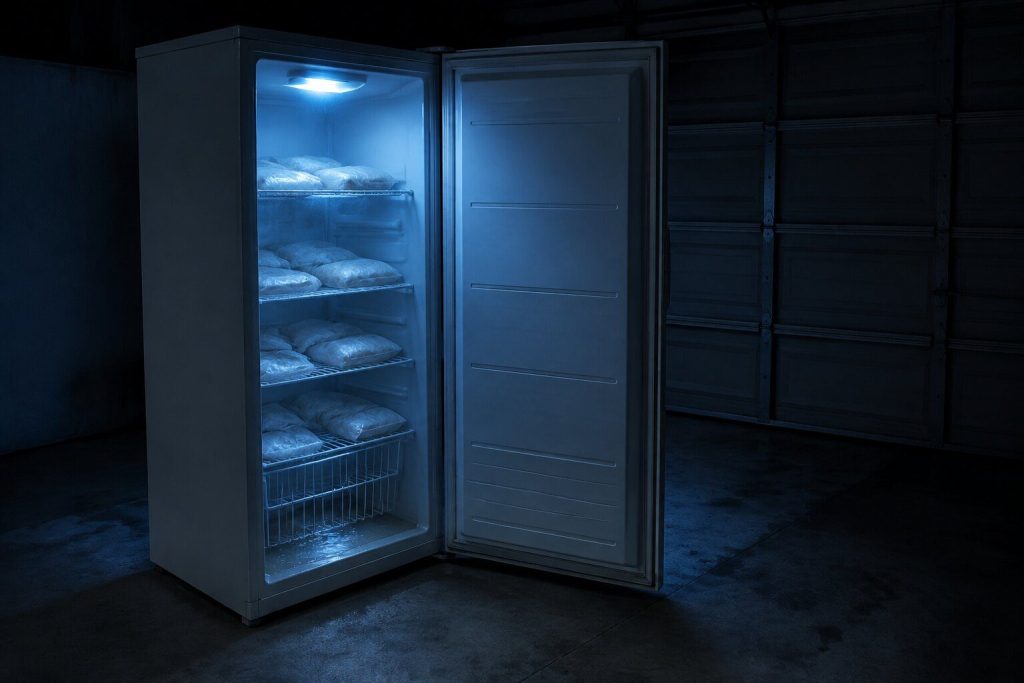
This maker publishes no numbered condition for any freezer at all — not one across the whole support library. That is not an omission on our part and it is worth stating plainly: a freezer that is not holding temperature will be diagnosed by measurement and by what you can see, and there is no code to look for.
- Nothing on the display will name this — the cabinet does not report it
- Frost on the back wall points at defrost; frost on the food points at the door
- A chest freezer and an upright fail in different places
-
from $165 Defrost system repair
Ice on the evaporator behind the back wall rather than frost around the door, and a cabinet that gets worse over weeks instead of failing outright. The circuit is a heater, a terminator and the sensor that decides when to stop, and on this make none of the three announces itself — so the finding takes longer than the fixing and the price says so. What sends a defrost circuit here is usually humidity getting in somewhere it should not.
- Ice at the back is the defrost circuit; ice at the door is the seal
- Heater, terminator and sensor measured cold, not judged by how thick the ice looks
- The way the moisture is getting in is found too, or it comes back next season
-
from $135 Refrigerator door seal replacement
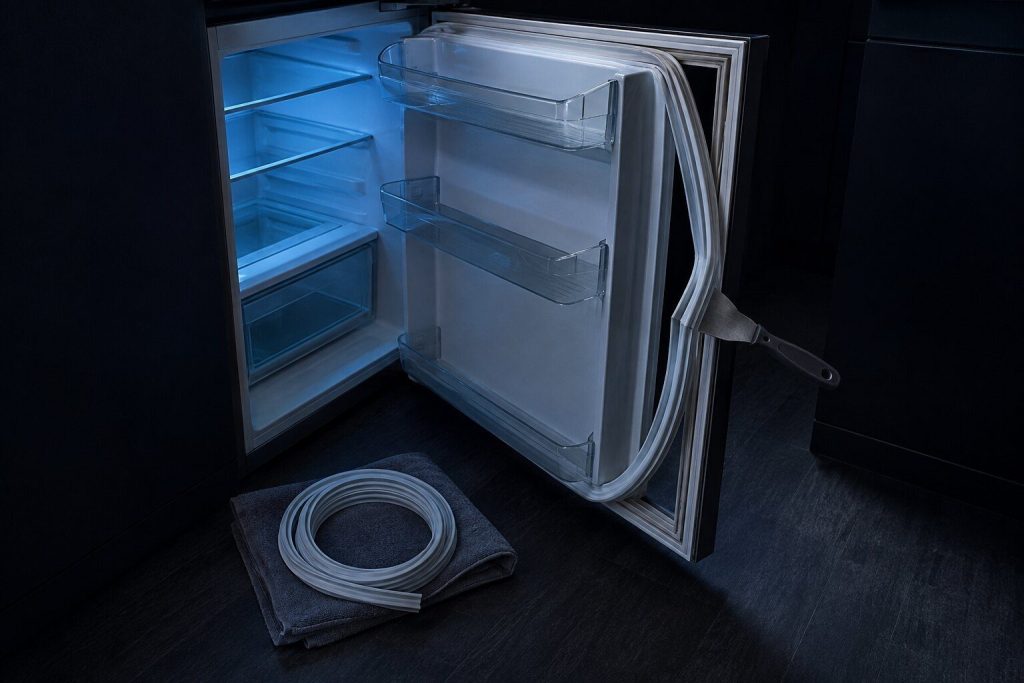
Few parts this inexpensive cost you as much temperature, and in this humidity the bill arrives in days rather than months. A gasket that has taken a set still touches along most of its run, which is why the handle side always feels fine — the gap is at a hinge corner or low down where the door is heaviest. Fitted to a door that no longer closes square it fails again, so the door is set at the same visit.
- Found along the whole run rather than at the handle
- The door is squared at the same visit, or the new gasket fails the same way
- Frost and condensation are traced to the seal before anything else is suspected
-
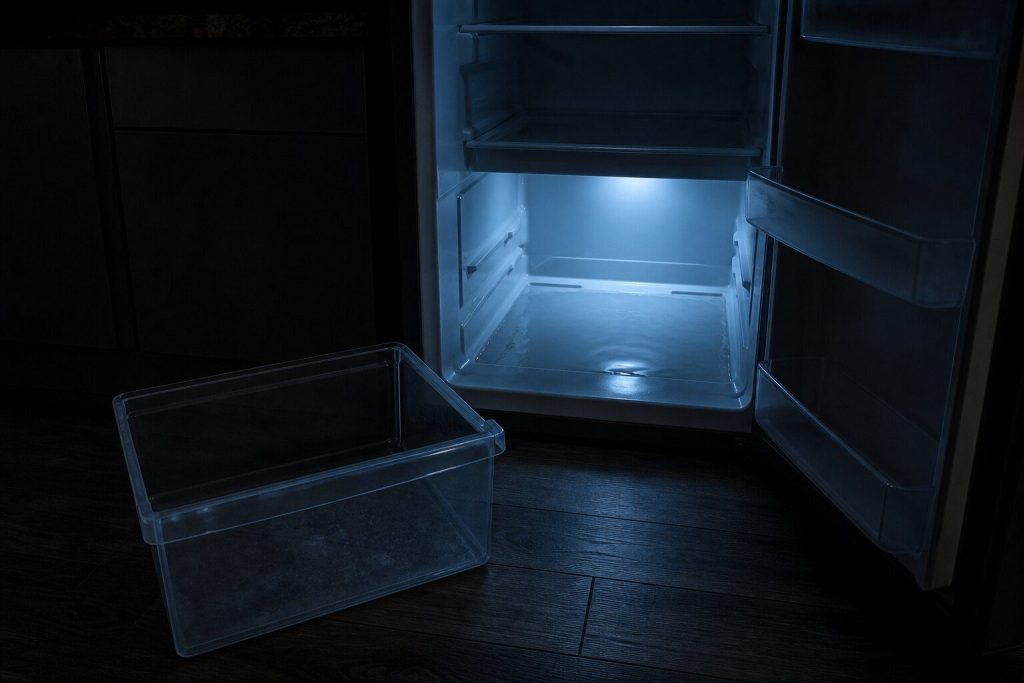
A pool under the crisper drawers, or water on the floor at the front Water inside or under the refrigerator
Water inside a refrigerator is nearly always the drain that carries defrost water away, and it has a specific and unglamorous failure — a small tube freezes shut, the water backs up, and it reappears under the drawers. It is one of the more satisfying repairs on this site because the cause is so consistent.
- Water under the crisper drawers is the defrost drain almost every time
- Water on the floor at the front is usually the drain pan or the water line
- This maker publishes an indicator for the water system but nothing for a drain
Questions people ask about this
Why is my maytag refrigerator freezer frosting up in summer only?
That fits the humidity picture exactly. Every door opening admits air carrying far more water in August than in January, so a seal that copes all winter fails visibly in the summer. It is still worth fixing, because the same gasket is costing you running cost year round.
Should I scrape the ice off?
Not with anything metal, and not off the back panel. Scraping the walls is harmless; scraping where the coil is behind a panel risks the tubing, and that turns a defined repair into a sealed system.
The ice comes back in a fortnight.
Then it is the defrost circuit rather than the seal. A gasket problem produces frost gradually and unevenly; a defrost problem produces the same sheet in the same place on a predictable schedule.
Is a frosted freezer using more electricity?
Yes, measurably. Ice on a coil is insulation in the one place you do not want it, so the appliance runs longer to reach the same temperature. That is the quiet cost of leaving this.
The drawer will not close properly.
On a bottom-freezer cabinet that is often the cause rather than the result — a drawer that sits a fraction open lets warm air in continuously, and a bag of peas caught at the back is enough to do it.
Common Problems
More guides like this one
-
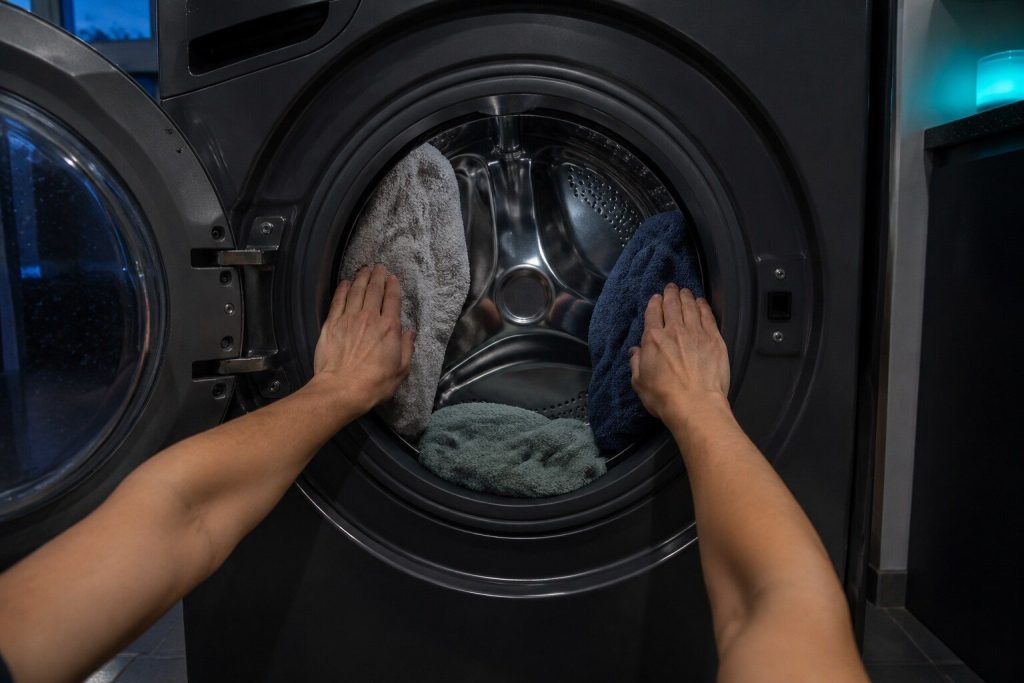
A Maytag Washer That Sits on Sensing Is Measuring, Not Waiting
Sensing is the machine weighing the load before it decides anything. A machine that will not leave it is reporting one of three things, and each has a different first check.
Read more -
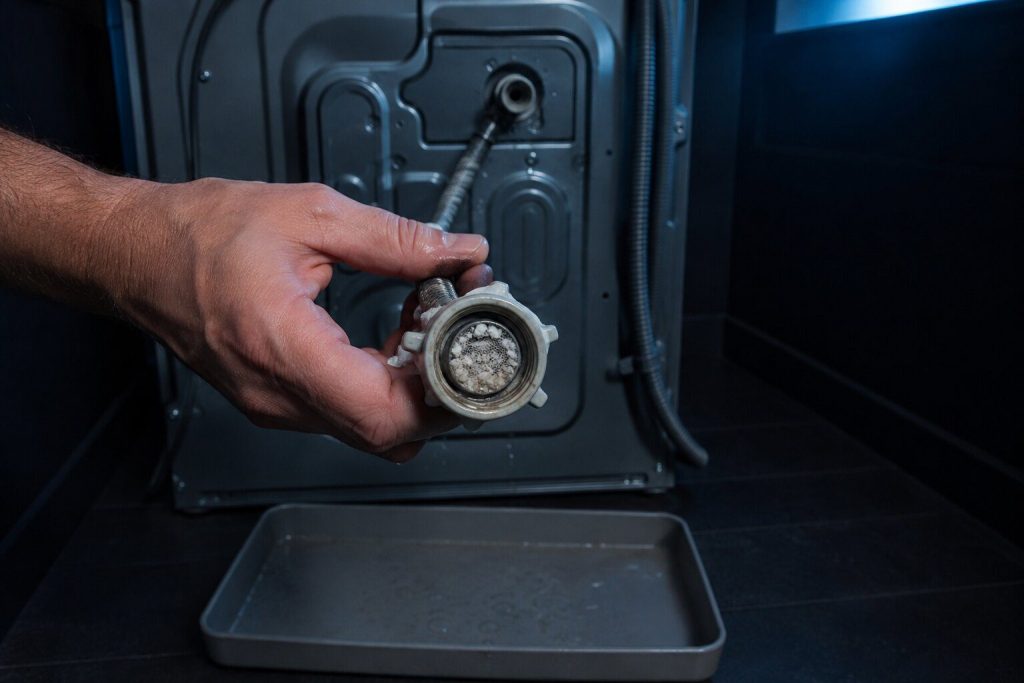
What Stops a Maytag Washer Filling, in the Order It Costs
Follow the water from the wall to the tub, the way a technician does. Four of the five things in that path cost nothing to check, and one of them is the answer surprisingly often.
Read more -
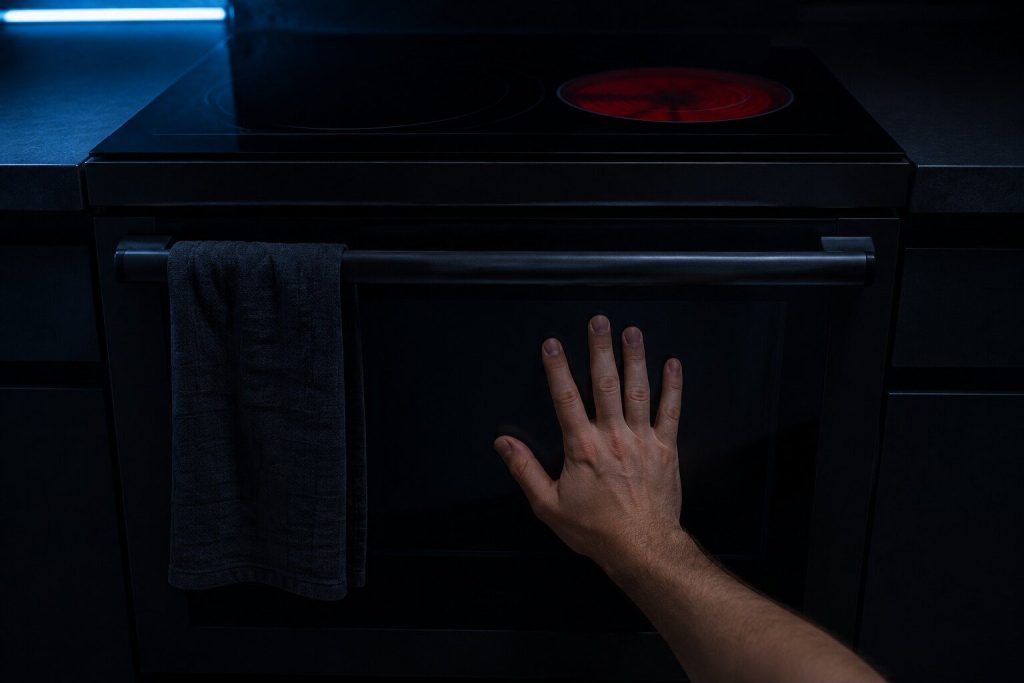
A Maytag Oven That Shuts Itself Off Is Protecting Something
Three completely different things stop an oven mid-bake, and which one it is depends on how long it ran, whether it came back, and whether anything appeared on the display.
Read more
Tell us the model number and what it is doing.
This article is based on:
- Official manufacturer documentation
- Internal repair procedures
- Technician repair history
- Company quality standards