Common Problems
What Stops a Maytag Washer Filling, in the Order It Costs
Water reaches the tub through five things in a line, and they are checked in that order because the first four cost nothing. The taps, which are half closed more often than anybody admits after plumbing work. The hoses, which kink behind a machine pushed into a closet. The small screens inside the hose ends at the machine, which collect the mineral this water carries and close gradually over years. The inlet valve, which either clicks and passes nothing or passes on one side only. And the control, which is last because four cheaper things produce the same silence. A machine that fills slowly and reports a long fill is describing a restriction. A machine that fills with cold only has told you which half of the valve is gone.
The full guide
The symptom page lists the five causes. This one walks them, because what causes a maytag washer not to fill with water is a question best answered by following the water rather than by guessing at parts.
What causes a Maytag washer not to fill with water? Start at the wall, not at the machine
Two taps sit behind every washer, and they are the only part of this system anybody ever touches deliberately. They also get closed for plumbing work and reopened by feel, which leaves one of them a quarter turn short.
That matters more than it sounds. A machine fed properly on one side and weakly on the other still fills — just slowly. And slowly is the same as never as far as the control is concerned, because the fill is timed. Past the allowance, the machine stops and reports it.
So the first thing worth doing is opening both taps fully and running the kitchen tap for a few seconds to confirm the building is delivering normally. It costs nothing and it is the answer often enough to be worth the minute.
The hoses, and the fold behind the cabinet
A washer pushed back into a laundry closet pushes its own hoses against the wall. The fold that results is invisible from the front and it passes very little water.
While the machine is out, look at the rubber itself. Supply hoses in this climate are on borrowed time after about five years — the heat and the humidity harden them, and a hose that has started to weep at the fitting is the one leak that gets dramatically worse while nobody is home. If they are original on a machine of any age, they are worth replacing whether or not they are the cause today.
The screens, which are the local answer
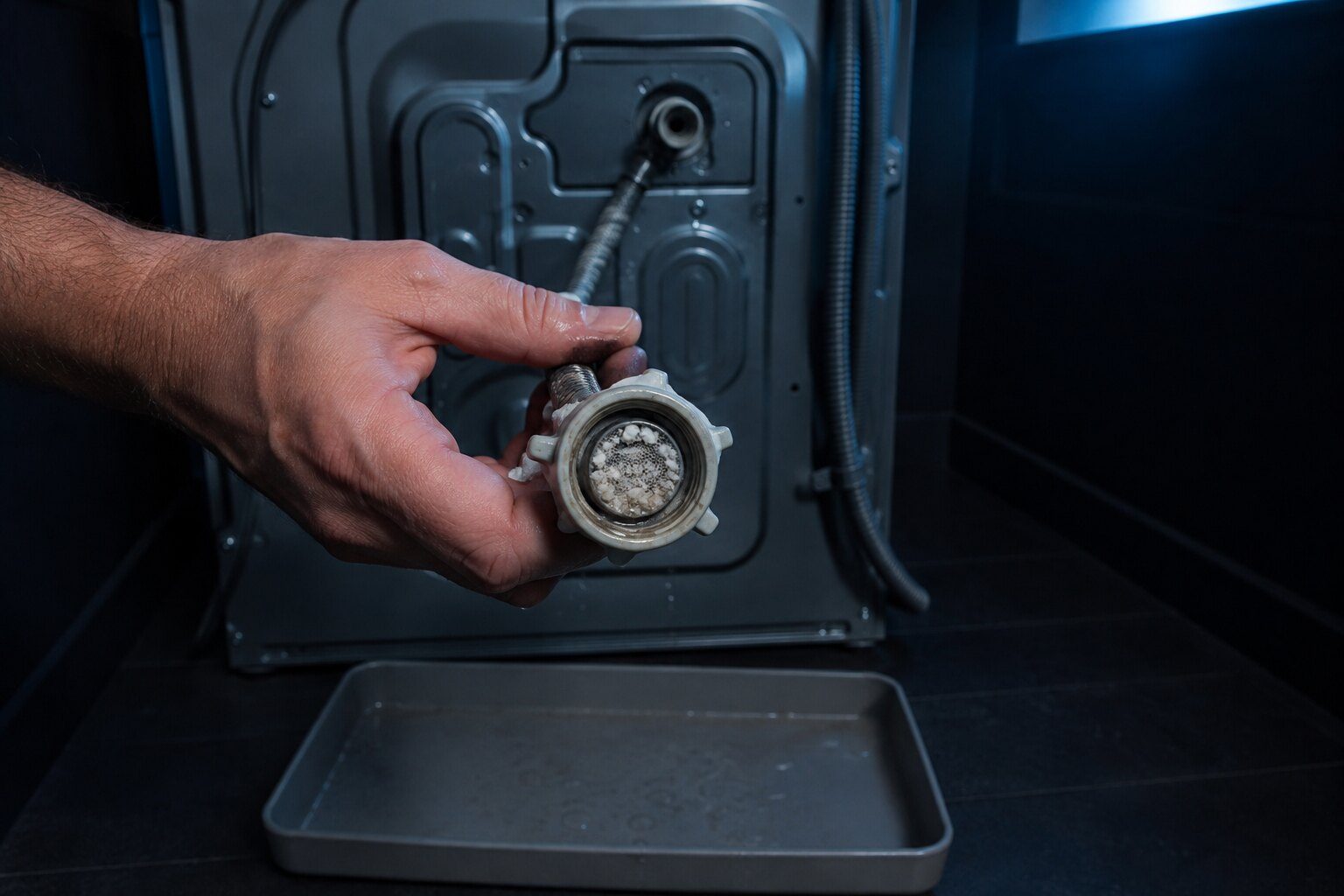
Inside each hose coupling, where it screws onto the back of the machine, there is a small mesh disc. It is there to stop grit reaching the valve, and it does its job by collecting everything that arrives.
The water here carries enough mineral that these close gradually rather than suddenly. A machine that has been filling a little more slowly every year is describing its screens, and eventually it crosses the line where the control decides the water is not coming and stops. That reads as a broken washer and it is a ten-minute clean with the taps off.
We ask about this early because it is the answer often enough to save a visit, and because it is the one thing on this list that is genuinely specific to where you live rather than to what you bought.
The inlet valve, and what its noise tells you
The valve is two electrically operated gates in one body, one for hot and one for cold. It fails in two ways and they sound different.
A valve that clicks and passes nothing is being told to open and cannot. A valve that is silent is not being told at all, which moves the question upstream to the control or the wiring. That single observation, made with the room quiet and a cycle running, splits the repair in half before anybody opens the machine.
The other useful signal is a machine that fills with cold water only. Both sides are asked to open on most cycles, so cold-only means one half of the valve has gone. It is the same part and the same repair, and it is a stocked one on this badge.
The control comes last, and rarely
It can happen. A control that never asks the valve to open produces exactly this. But it sits behind four cheaper explanations, and replacing a board on a machine whose inlet screen is packed solid produces a washer that fills badly with a new board in it.
That order is not caution for its own sake. It is what makes the difference between a repair that holds and a repair that comes back, and on a badge kept as long as this one, holding is the point.
The two things that make this badge different
Both are practical rather than flattering. The first is that a Maytag washer is frequently the oldest appliance in the building, which means its supply hoses, its taps and its inlet screens have all been in service for a decade or more. Nothing in that path is exotic and nothing in it is expensive, but everything in it has had time to accumulate.
The second is that the inlet valve on these machines is a stocked, commodity part rather than a special order. When the four free checks come up empty, the repair that follows is a short one with a part that is already on the van, and it closes on the first visit far more often than the equivalent on a low-volume badge.
That is worth saying because it changes the calculation. On a machine where the likely repair is cheap and available, spending twenty minutes eliminating the free causes first is not a delaying tactic — it is the difference between paying for a valve you needed and paying for one you did not.
What to tell us when you book
Whether the panel lights at all, whether you can hear water arriving in the first two minutes, whether it fills cold-only, and anything the display showed before it was cleared. Those four answers between them eliminate most of this page, and they decide what rides out on the van.
If it turns out to be a repair
What this leads to, and what it costs
Every job on this site is priced the same way: an on-site diagnostic first, the figure agreed in writing before anybody starts.
-
Washer will not start or will not fill
Two complaints that arrive in the same phone call and are cleared in the same order: is the machine getting power, is it getting water, and is it being allowed to begin. A Maytag washer will not start a cycle it cannot complete, so a machine that sits there is often reporting something rather than broken.
- LF is the machine saying the water took too long to arrive, rather than a verdict on the machine
- A control that has locked itself out looks exactly like a dead machine
- A lid or door that will not report closed stops the cycle before it starts
-
Washer error code LF
Maytag washer error code LF: Filling is timed rather than measured on most of this equipment, so the machine judges the water by the clock. Which machines can raise it, what the maker publishes about it, and what to do next.
What this one means -
Washer water inlet valve repair
A machine that fills slowly, fills on one temperature only, or will not fill at all. Most of it is upstream — screens, hoses and shut-offs that have not been turned since the machine was installed — and the valve itself is a modest part. In an older laundry closet the shut-offs are frequently the oldest thing in the room and worth replacing while the machine is out.
- Screens and shut-offs first: they are older than the machine in most closets
- Filling on one temperature only points at one half of the valve
- Measured under pressure, because a valve can pass at rest and stall under load
-
Washer will not spin
A load that finishes sopping wet has usually not failed to spin at all — it has tried, found something it did not like, and given up on purpose. Maytag machines refuse to spin for three different reasons, and they feel identical from outside the door.
- The machine has to drain before it will spin, so a drain problem shows up first as a wet load
- A lid or door that is not locked stops the spin without stopping the wash
- UL and F5E2 both describe balance and lock rather than the motor
Questions people ask about this
What causes a maytag washer not to fill with water after plumbing work?
A tap left half open, almost every time. Nobody did anything wrong: the valve was closed to do the work and reopened by feel. A machine fed through one hose fills slowly enough that the control reports it as no water at all.
It fills, but only cold.
That is one of the two supply paths not delivering, and it is the hot tap or the hot side of the inlet valve. It has nothing to do with temperature control, which is why turning the cycle up changes nothing.
Where are the screens?
Inside the hose couplings where they screw onto the back of the machine. Turn the taps off, unscrew a hose, and the screen is a small mesh disc in the fitting. It rinses clean and goes back the same way round.
It fills very slowly rather than not at all.
Same list, earlier in its life. A slow fill becomes a stopped fill once the control decides the water is not coming, and clearing a screen at this stage is a ten-minute job rather than a call.
Could it be the water pressure in the building?
It can, particularly in an older condominium at the hours everybody showers. If the kitchen tap is also weak at those times the machine is reporting the building rather than itself, and that is worth knowing before a valve is replaced.
Common Problems
More guides like this one
-
A Maytag Washer That Sits on Sensing Is Measuring, Not Waiting
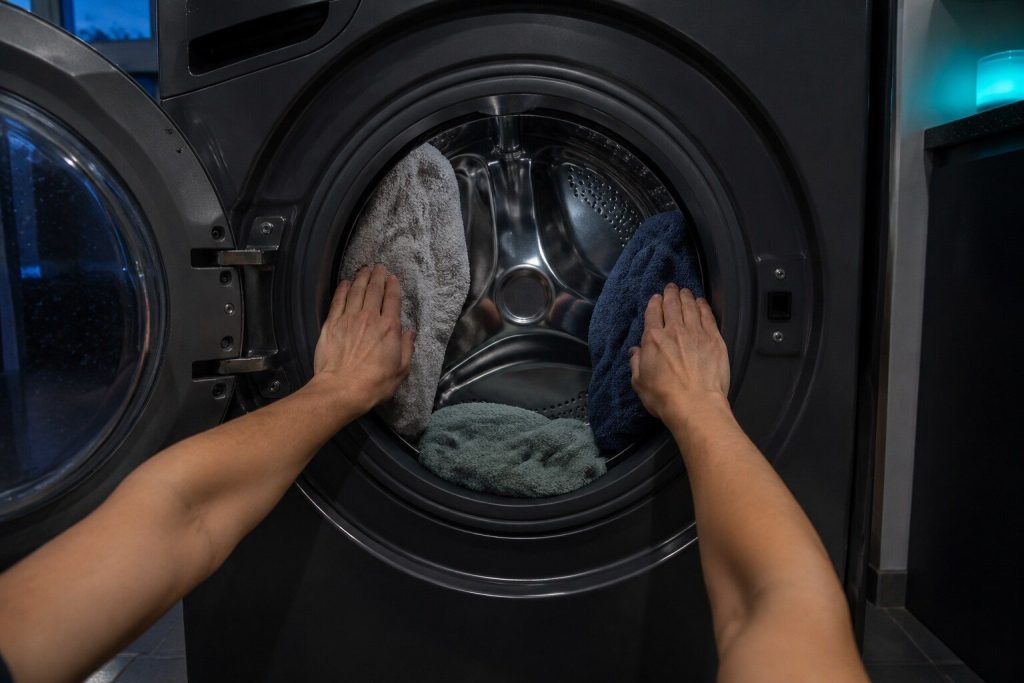
Sensing is the machine weighing the load before it decides anything. A machine that will not leave it is reporting one of three things, and each has a different first check.
Read more -
A Maytag Oven That Shuts Itself Off Is Protecting Something
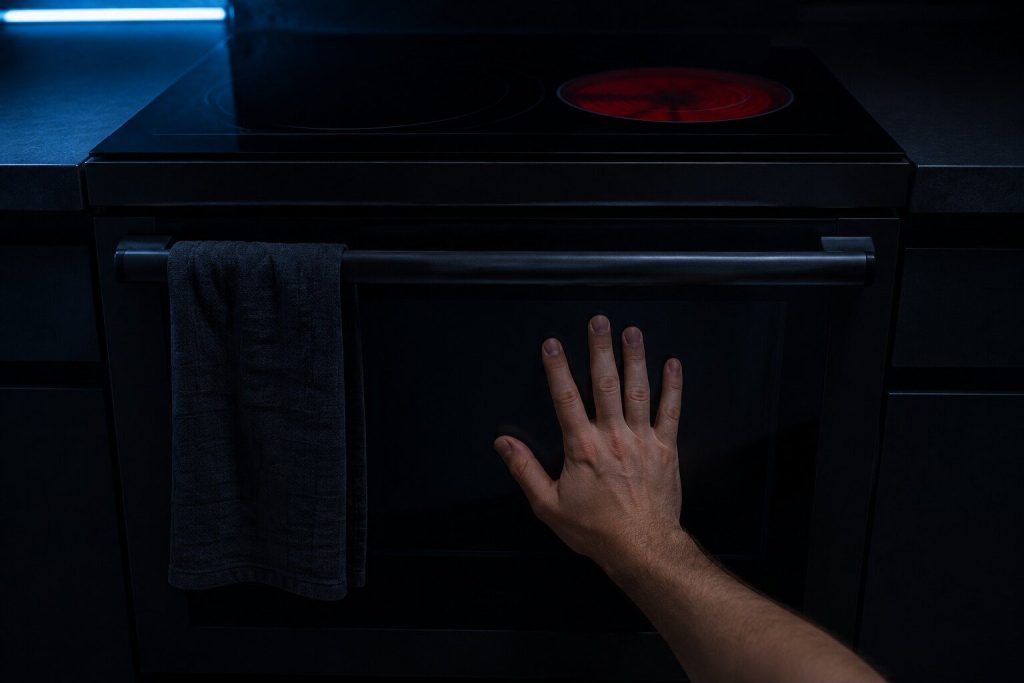
Three completely different things stop an oven mid-bake, and which one it is depends on how long it ran, whether it came back, and whether anything appeared on the display.
Read more -
A Maytag Oven Slow to Preheat Is Heating the Room, Not the Food
Preheat is air first and the walls second, and most ovens chime when the air is right. So a slow preheat and a preheat that lies feel identical and are not.
Read more
Tell us the model number and what it is doing.
This article is based on:
- Official manufacturer documentation
- Internal repair procedures
- Technician repair history
- Company quality standards