Maintenance & Prevention
Cleaning a Maytag Dryer Vent, and Why the Screen Is Not the Duct
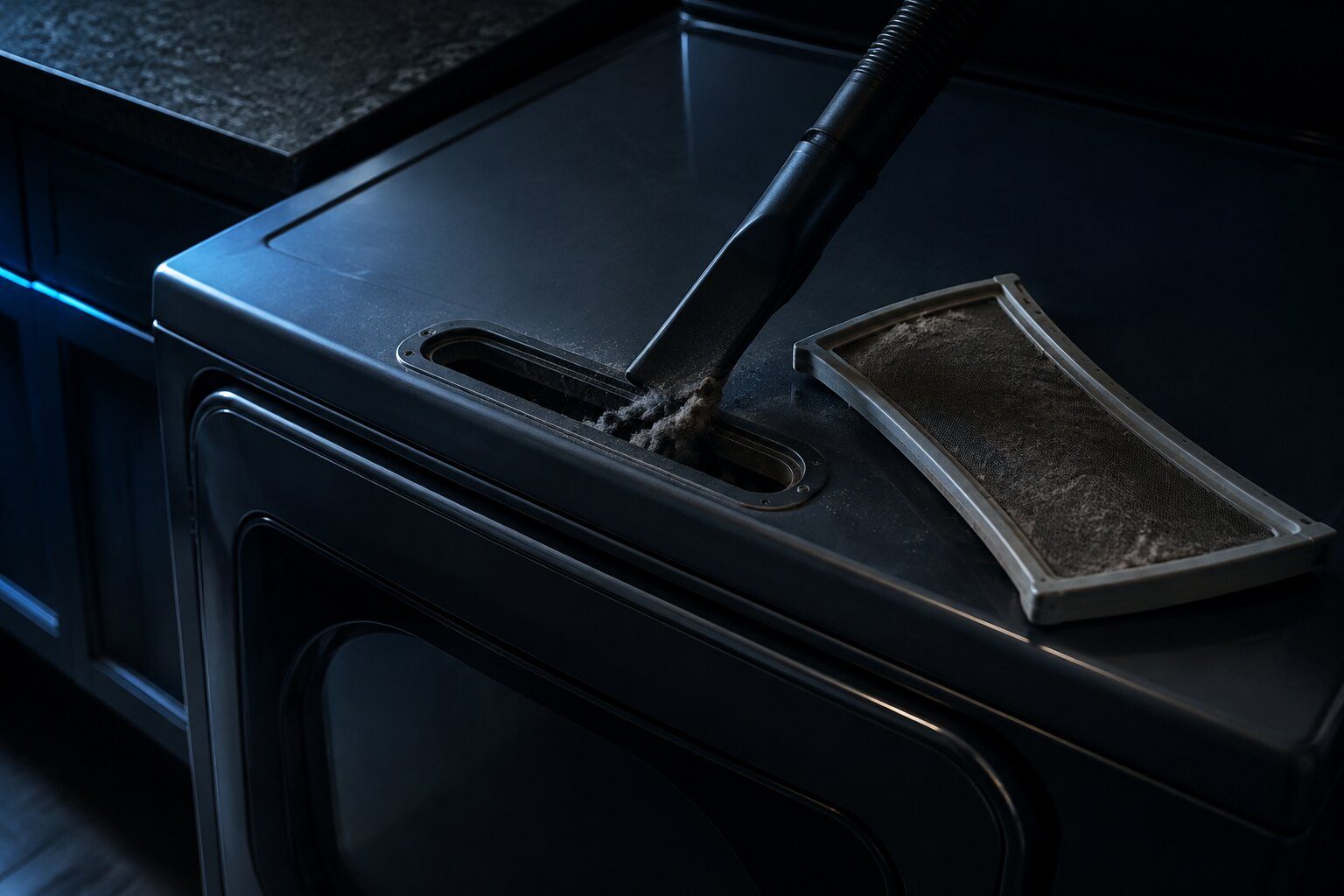
Four places, and they block in this order. The lint screen, which can be filmed over with softener residue and look perfectly clean — pour water on it, and if it beads rather than passing straight through it needs scrubbing. The housing the screen drops into, which packs with fine lint over years and needs a vacuum crevice tool pushed as far down as it will go. The flexible length behind the machine, worst at the first elbow where the bend is sharpest and the lint arrives wettest. And the flap on the outside wall, which decides everything and which nobody looks at — painted shut, screened over, glued with lint, or occupied. Run the machine and hold a hand in front of that flap: strong warm air means the run is clear, and weak air is your answer.
The full guide
How to clean maytag dryer vent is a question with a wider answer than the phrase suggests, because most people mean the lint screen and the screen is the least of the four places that matter.
How to clean Maytag dryer vent: four places, and the order they block
The screen itself. It looks clean when it is not. Softener and dryer sheets leave a transparent film across the mesh, and a filmed screen passes a fraction of the air a clear one does while presenting perfectly to the eye. There is a test: hold it under a running tap. Water that sits on top in beads is telling you the mesh is closed; water that falls straight through is telling you it is open. Warm soapy water and a soft brush restore it in a minute.
The slot the screen lives in. Different space, different problem, and the one nobody knows about. Every load pushes a little lint past the screen and it settles in the housing below, where nothing disturbs it. Over six or eight years that housing packs, and on a rental machine it is frequently the largest single obstruction anywhere in the system. A vacuum crevice tool pushed as far down as it will reach is the only thing that clears it.
The first bend behind the machine. Two things make this the worst spot in the run. It is the sharpest turn the air makes, and the lint reaching it is the wettest it will ever be, so it settles rather than carrying on down the run. Then add a dryer shoved back against a closet wall, folding its own flexible duct as it goes, and a marginal run becomes a closed one.
The hood on the outside wall. Whatever condition the rest of the run is in, this is where the air either leaves or does not. Hoods get painted over during exterior work, screened by somebody discouraging insects, matted shut with years of lint, or taken over by a nest. A spotless duct ending at a sealed hood is a sealed duct.
The test that comes first and last
Start the machine on air fluff, walk outside, and find the flap.
It should be pushed fully open, and there should be enough air behind it to feel clearly on the back of your hand from a foot away. That is a healthy run.
Do it before you start and do it again when you finish. A duct that has been cleaned and not tested is a duct somebody hopes is clear, and the difference between those two is the entire value of the work.
Why the interval is shorter here
The number most people carry is once every couple of years, and it came from somewhere with a dry winter.
Warm, humid air keeps lint damp, and damp lint sticks to duct walls instead of blowing through. A run that would stay serviceable for three years in a dry climate loads up in one here, and the household never notices because the decline is gradual — the dryer takes a little longer each season and everybody adjusts.
Once a year is a fair figure for a normal run. More often for a long one, and more often again for a household doing laundry most days.
The condo problem, honestly
A great many laundry closets in this region are interior. The duct leaves the machine, turns, runs horizontally through a ceiling or along a soffit, and turns again to reach an outside wall.
Every one of those bends costs the fan as much as several feet of straight duct. A route like that works when it is perfectly clean and stops working the moment it is not, which is why a condo dryer can seem fine for a year and then start needing two cycles.
If cleaning a run like that produces no improvement, the honest answer is that the route is the problem rather than the debris in it — and rigid metal duct with one fewer bend is worth more than anything anybody can do inside the cabinet.
What a professional clean actually involves
Worth describing, because "vent cleaning" covers a wide range of things and some of them are not much.
The run is cleared from both ends with a rotating brush on a flexible rod, which is what reaches the packed material rather than the loose material. The screen housing is emptied with a crevice tool. The flap outside is freed and checked for movement through its full travel. And the machine is run afterward so the airflow can be felt rather than assumed.
A leaf blower at the outside vent moves what was already going to move. It cannot reach the screen housing at all, and that is frequently the largest single restriction in the whole system.
What it is costing while you leave it
A dryer running two cycles instead of one draws roughly twice the energy for the same laundry, every load, every week. Over a year that is a real number, and it is usually larger than the cleaning.
The second reason is the one nobody enjoys discussing: a duct packed with lint and a machine working harder to push air through it are the two ingredients of a laundry fire. That is not a sales line and it is not a reason to panic tonight. It is the reason this particular maintenance item sits on the calendar rather than on the list of things to get around to.
If it turns out to be a repair
What this leads to, and what it costs
Every job on this site is priced the same way: an on-site diagnostic first, the figure agreed in writing before anybody starts.
-
Dryer takes two or three cycles
This is the complaint that costs the most money and gets reported the latest, because it creeps. A dryer that used to finish a load in fifty minutes and now takes two runs has generally lost airflow rather than heat, and it has been losing it for a year.
- Almost always airflow — the duct, the screen, or the slot the screen sits in
- A moisture sensor that has scaled over will end cycles early on an automatic setting
- The running cost of this doubles quietly, which is why it is worth fixing rather than living with
-
Dryer runs but does not heat
A dryer that tumbles without heating has one of two very different problems, and which one it is depends on whether it burns gas or draws current. On an electric machine the drum and the heat are on separate legs of the same circuit, which is why a machine can run perfectly and still produce no warmth at all.
- An electric dryer that turns but never warms is very often half a breaker rather than a part
- A gas dryer that tries and gives up is an ignition sequence you can hear from the laundry room
- AF is a restricted vent, and a restricted vent looks exactly like a heating problem
-
Dryer vent cleaning
The whole run rather than the first three feet, and measured before and after so the visit has a number behind it. In this region the runs are long and horizontal more often than short and vertical, and they carry humid air, so lint packs rather than blowing through. It is the cheapest thing that keeps a vented dryer working and the one nobody schedules until the machine has already been called broken.
- The whole run, and a reading before and after
- Long flat runs in this region pack rather than clear themselves
- The outside flap is checked, and it is blocked more often than the pipe
-
Dryer error code AF
Maytag dryer error code AF: Every dryer this badge sells is vented, so the run behind the machine is the appliance's real constraint and this code is usually about the house rather than the hardware. Which machines can raise it, what the maker publishes about it, and what to do next.
What this one means

Questions people ask about this
How to clean maytag dryer vent when the run goes through a ceiling?
That is the common condo arrangement and it is the one worth having done properly rather than attempted. The run is cleared from both ends with a rotating brush on a flexible rod, and the airflow is tested afterward rather than assumed.
How often should it be done?
Once a year for a normal run, and more often for a long one or a household doing laundry daily. In this climate the interval is shorter than the number most people have in their heads, because damp lint sticks rather than blowing through.
My lint screen is always clean.
Good, and it is still worth the water test. Softener residue films the mesh invisibly. And the housing the screen drops into is a separate space that almost never gets cleaned at all.
Is this really a fire risk?
A duct packed with lint and a machine working harder to push through it are the two ingredients, so yes, and that is the second reason to treat slow drying as a repair rather than a habit. The first is that it roughly doubles the running cost.
Can I just use a leaf blower at the vent?
It moves the loose material and leaves the packed material, which is the part that matters. It also cannot reach the screen housing at all, and that is frequently the biggest single restriction in the whole run.
Maintenance & Prevention
More guides like this one
-
How Often a Maytag Washer Needs Cleaning in a Humid Climate
The interval on the box was written for a machine in a dry laundry room. A warm closet with a rubber seal and standing water is a different appliance.
Read more -

The Maytag Defrost Drain, and Why Water Appears Under the Crispers
A small tube carries meltwater out of the coldest part of the cabinet. When it ices at the outlet the water comes forward instead, and clearing it is not the hard part.
Read more -
The Maytag Dishwasher Filter Nobody Knows They Have
It twists out by hand, it is meant to be cleaned, and doing it every couple of months prevents most of the drain calls we take on this badge.
Read more
Tell us the model number and what it is doing.
This article is based on:
- Official manufacturer documentation
- Internal repair procedures
- Technician repair history
- Company quality standards